In Q1 2025, Creality was still the biggest name in cheap 3D printers by volume, with 39% of entry-level shipments. By the end of that year Bambu Lab had taken the top spot, capping a run that began with a roughly 3,000% jump in its shipments in 2023, per the analyst firm CONTEXT.
The shift matters because the fast-growing entry-level market is now concentrated in four brands, all Chinese. Here is how the leaderboard changed, what is driving it, and how to pick a platform when the choices have narrowed.
Trend Signal
72/100 Strong momentum
- Emerging
- Rising
- Mainstream
- Peaking
- Cooling
Four brands now ship nearly nine in ten entry-level printers
CONTEXT reported that Bambu Lab, Creality, Elegoo and Anycubic shipped 88% of entry-level printers worldwide in Q1 2026, with Bambu Lab still in the lead after a 37% share in its report on late 2025.
Our editorial reading of the cited data, not a forecast. How it is scored
By the numbers
- 37%Bambu Lab share of entry-level printer shipments, CONTEXT report on Q4 and full-year 2025CONTEXT
- 88%Share of entry-level printers shipped by the top four brands, Q1 2026CONTEXT
- 39%Creality share of entry-level shipments in Q1 2025, when it still led by volumeCONTEXT
- 350,000Bambu Lab printers among about 390,000 in Chinese print farms, August 2026 estimate3DPrint.com
How the leaderboard flipped
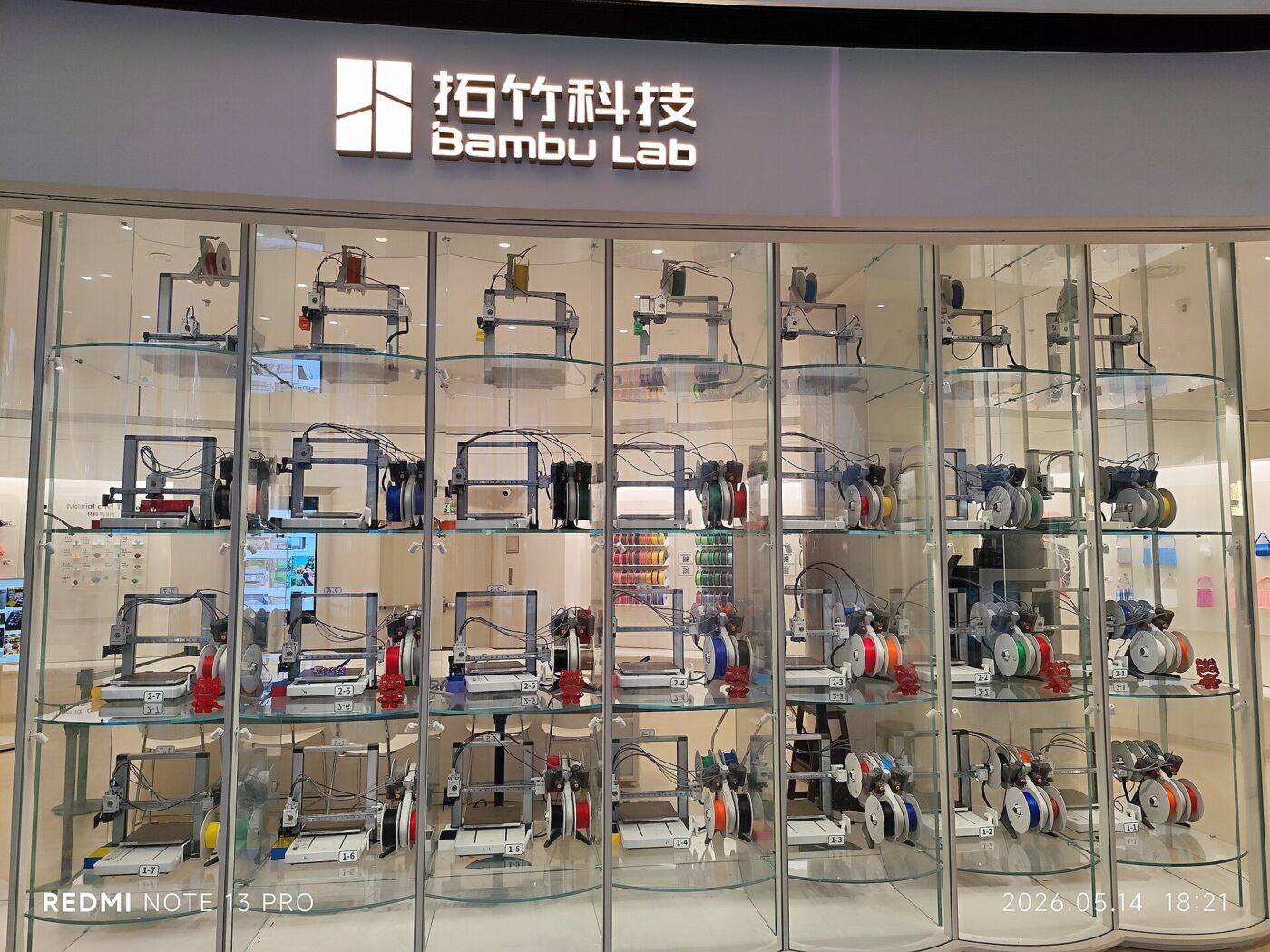
CONTEXT’s quarterly data trace the handover. In 2023, Bambu Lab’s shipments rose about 3,000% as the category set a quarterly record of 993,000 entry-level units in Q4. In Q1 2025 Creality still led by volume with a 39% share, though its sales slipped 3% while Bambu Lab’s shipments grew 64%. CONTEXT’s report on the fourth quarter and full year of 2025 gave Bambu Lab a 37% share, with Creality, Elegoo and Anycubic also among the leaders.
The field then tightened. In Q1 2026 those four brands accounted for 88% of all entry-level printers shipped worldwide. The fastest grower that quarter was a smaller player: Flashforge, whose shipments rose more than 120%.
| Period | What CONTEXT reported |
|---|---|
| Q4 2023 | 993,000 entry-level units, a quarterly record; Bambu Lab up about 3,000% for 2023 |
| Q1 2025 | Over 1 million units, up 15%; Creality 39% share; Bambu Lab up 64% |
| Q4 and full-year 2025 | Shipments up 47% in Q4 and 26% for the year; Bambu Lab share 37% |
| Q1 2026 | Shipments up 39%; top four brands hold 88% |
Tariffs, print farms and the China factor
Chinese vendors made 95% of entry-level shipments in Q1 2025 and over 90% across 2025, per CONTEXT. That concentration exposes the category to US trade policy. CONTEXT attributed almost all of Q1 2025’s growth to purchases pulled forward ahead of US tariffs on Chinese goods, and Bambu Lab delayed US sales of its P2S in October 2025, citing logistics, while warning that US pricing could change with tariff developments.
Print farms are the other driver. CONTEXT said in July 2026 that demand increasingly comes from farms around the world producing goods locally. In China, a veteran farm operator estimated at Formnext Asia Shenzhen in August 2026 that about 390,000 printers run in farms, around 350,000 of them Bambu Lab machines, and that equipping a 1,000-machine farm fell from about RMB 5 million in 2024 to RMB 1 million in 2026. One planned farm in Huizhou, backed by RMB 200 million, lists 6,500 Bambu Lab machines in its first phase.
Farm demand rewards whichever brand farms standardize on, and in China that is overwhelmingly Bambu Lab.
Creality goes public as Bambu Lab fills every price tier
Creality listed on the Hong Kong Stock Exchange on May 29, 2026, which CONTEXT described as a first for a consumer-focused 3D printing company. As a listed company it will publish regular results, which should give buyers and analysts a clearer view of its sales and finances.
Bambu Lab has answered by covering every price point. Its A2L launched in June 2026 at $489, or $569 with a multicolor unit, beneath the $549 launch price of its P2S. 3DPrint.com’s analysis described the strategy as Bambu Lab accepting that it will cannibalize its own sales rather than leave a niche open to rivals. For shoppers, that means frequent new models and more overlap between them.
The legal overhang on the market leader
On September 17, 2026, a jury in the US District Court for the Eastern District of Texas found that Bambu Lab infringed four Stratasys patents covering desktop 3D printing technology, including purge tower functionality, and awarded $27.6 million in past damages. The jury also found the infringement willful, Bloomberg Law reported. Bambu Lab said it disagrees with the verdict and will pursue post-trial review and an appeal, citing favorable outcomes on related patents in Europe and at the US Patent Trial and Appeal Board.
3DPrint.com’s report did not mention a sales injunction, and a second Stratasys case is pending in the same court. For current owners nothing changes. For buyers, it is one more reason to follow the appeal, since damages and licensing costs can eventually show up in prices.
How to pick a platform in a consolidated market

With four brands shipping nearly nine in ten entry-level printers, you are choosing an ecosystem as much as a machine: the slicer software, the multicolor add-on, spare nozzles and hotends, and the community print files tuned for that hardware. Check which add-ons work across a brand’s models, whether spare parts are sold separately, and whether the printer works fully offline if that matters to you.
Concentration cuts both ways. Large installed bases mean plentiful parts and tutorials, while fewer strong rivals can mean less price pressure over time. In Q1 2026, entry-level revenue rose 54% against 39% unit growth, which suggests buyers were paying more per printer, not less.
What to watch next
- Creality’s first interim results as a listed company, for whether it is regaining share
- Post-trial rulings and any appeal in Stratasys v. Bambu Lab, plus the second case pending in Texas
- CONTEXT’s next quarterly share data, for whether the top four stay near 88% and Flashforge keeps growing
Where to start
Paid links: we earn a commission if you buy through the buttons below, at no extra cost to you. As an Amazon Associate I earn from qualifying purchases.
3D printer types by the buyer they fit
| Product type | Good fit for | Where to look |
|---|---|---|
| Enclosed CoreXY 3D printer | Fits enclosed, faster printing | See listings on AmazonOpens Amazon search results, not one listing: check the model on the product page. |
| Open-frame 3D printer with auto leveling | Fits tight budgets and learning | See listings on AmazonOpens Amazon search results, not one listing: check the model on the product page. |
| Hardened steel nozzle kit | Fits keeping any brand running | See listings on AmazonOpens Amazon search results, not one listing: check the model on the product page. |
Product types that fit the trend described above, not tested models. Check the exact listing before you buy. How we pick them.
Enclosed CoreXY 3D printer
Where to look: Amazon
The design most farms and multicolor bundles are built around. Check the price and availability of spare hotends before you commit to a brand.
- Enclosure helps with warp-prone plastics
- Common in multicolor bundles
- Costs more than open frames
- Parts can be brand-specific
Open-frame 3D printer with auto leveling
Where to look: Amazon
A cheaper way to learn. Check the build volume and whether the brand sells a multicolor add-on for that model.
- Lower entry price
- Easy to see and reach the print
- Less suited to warp-prone plastics
- Fewer color add-on options
More: Hobbies and Crafts trends and how the Trend Signal is scored.
Sources
- Quarterly global 3D printer shipments, Q1 2026 — CONTEXT
- Quarterly Industrial 3D Printer Shipments Rebound Amid Continued Record-Breaking Entry-Level Growth — CONTEXT
- Quarterly Entry-level 3D Printer Shipments Surge on Tariff Fears — CONTEXT
- Bambu Lab driving market dominance of Entry-Level 3D printers, CONTEXT reports — 3D Printing Industry
- Formnext Asia Shenzhen 2026: China Has Built the AM Stack — 3DPrint.com
- AMPulse Asia: 6,500-Printer Farm Leads APAC Manufacturing Expansion — 3DPrint.com
- Bambu Launches A2L: What the New Printer Reveals About Its Strategy — 3DPrint.com
- Bambu Lab Launches P2S — 3DPrint.com
- Stratasys Wins $27.6M in Patent Case Against Bambu Lab — 3DPrint.com
Questions readers ask
Is Bambu Lab bigger than Creality now?
By shipments, yes. CONTEXT gave Bambu Lab a 37% share of entry-level shipments in its report on the fourth quarter and full year of 2025 and said it still led in Q1 2026; Creality had led by volume in Q1 2025 with 39%.
Are most 3D printers made in China?
Most entry-level ones are. CONTEXT said Chinese vendors accounted for 95% of entry-level shipments in Q1 2025 and over 90% in 2025.
What did the Stratasys verdict against Bambu Lab decide?
A Texas federal jury found on September 17, 2026 that Bambu Lab infringed four Stratasys patents, including purge tower technology, and awarded $27.6 million in past damages; Bloomberg Law reported the jury found the infringement willful. Bambu Lab says it will appeal.
When did Creality go public?
Creality listed on the Hong Kong Stock Exchange on May 29, 2026, which CONTEXT described as a first for a consumer-focused 3D printing company.