Google Trends listed portable induction cooktop as a rising US query over the 12 months to October 2026, up about 120%, and Amazon carries a whole RV branch underneath it: rv induction cooktop, two burner, drop in, built in, with oven. The products exist and the demand is real. The question people are actually asking is electrical, and the answer is published.
This compares what the makers put in writing, not how anything cooks. We chose the units below because they publish a complete electrical specification, and we checked each against the CPSC recall database ourselves. We have tested nothing.
Trend Signal
59/100 Steady momentum
- Emerging
- Rising
- Mainstream
- Peaking
- Cooling
RV-specific models arriving while the power budget they ask for stays the same
Furrion publishes a total connected load of 1,800 W and a maximum 15 amp load for its two-burner RV induction cooktop, with the two zones sharing power; Duxtop tells owners of its 1,800-watt portable to give it a dedicated 15 amp outlet.
Our editorial reading of the cited data, not a forecast. How it is scored
By the numbers
- 1,800 WTotal connected load Furrion publishes for its two-burner RV induction cooktopFurrion
- 15 AMaximum amp load Furrion publishes for that two-burner cooktop at 120 voltsFurrion
- 1,440 WReal power Furrion calculates from 1,800 W at the 0.80 power factor it publishesFurrion
- Only 1Yellowstone campgrounds offering electrical hookups, per the park campground pageNational Park Service
The number that matters is not printed on the cooktop
A portable induction cooktop is sold on wattage, and in a house that figure is nearly free information. In a recreational vehicle it is most of the budget. Duxtop states the household case in capitals: “ALWAYS USE A DEDICATED OUTLET. This unit is designed to operate using a 120V electrical outlet having a 15 amp capacity.” The troubleshooting section repeats that each unit draws about 15 amps, and the list of things not to do includes sharing a 120 V, 15 amp outlet with another item.
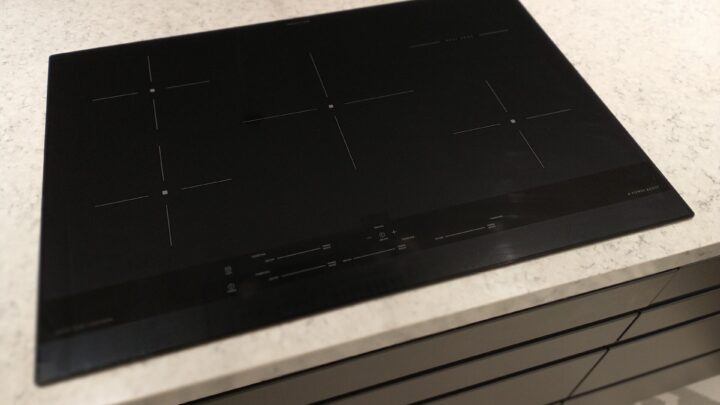
The RV-specific units publish the same draw with a tighter boundary. Furrion’s manual for its 21-inch double-burner cooktop, document CCD-0005718 Rev. 05.02.2023, instructs that it be connected to a 120 volt, 60 Hz, AC only, 15 amp or 20 amp dedicated circuit, and recommends a separate circuit serving only the cooktop. The Greystone listing publishes 120 V / 60 Hz, a maximum amp load of 15 A and a total connected load of 1,800 W.
Furrion also prints the line no consumer listing bothers with: “Induction cooktops power factor is less than 1. The power factor for induction heating ranges between 0.75 and 0.80. The real power would be 1800W x 0.80 = 1440W.” If you are sizing an inverter, those are two different numbers and the maker gave you both.
Treat an RV induction cooktop as a 15 amp load that wants the circuit to itself, because that is what both makers write.
What the RV-specific units publish
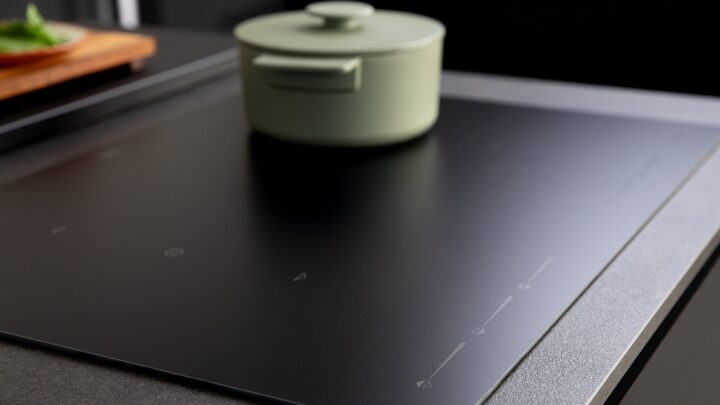
The difference between a drop-in RV unit and a countertop portable is what the maker designed around. Furrion lists high and low voltage protection as a feature, a response to shore-power pedestals rather than kitchens, and its manual carries error codes E2 and E3 for supply voltage that is too low or too high. It also tells installers to use butyl tape rather than the supplied foam tape in an RV, so the unit can still be removed for service.
The two-burner layout hides a constraint worth reading twice. Furrion publishes a left burner at 1,800 W and a right at 1,300 W against a total connected load of 1,800 W, and lists power sharing as applying to both zones. The pair is not additive: the published total is what the coach supplies, and the cooktop allocates it. Both makers also publish cookware limits tighter than a full-size cooktop — Furrion accepts flat bottoms from 4 3/4 to 10 7/8 inches, Duxtop sets a 5-inch minimum — so check the galley pans before the appliance.
| Published figure | Furrion 21-inch two-burner | Duxtop 9600LS portable |
|---|---|---|
| Supply | 120 V, 15 or 20 A dedicated circuit | 120 V, 60 Hz, 15 A circuit |
| Total connected load | 1,800 W | 200 to 1,800 W output |
| Zones | Two, 1,800 W and 1,300 W, sharing | One |
| Cookware base | 4 3/4 to 10 7/8 inches | 5 inches minimum |
| Mounting | Drop-in or countertop on four feet | Countertop, 11.4 by 14 by 2.5 inches |
| Supply protection | High and low voltage protection listed | Not listed |
Shore power, inverter and generator are three different ceilings

The cooktop is the easy half. What feeds it is three questions, and only one has a manufacturer document behind it. On shore power the pedestal decides, and an outlet is not always there: the National Park Service’s Yellowstone campground page, last updated February 25, 2026, states that Fishing Bridge RV Park is the only campground in the park offering water, sewer and electrical hookups, at 50 amp service.
On battery, compare the inverter’s continuous AC output and the pack’s usable capacity against the real-power figure rather than the label. A 1,440 W load for twenty minutes is roughly half a kilowatt-hour by our arithmetic, before inverter losses. We worked through matching those two sides in what a power station can actually run and matching a power station to solar panels; the fixed-appliance version is battery induction ranges on 120 volts.
On a generator, the comparison is the cooktop’s draw against the generator’s rated rather than peak output, and we have no manufacturer figure to offer there, so we are not going to assert one. Check the rated continuous watts on the generator’s data plate against the 1,800 W the cooktop publishes. In every case we are not telling you your coach’s wiring will take it; both manuals put that on the installer.
What the safety record shows, and what it does not
We downloaded the complete CPSC recall dataset on October 1, 2026 — 10,027 records from June 8, 1973 to September 24, 2026 — and searched it for induction cooktops of every kind. No standalone or portable induction cooktop appears in the file. Two records mention induction at all, and the one involving a cooktop is a 2007 Thermador notice covering about 2,000 built-in ceramic units that CPSC describes as having electric and induction heating elements.
The comparison that matters in a camper is with what induction replaces. The same file contains four portable butane camping stove recalls — 2000, 2001, 2010 and November 2025, the last about 201,000 Ozark Trail stoves CPSC says can explode or catch fire. That is not a verdict on fuel — induction is a young category with a short record — but it is the published record the propane alternative has to be read against, and we looked at the fuel side in the one-pound propane cylinder refill rules.
On the electrical standard, read the rating label rather than the listing copy. UL 1026, Household Electric Cooking and Food Serving Appliances, is in its sixth edition, published January 27, 2012 and revised June 9, 2026, covering appliances at 250 V or less while excluding household ranges and commercial appliances. Duxtop’s manual carries an FCC Part 18 statement, which concerns radio emissions and is not an electrical safety listing.
A clean recall record tells you what has failed, not what will. Look for a UL or ETL mark on the label.
Who should buy which
If the coach has a 15 or 20 amp circuit you can dedicate and you are replacing a cooking appliance permanently, the drop-in two-burner is the product designed for the job. If you want to try induction without committing, a countertop single-zone unit is the cheaper test, and the thing to respect is Duxtop’s instruction to give it an outlet of its own. If you boondock without a generator or a large inverter, nothing in this category fits, and no specification trick changes that.
One point the federal rules make explicit: portables sit outside the efficiency regime entirely. DOE defines a portable indoor conventional cooking top as one designed for indoor use and to be moved from place to place, and the integrated annual energy consumption standard arriving in January 2028 applies to conventional cooking tops other than portable indoor ones. No portable is tested against an energy standard, so a wattage figure on a listing is all you get. The dorm-room version of that same gap is in compact air fryers and dorm rules, and the small-format side generally in mini induction cooktops.
What to watch next
- Whether RV makers publish a continuous inverter rating alongside the cooktop load, as Furrion publishes its power factor
- Whether more National Park campgrounds add electrical hookups; the per-park pages carry the service size
- Whether CPSC records a first portable induction cooktop recall as low-volume importers scale
Where to start
Paid links: we earn a commission if you buy through the buttons below, at no extra cost to you. As an Amazon Associate I earn from qualifying purchases.
Induction options for a camper and the published load each one asks for
| Product type | Good fit for | Where to look |
|---|---|---|
| Two-burner RV induction cooktop | Fits a permanent galley install | See listings on AmazonOpens Amazon search results, not one listing: check the model on the product page. |
| Single-zone portable induction cooktop | Fits an occasional cook | See listings on AmazonOpens Amazon search results, not one listing: check the model on the product page. |
| Compact induction cookware set | Fits a small galley pan set | See listings on AmazonOpens Amazon search results, not one listing: check the model on the product page. |
Product types that fit the trend described above, not tested models. Check the exact listing before you buy. How we pick them.
Two-burner RV induction cooktop
Where to look: Amazon
Furrion publishes 120 V, a 15 amp maximum and 1,800 W total, with a 1,800 W left zone and a 1,300 W right zone sharing that budget.
- Published voltage protection
- Drop-in or countertop mounting
- Zones share 1,800 W, they do not add
- Wants a dedicated circuit
Single-zone portable induction cooktop
Where to look: Amazon
Duxtop publishes 120 V, 60 Hz, a 15 amp circuit and 200 to 1,800 W output, and tells owners not to share the outlet.
- No installation
- Cheapest way to test the idea
- Maker asks for an outlet of its own
- No supply voltage protection published
Compact induction cookware set
Where to look: Amazon
The part people forget. Furrion will not acknowledge a base under 4 3/4 inches and Duxtop stops at 5 inches, which rules out much camping cookware.
- Sized for a narrow counter
- Magnetic bases standard in these sets
- Small bases can fall under the minimum
- Published base figures are rare
More: Home and Kitchen trends and how the Trend Signal is scored.
Sources
- Furrion 21 inch double burner induction cooktop manual CCD-0005718 — Lippert Components
- Greystone two-burner RV induction cooktop BW-K35 specifications — Furrion
- Duxtop 9600LS user manual — Secura
- Campgrounds, Yellowstone National Park — National Park Service
- Recall database, full JSON export — CPSC
- 10 CFR 430.2, definitions including portable indoor conventional cooking top — eCFR
- 10 CFR 430.32, standards and compliance dates — eCFR
- UL 1026, Household Electric Cooking and Food Serving Appliances, Edition 6 — UL Standards and Engagement
Questions readers ask
How many amps does an RV induction cooktop draw?
Furrion publishes a maximum amp load of 15 A at 120 V for its two-burner RV cooktop with a total connected load of 1,800 W, and its manual asks for a 15 or 20 amp dedicated circuit. Duxtop specifies a 120 V, 15 amp circuit for its 1,800-watt portable.
Can both burners run at full power at once?
Not on the Furrion unit. It publishes a 1,800 W left burner and a 1,300 W right burner against a total connected load of 1,800 W, and lists power sharing for both zones, so the pair works within the published total rather than adding to it.
What is the power factor note in the Furrion manual about?
It is the maker separating apparent load from real power. The manual states the power factor for induction heating ranges between 0.75 and 0.80 and gives 1800W times 0.80 as 1440W of real power. Both matter when sizing an inverter.
Have portable induction cooktops been recalled?
None appears in the CPSC database. We pulled the full file on October 1, 2026, covering 10,027 records through September 24, 2026, and found no recall of a standalone or portable induction cooktop. The only cooktop record mentioning induction is a 2007 Thermador notice.