We have not tested any of these products. This compares the figures makers publish on their own spec pages with federal consumption data and the published safety standards. We limited the field to units sold in the US with a full spec sheet, and checked every brand named against the CPSC recall database on September 25, 2026.
Buyers searching for a home backup power station are asking one question: will it run my stuff? The listing answers with watt-hours, because watt-hours look big. The spec that decides it sits a few rows lower, in two numbers most pages print without explanation. Our earlier piece on power stations pitched as whole-home backup covers the recalls, the battery tariff and the wiring side; this one is about sizing.
Trend Signal
66/100 Steady momentum
- Emerging
- Rising
- Mainstream
- Peaking
- Cooling
Capacity sells the unit, but the inverter rating is what decides the answer
The three 1 kWh units we compared publish continuous outputs of 1,500 W to 1,800 W and surge ratings from 2,400 W to 3,600 W, while US household refrigeration averaged 2.9 million Btu of site electricity in 2020, about 850 kWh a year by our calculation.
Our editorial reading of the cited data, not a forecast. How it is scored
By the numbers
- 2.9 MMBtuAverage 2020 site electricity for refrigerators in US homes using that end useU.S. EIA, RECS 2020
- 1,800 WContinuous AC output EcoFlow publishes for the DELTA 3 Classic, September 2026EcoFlow
- 3,000 WSurge peak Jackery publishes for the Explorer 1000 v2, against 1,500 W ratedJackery
- 20 kWhLithium-ion capacity above which UL 2743 hands a power pack to UL 9540UL Standards and Engagement
Two ratings decide it: continuous watts and surge watts

Continuous watts is the load the inverter carries indefinitely. Surge watts is the brief spike it tolerates when a motor or compressor starts, and that spike is what trips an undersized unit.
The three best-documented 1 kWh units publish both. EcoFlow lists “120V~60Hz 1800W total” with a 3,600 W surge and an X-Boost mode rated 2,600 W. Anker lists 1,800 W pure sine wave with a 2,400 W surge. Jackery lists “1500W Rated, 3000W Surge peak.”
The headroom is distributed differently in each. Jackery pairs the smallest continuous rating with the second-largest surge; Anker does the reverse. A load that starts hard then settles low is a different problem from one that draws steadily.
| Model | Continuous AC output | Surge published | Extra mode published |
|---|---|---|---|
| EcoFlow DELTA 3 Classic | 1,800 W | 3,600 W | X-Boost rated 2,600 W; 10 ms UPS switchover |
| Anker SOLIX C1000 | 1,800 W | 2,400 W | SurgePad, which Anker says activates above the rated output |
| Jackery Explorer 1000 v2 | 1,500 W rated | 3,000 W peak | Bypass mode passing 1,500 W through from the wall |
Read the nameplate on the appliance, then check it against both ratings, not just the larger one.
The refrigerator question, in numbers you can check
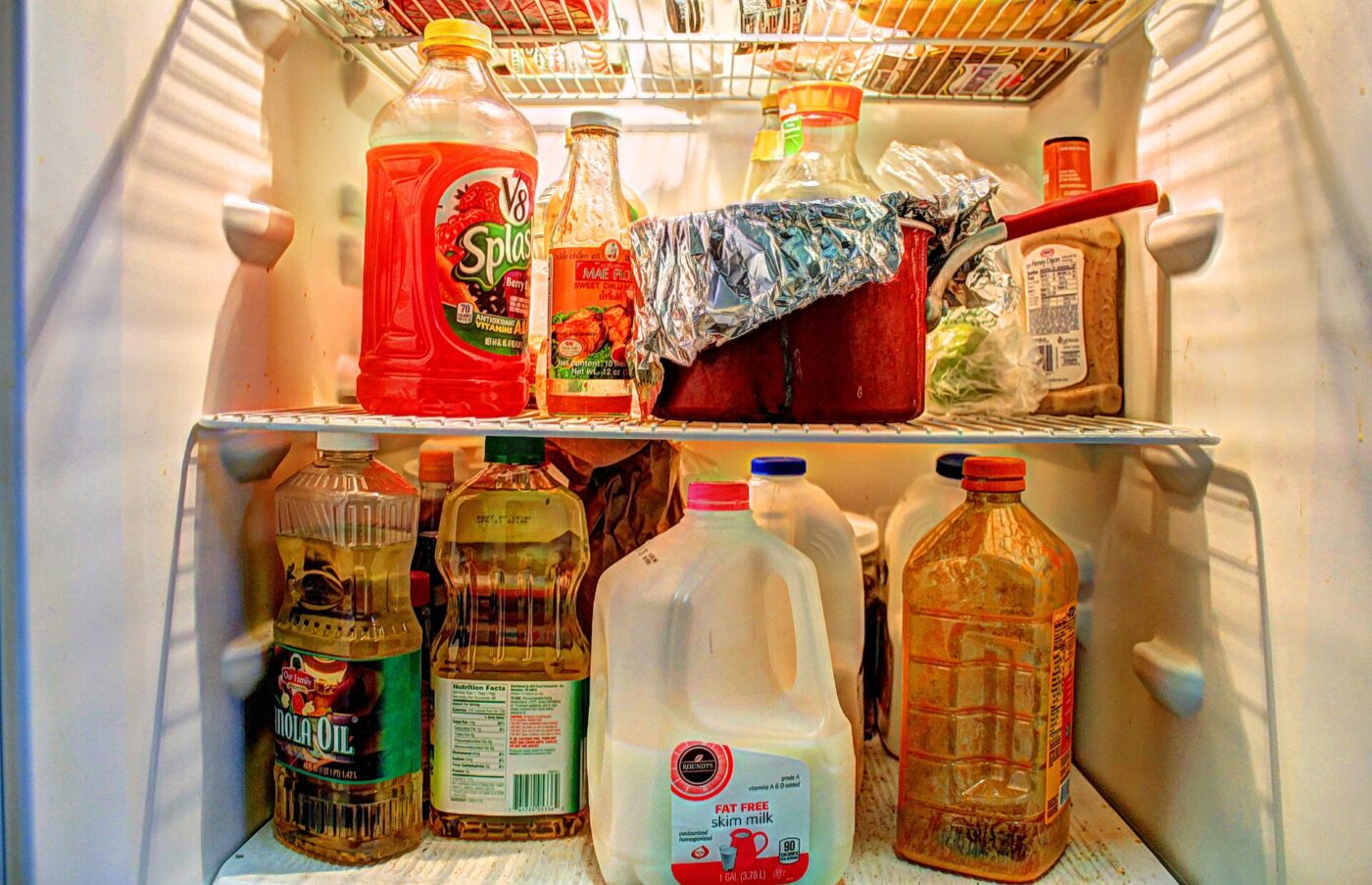
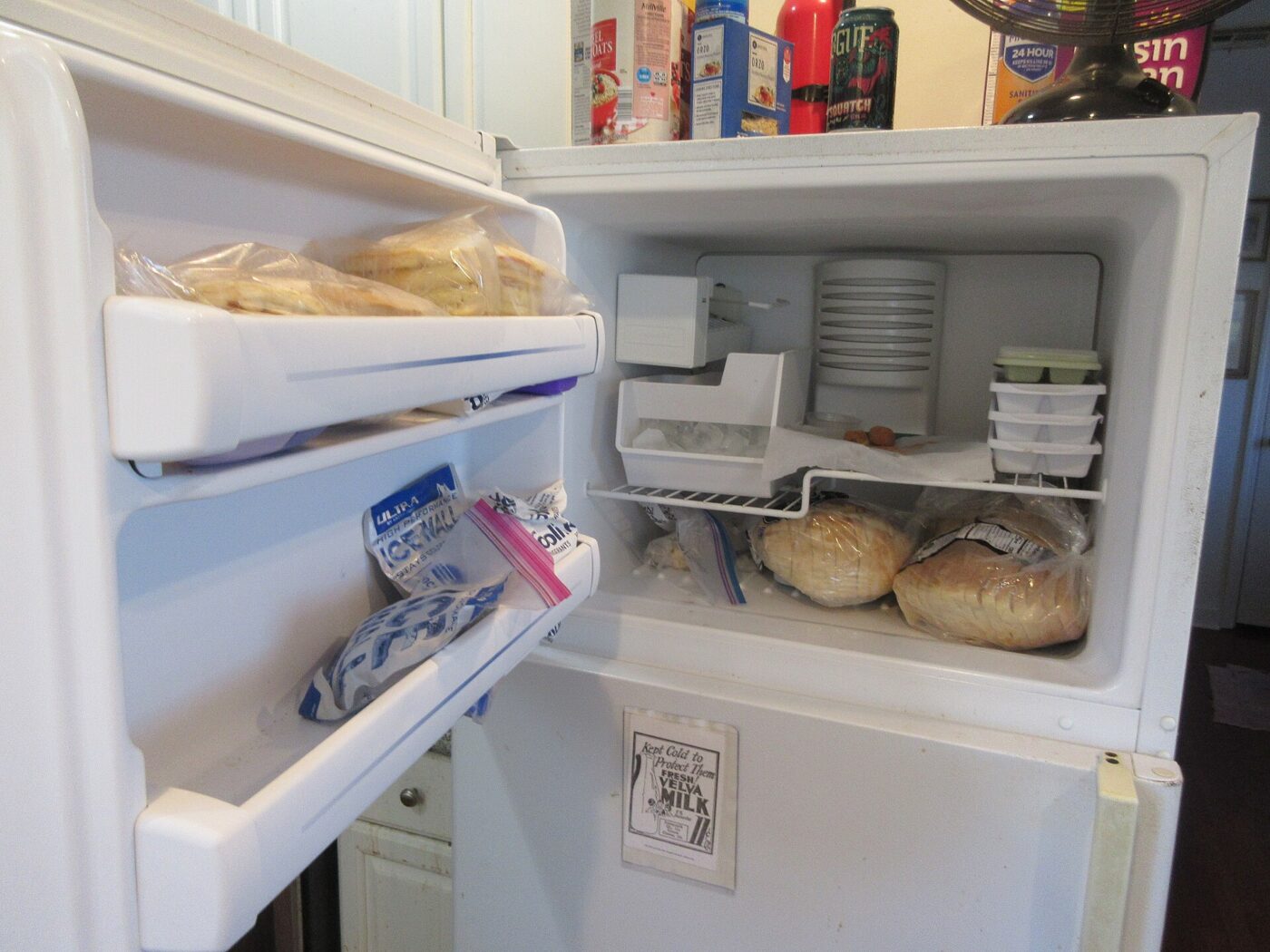
The refrigerator is the load almost every buyer asks about, and there is a federal figure for it. EIA’s Residential Energy Consumption Survey puts average 2020 site electricity for refrigerators at 2.9 million Btu per household using that end use. At 3,412 Btu per kWh that is about 850 kWh a year, or an average draw near 97 watts across all 8,760 hours, by our calculation. Read it as a household total rather than one appliance: EIA reports that 34% of US homes had two or more refrigerators in 2020, so a single box averages less than that.
That average is why capacity is rarely the problem. The catch is the duty cycle: the compressor is off most of the time and draws a multiple of its running wattage for a second or two at start. The surge rating, not the watt-hours, decides whether it works.
So read the appliance, not the article. Every refrigerator carries a nameplate with volts and amps. Multiply them for running watts and leave the surge rating as margin. A plug-in watt meter on the fridge for a day tells you more than any general figure, including ours.
What no portable unit in this class reaches
EIA reports that the three largest categories of US residential site electricity in 2020 were air conditioning at 19%, space heating at 12% and water heating at 12%. Those are the loads a 1 kWh portable station does not carry, and not because of capacity: central air conditioning, electric water heaters, well pumps, ranges and dryers are commonly 240-volt circuits, and every unit above publishes 120-volt output only.
Volts come before watts. A 240-volt appliance cannot run from a 120-volt outlet at any wattage, so no amount of surge headroom turns a portable unit into a whole-house solution.
One category deserves a flat statement rather than a calculation. Do not plan life-sustaining or prescribed medical equipment around a consumer power station. These units publish no guaranteed availability, several have been recalled, and the runtime you would rely on is an estimate from the maker’s own laboratory. If someone in the household depends on powered equipment, that conversation belongs with the equipment supplier and the utility’s medical-baseline program, not with a spec sheet.
- 240-volt loads: central air conditioning, electric water heaters, ranges, dryers and most well pumps
- Anything whose nameplate running watts exceed the continuous rating, regardless of surge
- Several motor loads starting at once, since surge ratings assume one spike at a time
- Life-sustaining medical equipment, which should never be planned around a consumer battery
Where the standard stops and the house wiring begins
There is a published boundary for the home-backup version of this question, and it sits in the safety standard rather than in any listing. UL 2743, Portable Power Packs, reached its Third Edition on September 24, 2025. Its scope states that packs permanently connected to premises wiring, packs with a function to supply power to premises wiring, and utility-interactive packs are covered not by UL 2743 but by UL 9540, the Standard for Energy Storage Systems and Equipment.
The same scope carries a capacity threshold. UL 2743’s Table 1.1 sets the aggregate limit at 20 kWh for lithium-ion or sodium-ion and 70 kWh for lead-acid. UL 9540 in turn caps residential electrochemical storage at 20 kWh unless the unit passes a UL 9540A unit-level test.
For a shopper the reading is simple: while the unit stays a plug-in appliance it is a portable power pack, and the moment it is wired to feed household circuits it is a different product under a different standard, and an electrician’s job. Our desk-side battery backup piece sits in Work and Office.
Plug-in use keeps it inside UL 2743. Wiring it into the house moves it under UL 9540.
How to size one before you buy
Work from a list, not a category. Write down every device you would plug in during an outage, read the running watts off each nameplate, and add them. That total has to sit under the continuous rating with room to spare, since a published rating is a ceiling.
Then check the one or two items with motors or compressors against the surge figure. If the fridge is on the list it usually sets the minimum unit size, and it is why a 1,500 W unit with a 3,000 W peak can fit better than an 1,800 W unit with a 2,400 W peak.
Capacity comes last, and it is division: watt-hours over total running watts, before conversion losses. Buy the inverter rating first and the battery size second.
What to watch next
- Whether makers publish surge duration as well as surge watts, since duration is what a compressor start needs
- UL 2743 Third Edition uptake on listings, which added a UPS reference for packs with AC pass-through
- New CPSC power station notices, five since December 2023 by our count
Where to start
Paid links: we earn a commission if you buy through the buttons below, at no extra cost to you. As an Amazon Associate I earn from qualifying purchases.
Power station classes compared on the ratings that decide it
| Product type | Good fit for | Where to look |
|---|---|---|
| Plug-in watt meter | Fits measuring before buying | See listings on AmazonOpens Amazon search results, not one listing: check the model on the product page. |
| Power station in the 1,500-watt class | Fits a fridge plus lights and a router | See listings on AmazonOpens Amazon search results, not one listing: check the model on the product page. |
| Heavy-gauge extension cord | Fits running a load away from an outlet | See listings on AmazonOpens Amazon search results, not one listing: check the model on the product page. |
Product types that fit the trend described above, not tested models. Check the exact listing before you buy. How we pick them.
Plug-in watt meter
Where to look: Amazon
The cheapest way to answer the question for your house rather than in general. Leave it on the fridge for a day and you will know the running watts a published average can only approximate.
- Measures your own appliances
- Cheap next to the station
- Only measures 120-volt plug loads
- Some models miss brief peaks
Power station in the 1,500-watt class
Where to look: Amazon
A 1,500 W unit with a 3,000 W peak covers a refrigerator plus lights, a router and phones. Check both numbers: Jackery publishes 1,500 W with 3,000 W surge, Anker 1,800 W with 2,400 W.
- Surge headroom for one compressor start
- Plug-in use needs no electrician
- 120-volt output only
- Cannot reach 240-volt appliances
Heavy-gauge extension cord
Where to look: Amazon
A power station has to sit where air can move around it, which is rarely next to the appliance. Match the cord gauge to the load.
- Keeps the unit out of a closed cabinet
- One cord beats several adapters
- Thin cords waste watts as heat
- Long runs drop voltage
More: Travel and Adventure trends and how the Trend Signal is scored.
Sources
- Table CE4.6, household site end-use consumption, averages 2020 — U.S. Energy Information Administration
- Electricity use in homes — U.S. Energy Information Administration
- DELTA 3 Classic specifications — EcoFlow US
- Anker SOLIX C1000 specifications — Anker
- Jackery Explorer 1000 v2 tech specs — Jackery
- UL 2743 Portable Power Packs, Third Edition — UL Standards and Engagement
- UL 9540 Energy Storage Systems and Equipment — UL Standards and Engagement
Questions readers ask
Will a 1,000 Wh power station run a refrigerator?
Usually yes for plug-in use, if the surge rating covers the compressor start. EIA puts average US household refrigeration at 2.9 million Btu of site electricity in 2020, about 850 kWh a year or near 97 watts averaged over the year by our calculation. That is a household total across every refrigerator in the home, and EIA reports 34% of homes had two or more. The start-up spike is what the inverter has to survive.
What is the difference between continuous watts and surge watts?
Continuous is the load the inverter carries indefinitely; surge is the brief spike it tolerates at start-up. Jackery publishes 1,500 W rated and 3,000 W surge peak for the Explorer 1000 v2.
Can a portable power station run an air conditioner or a water heater?
Not the central kind. EIA reports air conditioning at 19% and water heating at 12% of US residential site electricity in 2020, and those systems are usually on 240-volt circuits, while the units here publish 120-volt output only.
When does a power station stop being covered by UL 2743?
When it is wired to the house or exceeds the capacity threshold. UL 2743 excludes packs permanently connected to premises wiring, packs that supply power to premises wiring and utility-interactive packs, and caps lithium-ion or sodium-ion at 20 kWh.
Can I run medical equipment from one?
Do not plan on it. These are consumer products with published estimates rather than guaranteed availability, and several models have been recalled. Anyone who depends on powered medical equipment should arrange backup with the equipment supplier and the utility.