The National Weather Service answered the roof-snow question on page 14 of its Cloudburst Chronicle, and the method is short. Take a core sample of the snow to the ground with a capped length of PVC, melt it indoors, and measure the inches of water left. That is the water equivalent. Water weighs 62.4 pounds per cubic foot, so the agency converts at 5.2 pounds per square foot per inch.
Depth is not the input, which is where roof-snow talk goes wrong: a foot of dry powder and a foot of wet snow are nothing alike. What follows is which part of the problem a roof rake solves.
Trend Signal
56/100 Steady momentum
- Emerging
- Rising
- Mainstream
- Peaking
- Cooling
Steady winter demand, and the qualifiers buyers add are about the roof, not the snow
Amazon returns seven completions for the prefix roof rake snow, and three name a feature rather than the job: an angled head, rollers, telescoping reach. The arithmetic underneath has not moved. The National Weather Service still converts at 5.2 pounds per square foot per inch of water equivalent.
Our editorial reading of the cited data, not a forecast. How it is scored
By the numbers
- 5.2 lbRoof load per square foot for each inch of snow water equivalentNational Weather Service
- 3 to 21 lbWeight per square foot of 1 foot of fresh snow, light and dry through wet and heavyFEMA P-957, citing Gooch 1999
- 57 lbApproximate weight per square foot of 1 foot of ice on a roofFEMA P-957
- $1.4BUS insured losses from winter storms in 2025, fourth lowest of the past ten yearsInsurance Information Institute
What the snow on your roof actually weighs
Everything comes from one definition: each inch of water over a square foot is 5.2 pounds. Snow is mostly air, which is why you melt a core rather than read a ruler. The published table runs from 1.0 inch of water equivalent at 5.2 pounds per square foot to 40.0 inches at 208.0.
Pitch comes next. A roof 35 degrees up from the horizon with 2.0 inches of water equivalent carries 10.4 pounds per square foot against a flat roof; multiplying by the cosine of the pitch gives 8.5 pounds directed into the roof. The rest acts along the plane, cumulative down the column of snow, and holds only while friction balances it.
The cautions matter more than the table. Measure on your own roof where you can, the agency says, because of the great variations in snow depth over even a small geographic area, and treat the answer as a rough estimate.
| Water equivalent, inches | Flat roof, lb per sq ft | Normal to a 35-degree pitch |
|---|---|---|
| 1.0 | 5.2 | 4.3 |
| 2.0 | 10.4 | 8.5 |
| 3.0 | 15.6 | 12.8 |
| 4.0 | 20.8 | 17.0 |
| 6.0 | 31.2 | 25.6 |
| 8.0 | 41.6 | 34.1 |
| 12.0 | 62.4 | 51.1 |
The number you need is inches of water, not inches of snow.
A foot of snow is not a unit of weight
FEMA reaches the same place from the structural side. Its Snow Load Safety Guide, FEMA P-957 of January 2013, puts 1 foot of fresh snow between 3 pounds per square foot for light, dry snow and 21 pounds for wet, heavy snow, crediting a 1999 figure from Gooch. Its own summary: 1 foot of snow in Utah need not weigh what 1 foot in Vermont weighs. Ice is worse per inch, a little under 5 pounds per square foot for 1 inch and roughly 57 pounds for 1 foot.
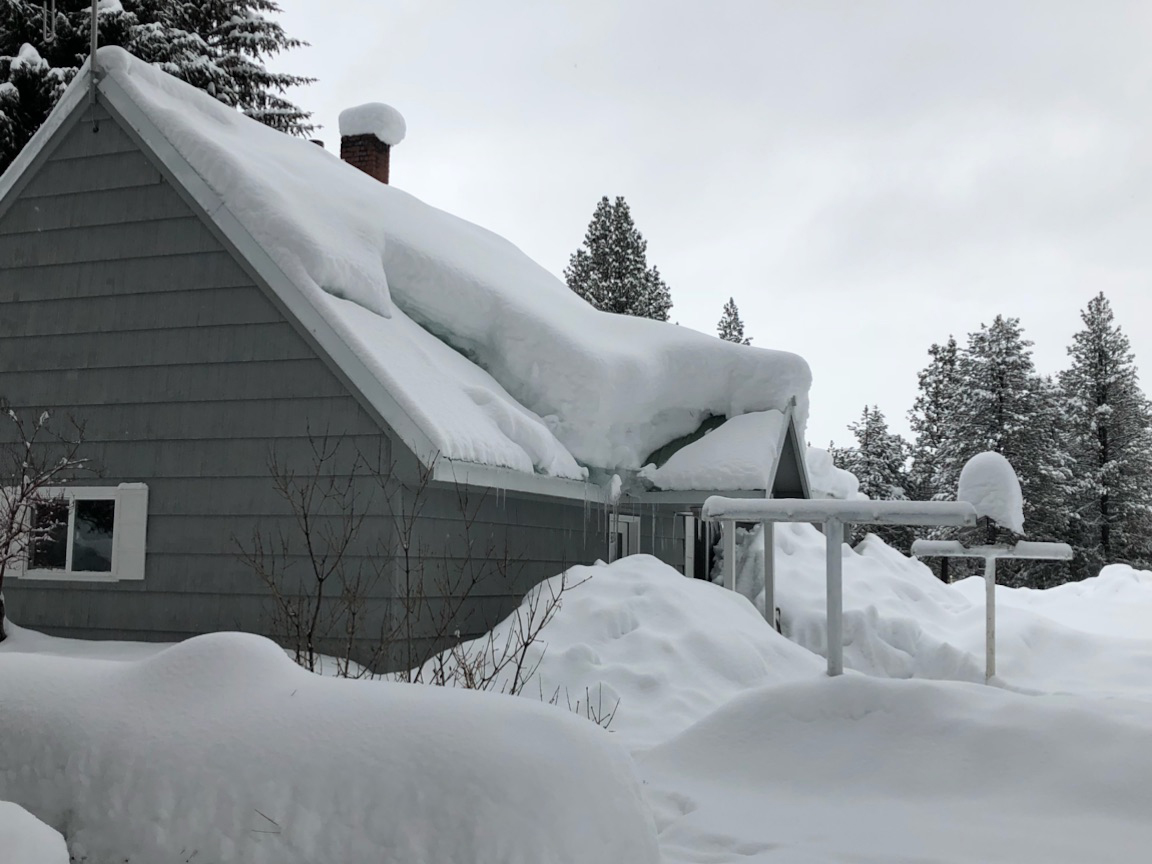
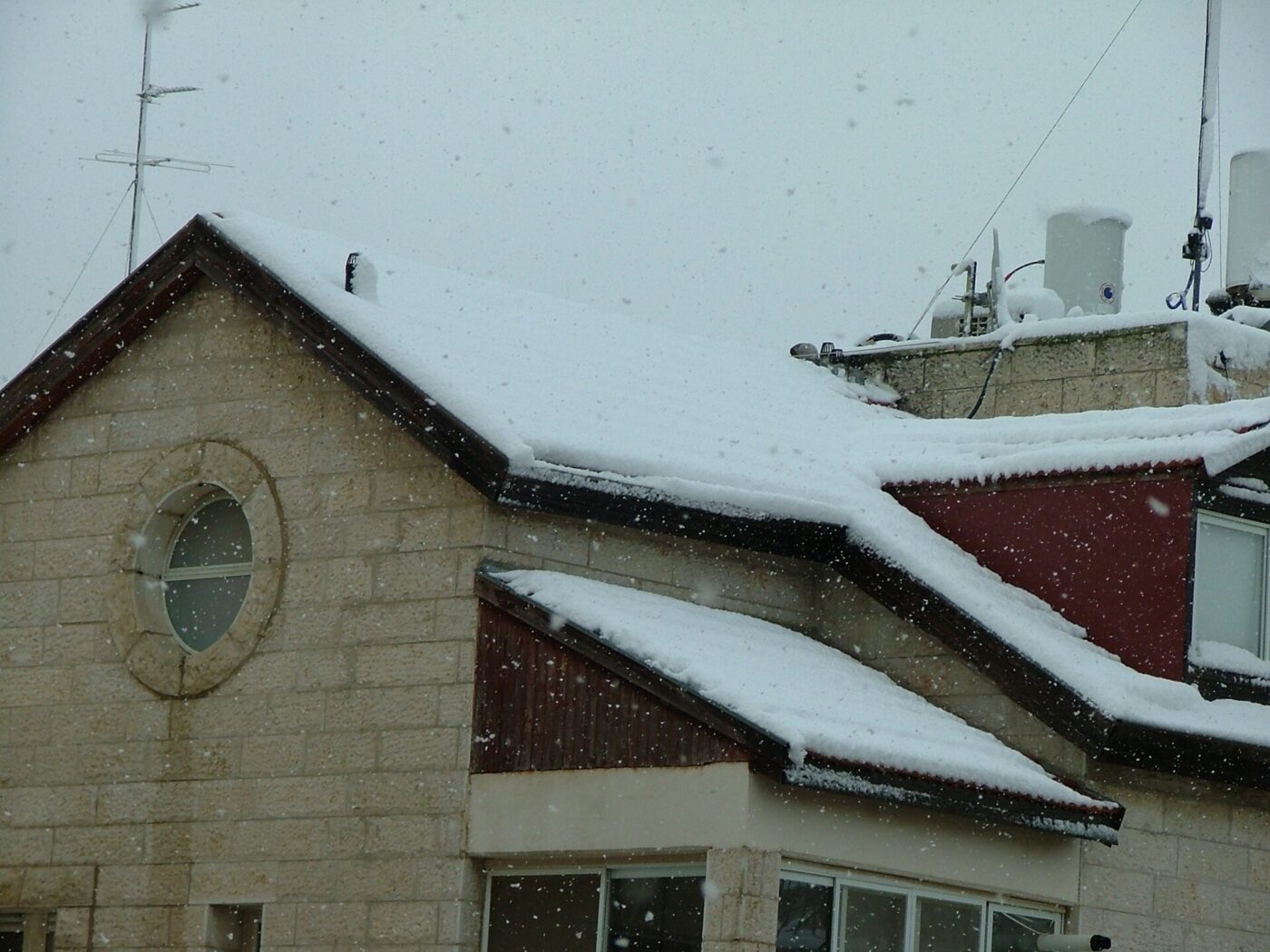
Two corrections in the same chapter matter as much. A foot of snow on the ground is not a foot on a roof, and FEMA says measuring ground snow and assuming it equals the roof snow load is incorrect. Snow also does not sit evenly: drifting and sliding create unbalanced loads, a greater risk than a uniform one, and the guide names chimneys, dormers, porch roofs and skylights as the collectors.
What a roof rake fixes, and what it leaves in place

North Dakota State University Extension published the mechanism in February 2013, quoting Ken Hellevang, an engineer with the service. Ice dams turn up when snow sits on the roof and outdoor temperatures are just below freezing. Meltwater runs down, refreezes at the cooler eaves, and the growing dam backs the next round of water under the shingles into the attic. Heat loss into the attic is the major cause.
What the rake does is narrower than it looks. NDSU says clearing the lower roof should reduce icicles and dams near the gutter because the source of the water has been removed. The repair is upstairs, covered in air sealing versus insulation and weatherstripping. One twist from FEMA: a well-insulated or well-ventilated roof typically holds more snow than a poorly insulated one, because inside heat no longer melts it from beneath.
- NDSU attic leak paths: unsealed plumbing, heating and electrical penetrations, can lights, attic hatches and ladders
- NDSU minimum for northern attics: roughly 15 inches of insulation, with soffit-to-ridge airflow kept clear by baffles
- A 1979 University of Minnesota extension sheet, flagged by its archive as possibly outdated: a roof rake and push broom, never chopping ice to the shingles, never a blowtorch
- Same sheet on heat tape: it melts only a few inches from the cable and often starts secondary dams higher up
The rake takes away the water supply. Only insulation and ventilation take away the heat.
Reach, weight and what the head is allowed to touch
A rake is a head on a pole, and the pole is the argument for owning one. NDSU puts it in a line: removing snow from the roof can be dangerous, so avoid getting on the roof by using a roof rake. FEMA agrees that removal can be conducted from the ground, taking away the risk to people on a hazardous roof. More pole buys more roof, and more mass overhead.
The head has published limits. FEMA advises against metal snow rakes because they can damage roofing material, prefers non-metallic on steep slopes, rules out sharp tools such as picks, and says complete removal can seriously damage the covering — at least 2 inches should stay on. It warns that roof snow can slide at any moment, so stay outside the sliding range of the eave. NDSU adds what the pole must never touch: overhead power lines.
For scale on winter ladder work, the nearest federal count is old and covers a different chore: CDC, using the Consumer Product Safety Commission NEISS All Injury Program, estimated 17,465 emergency-department-treated holiday-decorating falls across the 2000 to 2003 seasons, 43 percent of them from ladders, and 47 percent of the people who fell from ladders hospitalized.
Buy the reach you can hold steady from a safe spot, and a head allowed to touch your roof.
When the answer is a phone call, not a pole
FEMA lists the warning signs of overstress during a snow event: sagging roof members or sheathing, sagging ceiling boards, popping and cracking noises, bowing truss chords, doors or windows that will no longer open, cracks in masonry, severe roof leaks. If any appear, the guide says evacuate promptly and call a qualified design professional.
For the number you would measure against, FEMA says the design snow load comes from the construction drawings, and where there are none a licensed design professional should be retained before the snow season. The mapped ground snow loads behind it, in the International Building Code and ASCE 7, come from National Weather Service data, drawn at a 2 percent probability of being equaled or exceeded in any given year. Age matters too: FEMA, writing in January 2013, notes that a building put up 40 years earlier may not have been designed for snow loads as understood today.
The Insurance Information Institute, using Aon figures as of January 2026, puts US insured winter storm losses at nearly $1.4 billion in 2025, the fourth lowest of the past ten years, against $18.5 billion in 2025 dollars for the February 2021 polar vortex. See also home improvement spending in 2026.
A mild loss year is not a light roof. The design number lives in your drawings, not the forecast.
What to watch next
- The winter storm insured-loss table the Insurance Information Institute builds from Aon figures, dated as of January 2026
- Icicles along your own gutter line after the first thaw, the published early sign of attic heat loss
Where to start
Paid links: we earn a commission if you buy through the buttons below, at no extra cost to you. As an Amazon Associate I earn from qualifying purchases.
Roof rake types compared on reach, head design and what they leave behind
| Product type | Good fit for | Where to look |
|---|---|---|
| Telescoping roof rake | Fits a single-story eave worked from the ground | See listings on AmazonOpens Amazon search results, not one listing: check the model on the product page. |
| Roof rake with rollers | Fits shingle roofs where contact is the worry | See listings on AmazonOpens Amazon search results, not one listing: check the model on the product page. |
| Roof rake with an angled head | Fits dormers, valleys and awkward eave angles | See listings on AmazonOpens Amazon search results, not one listing: check the model on the product page. |
Product types that fit the trend described above, not tested models. Check the exact listing before you buy. How we pick them.
Telescoping roof rake
Where to look: Amazon
The figure on a listing is the pole, not the working reach from a safe spot. FEMA says roof snow can slide at any moment, so where you stand decides the length.
- Keeps the user off the roof, which NDSU and FEMA both advise
- Reaches the lower slope where ice dams form
- Hardest to control at full extension
- Will not reach a second-story eave
Roof rake with rollers
Where to look: Amazon
FEMA says at least 2 inches of snow should stay on, and that complete removal can damage the covering. A head that cannot reach the deck is following the guide.
- Standoff wheels limit contact with the roof covering
- Suits asphalt shingles, which hold snow rather than shed it
- Wheels add mass at the far end
- Leaves a layer of snow behind by design
Roof rake with an angled head
Where to look: Amazon
FEMA names chimneys, dormer windows, porch roofs and skylights as where snow drifts on residential roofs, and says drifted snow comes off first. An adjustable head is for those.
- A pivoting head works around dormers and valleys
- Reaches the drift-prone spots FEMA says to clear first
- More joints to flex under wet snow
- Harder to control at full reach
More: Home Improvement trends and how the Trend Signal is scored.
Sources
- Snow Loads, Cloudburst Chronicle page 14 — National Weather Service
- Snow Load Safety Guide, FEMA P-957, January 2013 — FEMA, copy hosted by the Whole Building Design Guide
- Reduce Ice Dam and Icicle Damage, February 2013 — North Dakota State University Extension
- Preventing Ice-Dams on Minnesota Homes, Forestry Fact Sheet 12, 1979 — University of Minnesota Agricultural Extension Service
- Fall-Related Injuries During the Holiday Season, United States 2000 to 2003 — CDC Morbidity and Mortality Weekly Report
- Facts and Statistics: Winter storms — Insurance Information Institute
Questions readers ask
How do I work out what the snow on my roof weighs?
Melt a core of it. The National Weather Service method takes a core sample with a capped cylinder, melts it indoors and reads the inches of water left; each inch is 5.2 pounds per square foot. For a pitch, multiply by the cosine.
Does a roof rake stop ice dams?
It removes the snow that feeds them, not the cause. NDSU Extension says clearing the lower roof should reduce icicles and dams near the gutter because the source of the water is gone, but that heat loss into the attic is the major cause. Its fix is sealing attic leak paths and insulating.
Should I clear all the snow off the roof?
FEMA P-957 says no. Complete removal can seriously damage the roof covering and possibly lead to leaks, and the guide says at least 2 inches should be left on. It also advises against metal snow rakes, which can damage roofing material.
Is a ladder safer than a long rake?
Both documents that address it put you on the ground. NDSU says avoid getting on the roof by using a roof rake, and watch for overhead power lines. FEMA says removal can be done from the ground, taking away the risk to people on a hazardous roof.