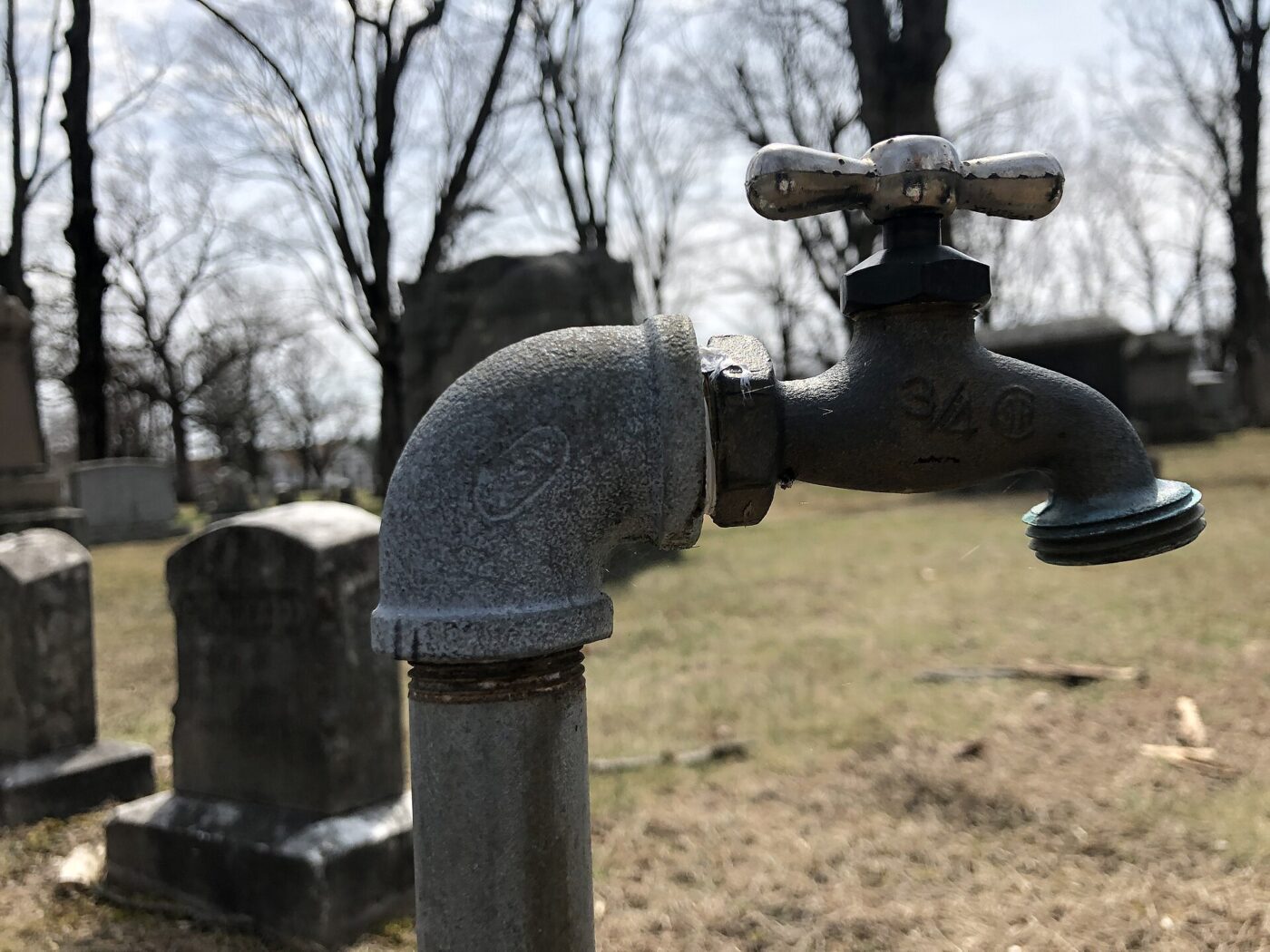
Amazon returns ten completions for outdoor faucet cover; apart from the phrase itself, the top three all add winter or freeze protection. The product behind that demand is a foam dome or sock that slips over the spigot and cinches to the siding. It costs little, fits in a minute, and is the smallest of three things that decide whether your spigot survives a cold snap.
Nothing here was installed, frozen or tried out. What follows reads the faucet makers’ own catalog sheets, an extension engineer’s calculations on insulation and flow, NWS freeze criteria, and our pull of the CPSC recall database on October 7, 2026.
Trend Signal
64/100 Steady momentum
- Emerging
- Rising
- Mainstream
- Peaking
- Cooling
Seasonal demand opens in October while the failure it prevents is mostly self-inflicted
Amazon returns ten completions for outdoor faucet cover, and apart from the phrase itself the top three all qualify it with winter or freeze protection. ISO data published by the Insurance Information Institute puts water damage and freezing at 1.6 percent of insured homes over 2018-2022, averaging $15,400 a claim over 2019-2023.
Our editorial reading of the cited data, not a forecast. How it is scored
By the numbers
- 1.6%Insured US homes with a water damage and freezing loss, 2018-2022Insurance Information Institute
- 2.9 hoursInsulated half-inch copper at 5 degrees F freezing solid with no flowClemson Extension
- $15,400Average water damage and freezing claim paid, 2019-2023Insurance Information Institute
- 3.2 millionExpandable hoses recalled July 2025 after 222 reports of burstingCPSC
A cover is insulation, and insulation only buys time
A faucet cover is closed-cell foam, sometimes inside a hard dome, held to the siding by a cord or magnet. No heater, no thermostat. It slows heat leaving the faucet — a different job from the air sealing that stops cold air crossing the wall.
Clemson Cooperative Extension factsheet HGIC 2369, published March 3, 2026 by agricultural engineer W. Bryan Smith, prices that slowdown in tables calculated from D. G. Stevenson’s published equations rather than measured on a faucet. For 20 feet of exposed half-inch copper in a 5 mph wind, with water entering at 55 degrees F, the flow needed to prevent freezing at 5 degrees F is 2.42 gallons per hour bare and 0.57 with half an inch of insulation. Galvanized pipe goes from 3.01 to 0.68.
With no flow and that same half inch of insulation, the copper freezes solid 2.9 hours after the water reaches 32 degrees F; PVC takes 4.1 hours. A cover buys hours: right for an overnight dip, wrong for a three-day freeze. Smith also warns an outside faucet can freeze at the outlet and block the drip you relied on.
What actually bursts, and why you find out in spring
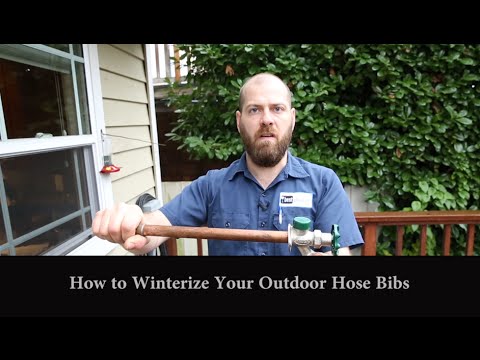
Woodford Manufacturing publishes a one-page document, Form works.104, on how a frost-proof faucet works. The shutoff seat sits several inches inside the heated wall, so, in its words, “The product cannot freeze because there is no water in the faucet.” Close the handle and everything in front of the seat drains by gravity, provided the faucet was pitched slightly downward and nothing blocks the nozzle.
Block the nozzle and the protection inverts. Woodford gives the sequence as hose attached, freezing begins, pressure builds, tube integrity lost, and states in capitals that the only possible cause of a burst tube is an obstruction such as a hose left on in freezing conditions, or an installation that prevents draining. Its wall flange is printed REMOVE HOSE OR FAUCET MAY FREEZE AND BURST.
Because the split is downstream of the seat, Woodford notes that “Only a few drops of water will leak through this bulge at the time of the bursting,” and that considerable time can pass between rupture and discovery. That is what a water leak detector inside that wall is good at catching.
Iowa State University Extension and Outreach, in an archived page by Shawn Shouse, says it plainly: “Connected hoses can trap water and cause freezing even in faucets designed to be freeze-proof.” IBHS adds who owns which faucet: homes built before 2010 typically do not have frost-proof ones, so their valves should be shut off and the faucets insulated.
Three jobs, and the cover is the third
IBHS lists the order in its Winter Ready guidance: shut down pool and irrigation systems, remove hoses attached to the house and drain and store them, then shut off the valves and insulate. If the yard runs on drip irrigation, line one comes first.
| Step | What it needs | What it still does not fix |
|---|---|---|
| Unscrew the hose, drain it, store it | A few minutes | A splitter or timer left threaded on, which also blocks draining |
| Close the indoor stop valve, bleed the spigot | A stop valve on that branch | Branches with no stop valve, or water in a low spot |
| Fit an insulated cover | Depth to clear the spigot, a seal to the siding | A multi-day freeze, or a faucet blocked by a hose |
| Replace with a frost-free sillcock | Stem matched to wall thickness, downward pitch | An installation set level or uphill, which traps water |
| Run a self-regulating heating cable | A grounded outdoor outlet, the wrapping rules | A power outage, which IBHS names as a cause of freezing |
If the hose is still on the spigot in December, the cover over it is decoration.
The marking on the sillcock box is ASSE 1019, and the length matters more
Replacing the faucet is the permanent fix. Woodford lists its Model 17 and Model 19 freezeless anti-siphon wall faucets as ASSE 1019 – Type C Listed, each with an integral backflow device rated to 125 psi of backpressure, so no add-on vacuum breaker is needed. Both sheets cap the device at 120 degrees F and bar more than 12 hours of continuous pressure.
Length is the specification buyers get wrong. The Model 17 sheet lists wall thicknesses from 4 to 24 inches in 2-inch steps. The long stem puts the seat in heated space; order one too short and the shutoff sits in the cold cavity, where nothing drains.
One published feature forgives that mistake. The Model 19 sheet describes a “Patented resetting pressure relief valve” that “prevents the faucet tube from bursting in freezing conditions even if a hose is unintentionally left on.” Model 19 also requires the inlet in a heated area, a downward pitch, and the house-to-faucet gap sealed against air leaks — the same job as sealing the exterior.
Match the stem to the wall thickness first, then decide whether you need the pressure-relief version.
What the claim file and the recall file show
The loss this category prevents is narrower than the marketing implies. ISO data published by the Insurance Information Institute shows that across 2018-2022, 5.8 percent of insured homes had any claim: wind and hail 2.8 percent, water damage and freezing 1.6 percent. Over 2019-2023 that category averaged $15,400 a claim.
The safety record is thin in both directions. We downloaded the full CPSC recall file on October 7, 2026: 10,039 records, the most recent dated October 1, 2026. None names a faucet cover, hose bib, sillcock, wall hydrant, heat tape or heating cable, and 16 CFR chapter II, the list of CPSC safety standards, covers none of them. An empty recall file says what has failed, not what is safe.
The one adjacent recall is the hose. On July 24, 2025, Winston Products recalled HydroTech expandable hoses sold as burst-proof, recall 25-394; the CPSC page as updated January 9, 2026 puts it at about 3.2 million units. CPSC states that “The recalled hoses can burst, posing an impact hazard and a risk of temporarily impaired hearing,” and records at least 222 reports of bursting with 29 injuries. The date code sits on the end that screws onto the spigot.
Timing is local, and the National Weather Service publishes it. Its Tallahassee office issues a freeze warning at a forecast 32 degrees or lower for at least two hours and calls 25 degrees a hard freeze, noting that definition varies by office. Its 1991-2020 normals put the average first freeze at the Tallahassee airport on November 25.
What to watch next
- The CPSC recall database at saferproducts.gov: a first recall naming a faucet cover or a pipe heating cable would be this aisle’s first enforcement-grade signal
- Your own NWS office page for the local first-freeze normal and the hard freeze threshold it uses, set office by office
- Whether a quoted sillcock is listed to ASSE 1019 and its stem matches your wall thickness
Where to start
Paid links: we earn a commission if you buy through the buttons below, at no extra cost to you. As an Amazon Associate I earn from qualifying purchases.
Outdoor faucet freeze protection compared on what each type actually does
| Product type | Good fit for | Where to look |
|---|---|---|
| Insulated outdoor faucet cover | Fits a spigot you can still drain | See listings on AmazonOpens Amazon search results, not one listing: check the model on the product page. |
| Frost-free anti-siphon sillcock | Fits a wall with no interior stop valve | See listings on AmazonOpens Amazon search results, not one listing: check the model on the product page. |
| Self-regulating pipe heating cable | Fits an exposed run the cover cannot reach | See listings on AmazonOpens Amazon search results, not one listing: check the model on the product page. |
Product types that fit the trend described above, not tested models. Check the exact listing before you buy. How we pick them.
Insulated outdoor faucet cover
Where to look: Amazon
For a spigot you have already drained, where freezes are overnight events. Measure from the siding to the handle first: a cover that will not seat flat leaves a gap.
- Fits in a minute with no tools
- Keeps ice off the nozzle so a drip keeps moving
- Cheapest layer in the sequence
- Adds no heat at all
- Insulated half-inch copper still freezes solid in 2.9 hours with no flow
- Useless over an attached hose
Frost-free anti-siphon sillcock
Where to look: Amazon
Removes the problem rather than insulating it. Woodford publishes wall thicknesses from 4 to 24 inches for its Model 17, and a resetting pressure relief valve on the Model 19.
- Shutoff seat sits inside the heated wall
- Woodford’s ASSE 1019 models carry backflow protection to 125 psi
- Relief-valve models tolerate a hose left on
- Needs the stem matched to the wall
- Must be pitched downward or it traps water
- Replacement is plumbing work, not a seasonal chore
Self-regulating pipe heating cable
Where to look: Amazon
For crawl space or above-ground pipe feeding the spigot, where exposed length runs to feet. Follow the wrapping instructions exactly.
- Adds heat instead of only slowing its loss
- Self-regulating types cut output as the pipe warms
- Reaches pipe a dome cannot
- Dead during the outage that causes many freezes
- Iowa State warns against double wrapping or running it over or under insulation unless the maker allows
- Needs a grounded outdoor outlet
More: Home Improvement trends and how the Trend Signal is scored.
Sources
- Facts + Statistics: Homeowners and renters insurance — Insurance Information Institute
- Winter Ready Home — Insurance Institute for Business and Home Safety
- Preventing Pipe Freezing by Flowing Water, HGIC 2369 — Clemson Extension
- Protecting Water From Freezing — Iowa State University Extension
- How a Standard Frost-Proof Faucet Works — Woodford Manufacturing
- Model 19 freezeless anti-siphon wall faucet — Woodford Manufacturing
- Model 17 freezeless anti-siphon wall faucet — Woodford Manufacturing
- Winston Products recalls HydroTech expandable hoses — CPSC
- Frost and Freeze Information — National Weather Service Tallahassee
- Title 16, Chapter II, CPSC regulations — eCFR
Questions readers ask
Will an outdoor faucet cover stop a pipe from bursting?
Not on its own. Clemson Extension factsheet HGIC 2369 calculates that half an inch of insulation on half-inch copper at 5 degrees F cuts the flow needed to prevent freezing from 2.42 to 0.57 gallons per hour, and that with no flow it still freezes solid in 2.9 hours.
Do I still need a cover if I have a frost-free faucet?
A correctly installed, unobstructed one drains itself, because the seat sits inside the heated wall; Woodford states it cannot freeze when closed because no water is left in it. A cover is cheap insurance against an installation that was never pitched downward.
What happens if I leave the hose on all winter?
Woodford Form works.104 names an obstruction such as a hose left on in freezing conditions as one of only two possible causes of a burst faucet tube. The split lands behind the shutoff, so few drops escape at the time and the leak shows up when the valve is next opened.
Are outdoor faucet covers regulated or ever recalled?
Our pull of the CPSC recall file on October 7, 2026, covering 10,039 records through October 1, 2026, found no record naming a faucet cover, hose bib, sillcock, wall hydrant, heat tape or heating cable, and no CPSC safety standard in 16 CFR chapter II covers one.