Cabinets are the most expensive thing in a typical kitchen remodel and the one most likely to be imported, which is why a trade action written about timber ended up reshaping a renovation budget. Under a proclamation issued under Section 232 of the Trade Expansion Act of 1962, which took effect on October 14, 2025, imports of kitchen cabinets and vanities, including parts, carry a 25% ad valorem duty, upholstered wooden products carry 25% and softwood timber and lumber carry 10%.
The text also set an escalation: from January 1, 2026 the cabinet and vanity rate was to rise to 50% and the upholstered rate to 30%. That did not happen. A proclamation signed on December 31, 2025 delayed both increases by a year, to January 1, 2027, on the stated ground that trade negotiations were progressing and a delay would make them more productive. For anyone planning a kitchen, that turned 2026 into a defined window rather than a cliff.
Trend Signal
62/100 Steady momentum
- Emerging
- Rising
- Mainstream
- Peaking
- Cooling
Duties are steady at 25% for 2026 and scheduled to double a year later
A proclamation signed December 31, 2025 delayed the increase on kitchen cabinets and vanities from 25% to 50% by one year, and MasterBrand told investors gross tariff costs would run about 5% to 6% of its full-year 2026 net sales.
Our editorial reading of the cited data, not a forecast. How it is scored
By the numbers
- 25%Section 232 duty on imported kitchen cabinets and vanities through 2026White House
- 50%Rate the cabinet and vanity duty is now scheduled to reach, delayed by one yearFederal Register
- 5% to 6%Gross 2026 tariff cost MasterBrand expects, as a share of full-year net salesMasterBrand via SEC
- +4.3%Producer prices, wood kitchen cabinet and countertop manufacturing, Aug 2025 to Aug 2026Bureau of Labor Statistics
The tariff schedule in plain numbers
Proclamation 10976 of September 29, 2025, issued under Section 232 of the Trade Expansion Act of 1962, set three rates, effective October 14, 2025: 10% on softwood timber and lumber, 25% on upholstered wooden products and 25% on kitchen cabinets and vanities including parts. It also wrote in an increase, stating that effective January 1, 2026 the upholstered rate would rise to 30% and the cabinet and vanity rate to 50%, and it capped the combined rate for some trading partners, with the United Kingdom at a maximum of 10% and the European Union and Japan limited so that the tariff plus the standard duty rate does not exceed 15%.
The December 31, 2025 proclamation changed the calendar rather than the rates. It delayed the increases for an additional year, so upholstered wooden products stay at 25% and cabinets and vanities stay at 25% until January 1, 2027, when the scheduled 30% and 50% take effect unless something changes again.
That is the whole mechanism, and it is worth stating plainly because the reporting around it has not been consistent. Through 2026, an imported cabinet or vanity carries 25%, not 50%. These are Section 232 duties, which rest on a different statute from the emergency-powers tariffs the Supreme Court struck down on February 20, 2026, and they were not part of that case.
| Product | From October 14, 2025 | Scheduled next step |
|---|---|---|
| Softwood timber and lumber | 10% | No increase in the proclamation |
| Kitchen cabinets and vanities | 25% | 50%, delayed to January 1, 2027 |
| Upholstered wooden products | 25% | 30%, delayed to January 1, 2027 |
For 2026 the number is 25%. The 50% headline is a scheduled step, not a current rate.
What producer prices show so far
The domestic price indexes have moved less than the rate suggests, for a structural reason: producer price indexes measure what US producers charge, and a tariff falls on imports. The BLS industry index for wood kitchen cabinet and countertop manufacturing was 272.500 in January 2025, 276.047 in August 2025 and 288.048 in August 2026, an increase of 4.3% over 12 months and 5.7% since the start of 2025.
The narrower commodity index for stock wood kitchen cabinets, related cabinetwork and countertops barely moved at all: 122.158 in January 2025, 122.947 in August 2025 and 123.140 in August 2026, a 0.2% change over the year. Domestic stock cabinets are the part of the market least exposed to the duty, and the data behave accordingly.
Neither index captures what an importer pays. That shows up instead in company disclosures, which is where the size of the effect becomes visible.
Demand is falling while cost is rising
MasterBrand, which describes itself as the largest residential cabinet manufacturer in North America, reported second-quarter 2026 net sales of $815.2 million, including $125.5 million from its all-stock merger with American Woodmark. Stripping that out, legacy sales fell 5.6% to $689.7 million from $730.9 million a year earlier. The company described a mid- to high-single-digit market decline, in line with its own outlook, and said it expects its addressable market to decline by mid-single digits across full-year 2026.
On tariffs, the company told investors it expects gross tariff costs of roughly 5% to 6% of full-year 2026 net sales, and that it expects those to be fully offset on a dollar-for-dollar run-rate basis by the end of the year. It also flagged what it called the dynamic nature of tariffs and the uncertainty of implementation as limits on forecasting.
That combination, a shrinking market and a cost being recovered through price, is the unusual part. In most categories a soft market means discounting. Here the largest supplier is consolidating, absorbing a competitor and raising prices into falling demand.
Cabinet buyers in 2026 are shopping a market that is smaller and more expensive at the same time.
The cheaper paths through a kitchen
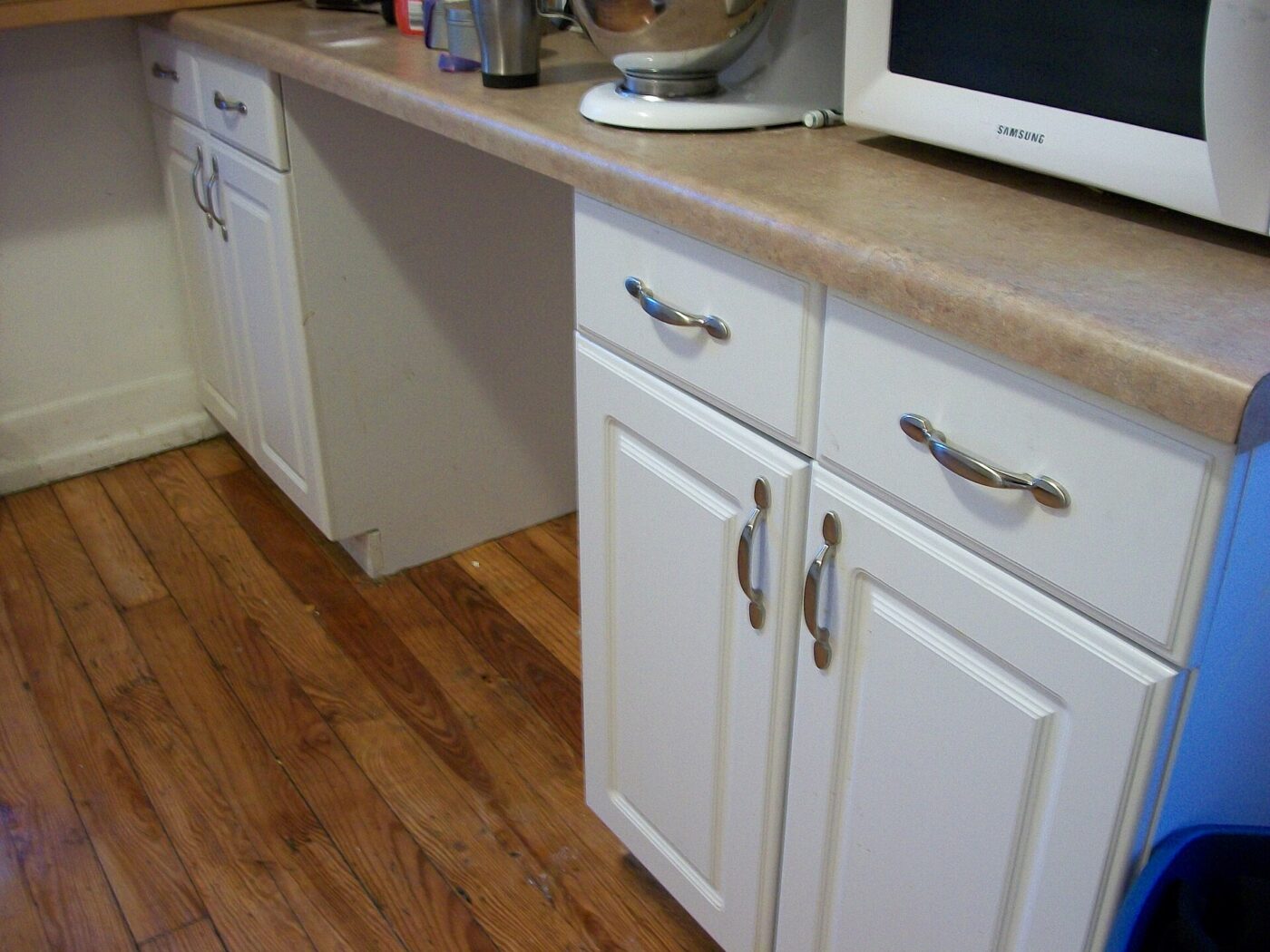
When boxes get more expensive, the parts of a kitchen that are not boxes get more attention. Refinishing or repainting existing doors and frames, refacing with veneer over sound carcasses, and replacing only the hardware are all ways to change how a kitchen looks without buying cabinets subject to a duty at all.
They are not equivalent jobs. Painting is the cheapest and the most sensitive to preparation, because cabinet faces are usually coated in something designed not to accept a new finish. Refacing keeps the carcass and replaces the visible surfaces, so it depends on the existing boxes being square and solid. Hardware is the smallest change and the one most likely to be done in an afternoon, provided the new pulls match the existing hole spacing.
The duty schedule gives that decision a calendar. Anyone weighing a full cabinet replacement against a surface update is choosing inside a 2026 window in which the rate on imported cabinets and vanities is 25%, with a scheduled step to 50% after it.
- Repaint: cheapest, and only as good as the degreasing and priming underneath
- Reface: keeps the boxes, replaces doors, drawer fronts and visible surfaces
- Rehardware: fastest change, but measure the existing hole spacing first
- Replace: the option the duty schedule prices, and the one with a deadline attached
Who should order now and who should wait
If a full replacement is already planned and the cabinets are imported, 2026 is the cheaper side of the scheduled step, and the supplier is the only party who can tell you whether a given line is imported at all. Domestic stock cabinets, judged by the commodity index that covers them, have seen almost no price movement, so the urgency is specific to imported product rather than general.
If the kitchen mainly needs to look different, the surface options are outside the tariff question entirely and can wait for whenever the time is right. We read the evidence as a market where the pressure is concentrated on imported boxes, not on kitchens as a whole, and where the announced calendar has already slipped once.
What to watch next
- Whether the scheduled increase on cabinets and vanities is delayed again or takes effect as written
- MasterBrand’s quarterly results, for whether tariff costs stay fully offset by pricing and whether the market decline deepens
- The BLS producer indexes for wood kitchen cabinet manufacturing and for stock wood cabinets, which have been moving at very different speeds
Where to start
Paid links: we earn a commission if you buy through the buttons below, at no extra cost to you. As an Amazon Associate I earn from qualifying purchases.
Ways to change a kitchen without buying new boxes
| Product type | Good fit for | Where to look |
|---|---|---|
| Cabinet paint and primer kit | Fits a low-cost refresh | See listings on AmazonOpens Amazon search results, not one listing: check the model on the product page. |
| Cabinet pulls and knobs multipack | Fits a one-afternoon update | See listings on AmazonOpens Amazon search results, not one listing: check the model on the product page. |
| Peel-and-stick cabinet refacing veneer | Fits sound boxes with tired faces | See listings on AmazonOpens Amazon search results, not one listing: check the model on the product page. |
Product types that fit the trend described above, not tested models. Check the exact listing before you buy. How we pick them.
Cabinet paint and primer kit
Where to look: Amazon
The cheapest way to avoid buying tariffed boxes. Cabinet faces are usually finished in something that resists new coatings, so the degreasing and priming steps are the job.
- Lowest material cost
- Changes the look completely
- Preparation decides the result
- Doors are out of service for days
Cabinet pulls and knobs multipack
Where to look: Amazon
The smallest possible intervention and the only one you can undo. Measure center to center on an existing pull before ordering, or plan to fill and redrill.
- No finish work
- Reversible if you change your mind
- Only changes the details
- Hole spacing has to match
Peel-and-stick cabinet refacing veneer
Where to look: Amazon
A middle path between paint and replacement. It only works when the boxes themselves are in good condition, since everything visible is being resurfaced over what is already there.
- Keeps the existing carcasses
- No cabinet duty involved
- Needs square, solid boxes
- Edges and corners show mistakes
More: Home Improvement trends and how the Trend Signal is scored.
Sources
- Adjusting Imports of Timber, Lumber and Their Derivative Products — The White House
- Proclamation 11000 of December 31, 2025, amendments on timber and lumber — Federal Register via GPO
- MasterBrand second quarter 2026 results — MasterBrand via SEC EDGAR
- PPI industry data, wood kitchen cabinet and countertop manufacturing — Bureau of Labor Statistics
- PPI commodity data, stock wood kitchen cabinets and countertops — Bureau of Labor Statistics
- Learning Resources, Inc. v. Trump, No. 24–1287, decided February 20, 2026 — Supreme Court of the United States
Questions readers ask
What is the tariff on imported kitchen cabinets in 2026?
It is 25%, under Section 232 of the Trade Expansion Act of 1962. The proclamation effective October 14, 2025 set a 25% ad valorem duty on imported kitchen cabinets and vanities including parts, and a proclamation signed December 31, 2025 delayed the scheduled increase to 50% by one year.
Does the tariff apply to bathroom vanities as well?
Yes. The proclamation treats kitchen cabinets and vanities as one category, with the same 25% rate from October 14, 2025 and the same scheduled step to 50% after the one-year delay.
Have cabinet prices actually gone up?
Domestic producer prices have risen modestly. The BLS industry index for wood kitchen cabinet and countertop manufacturing rose 4.3% between August 2025 and August 2026, while the narrower commodity index for stock wood kitchen cabinets moved 0.2%. Producer indexes measure US producers, so the duty on imports is visible mainly in company disclosures: MasterBrand expects gross tariff costs of about 5% to 6% of full-year 2026 net sales.
Is refacing cheaper than replacing cabinets under the tariff?
Refacing avoids buying new boxes, which is the part the duty applies to, but it is only viable when the existing carcasses are square and solid. It replaces doors, drawer fronts and visible surfaces while keeping the structure, so the comparison depends on the condition of what you already have rather than on the tariff alone.