Showerheads spent 2025 and 2026 in the odd position of being heavily discussed and barely changed. A final rule published in the Federal Register on April 15, 2025 repealed the Department of Energy’s regulatory definition of showerhead at 10 CFR 430.2, and from May 15, 2025 the statutory definition in the 1992 energy law controls instead. DOE described the effect as restoring a simple 2.5-gallons-per-minute standard, and said the earlier definition had made multi-nozzle showers illegal if they collectively discharged more than 2.5 gallons per minute.
What that leaves is a narrower change than the coverage suggested: a fixture with several nozzles is treated differently, while the number written into federal law stayed where it was. For someone standing in front of a shelf of showerheads, the practical questions are what the printed gpm means, whether the WaterSense label is worth paying for, and why the price of plumbing trim went up while the rule was being loosened.
Trend Signal
52/100 Steady momentum
- Emerging
- Rising
- Mainstream
- Peaking
- Cooling
The federal definition changed, the 2.5 gallon limit did not, and prices rose anyway
The Department of Energy repealed its regulatory definition of showerhead effective May 15, 2025, leaving the statutory standard in place, while producer prices for plumbing fixture fittings and trim rose 5.1% between August 2025 and August 2026.
Our editorial reading of the cited data, not a forecast. How it is scored
By the numbers
- 2.5 gpmFederal showerhead standard from the 1992 energy law, as DOE describes itU.S. Department of Energy
- May 15, 2025Date the repeal of the regulatory showerhead definition took effectFederal Register
- 2,700 galWater an average family can save a year with a WaterSense showerhead, per EPAEPA WaterSense
- +5.1%Producer prices for plumbing fixture fittings and trim, August 2025 to August 2026Bureau of Labor Statistics
What changed in the federal rule
The document to read is short. Published on April 15, 2025 and effective May 15, 2025, it repeals the definition of showerhead in 10 CFR 430.2 and states that from that date the statutory definition of showerhead in 42 U.S.C. 6291(31)(D) will control. The Department of Energy’s own description says the action restores the definition established in the 1992 energy law, which sets a simple 2.5-gallons-per-minute standard for showers.
The substance of the change is in how a fixture with more than one outlet is counted. DOE says the earlier regulation made multi-nozzle showers illegal if they collectively discharged over 2.5 gallons of water per minute. Repealing the regulatory definition removes that aggregation rule from the code of federal regulations.
Legislation has followed. On January 13, 2026 the House passed the Shower Act, 226 to 197, to write the looser treatment of multi-nozzle fixtures into statute; the Associated Press reported at the time that its prospects in the Senate were uncertain. A bill that has passed one chamber is not a rule a manufacturer can build to.
The definition of the fixture changed. The 2.5 gallons per minute written into federal law did not.
What did not change
The 2.5-gallons-per-minute figure comes from statute rather than from the regulation that was repealed. DOE calls it the standard the 1992 energy law set, and EPA tells shoppers that standard showerheads use 2.5 gallons per minute. A showerhead sold as a single fixture is still built to that ceiling, which is why the vast majority of what is on the shelf looks exactly as it did in 2024.
The voluntary tier also stayed put. A WaterSense labeled showerhead must use no more than 2.0 gpm, and EPA says the average family could save 2,700 gallons of water per year and more than 330 kilowatt hours of electricity annually by switching. Earning the label is not only a flow test: EPA says certified models must demonstrate spray force, spray coverage and pressure compensation across varying household water pressures.
That last point is the one worth carrying into a store. The complaint people describe as low pressure is usually a complaint about spray force and coverage, and the label is the only widely available third-party check on those two attributes rather than on flow alone.
Prices moved even though the rule did not
While the regulatory argument ran, the price of plumbing trim kept climbing. The BLS producer price index for plumbing fixture fittings and trim was 394.728 in January 2023, 431.266 in August 2025 and 453.198 in August 2026. That is a 5.1% increase over the most recent 12 months and 14.8% since the start of 2023, on our arithmetic.
None of that increase is attributable to the showerhead rule, and nothing in the index isolates showerheads from faucets and other trim. It is a useful reminder all the same: the cost pressure in this aisle is coming from metal, manufacturing and freight, not from how many gallons a fixture is allowed to pass.
For a buyer, that means the choice between a 2.5 gpm fixture and a 2.0 gpm WaterSense model is not a trade of money against performance in any reliable way. Both tiers exist at most price points, and the spread within a tier is far wider than the spread between tiers.
| Tier | Maximum flow | What it is |
|---|---|---|
| Federal standard | 2.5 gpm | The statutory standard DOE traces to the 1992 energy law |
| WaterSense label | 2.0 gpm | Voluntary EPA label, also tested for spray force and coverage |
| State standards | Varies | Some states set their own standards for fixtures sold there |
Where state rules come in
Federal action does not clear the field. States run their own appliance and fixture efficiency programs, and those rules sit on top of the federal floor for products sold in the state. Colorado is a current example: HB23-1161, signed by the governor on June 1, 2023, updates standards for a list of new appliances and fixtures that includes showerheads, urinals, water closets and certain faucets.
Our read is that a model sold nationally may be built to whichever state rule is tightest rather than to the federal one, because manufacturers prefer a single stock-keeping unit. This is also the part a shopper can check directly, because the flow rate is printed on the fixture and on the box.
Read the printed gpm on the box; it is the only number that travels with the product.
How to choose one in 2026
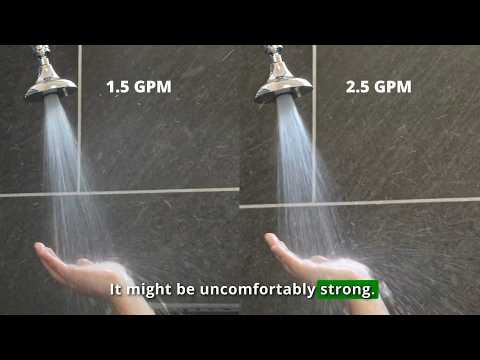
Decide first whether you want the label. A WaterSense model caps flow at 2.0 gpm and has been tested for spray force, spray coverage and pressure compensation, which is the closest thing to an independent check that a lower-flow head still feels like a shower. A standard 2.5 gpm head is legal everywhere under the federal ceiling and will move more water per minute.
Then match the format to the plumbing you already have. A fixed head swaps onto the existing arm in minutes; a handheld on a slide bar adds a hose, a bracket and usually a diverter, which is more parts to leak and more that has to fit the wall. Either way the flow rating is printed on the product, and that is the number to compare rather than a description of pressure.
- The gpm printed on the box, which is the figure regulators use
- Whether the model carries the WaterSense label, capped at 2.0 gpm
- Thread and arm compatibility, since replacing the arm turns a swap into a plumbing job
- Hose length and diverter type if you are buying a handheld
What to watch next
- Whether the Senate takes up the showerhead bill the House passed on January 13, 2026
- State appliance standards programs, which set the stricter rules that products sold nationally are often built to
- The BLS producer price index for plumbing fixture fittings and trim, for whether the 5.1% annual increase continues
Where to start
Paid links: we earn a commission if you buy through the buttons below, at no extra cost to you. As an Amazon Associate I earn from qualifying purchases.
Showerhead formats compared on flow, fit and what has to be installed
| Product type | Good fit for | Where to look |
|---|---|---|
| Fixed showerhead rated at the federal limit | Fits a straight swap | See listings on AmazonOpens Amazon search results, not one listing: check the model on the product page. |
| Handheld showerhead with slide bar | Fits shared or accessible bathrooms | See listings on AmazonOpens Amazon search results, not one listing: check the model on the product page. |
| WaterSense labeled showerhead | Fits households cutting water use | See listings on AmazonOpens Amazon search results, not one listing: check the model on the product page. |
Product types that fit the trend described above, not tested models. Check the exact listing before you buy. How we pick them.
Fixed showerhead rated at the federal limit
Where to look: Amazon
The simplest replacement there is. Federal law sets 2.5 gpm as the ceiling, which DOE traces to the 1992 energy statute, so this tier is the ceiling rather than an upgrade.
- Installs on the existing arm
- Moves the most water per minute
- Higher water and heating use
- Some states set their own standards
WaterSense labeled showerhead
Where to look: Amazon
EPA says a WaterSense model can save an average family 2,700 gallons and more than 330 kilowatt hours a year, and that certification tests spray force, coverage and pressure compensation, not only flow.
- Capped at 2.0 gpm
- Tested for spray force and coverage
- Less water per minute
- Label adds no pressure guarantee
Handheld showerhead with slide bar
Where to look: Amazon
A handheld adds function and parts at the same time. Check the hose length and the bracket mounting before assuming it is a drop-in swap.
- Useful for cleaning and bathing
- Slide bar suits different heights
- More joints that can leak
- Needs a diverter and wall bracket
More: Home Improvement trends and how the Trend Signal is scored.
Sources
- Repeal of the Definition of Showerhead — Federal Register via GPO
- Energy Department repeals the legal definition of showerhead — U.S. Department of Energy
- Showerheads — EPA WaterSense
- PPI commodity data, plumbing fixture fittings and trim — Bureau of Labor Statistics
- House passes bill to codify Trump order on showerhead regulations — Associated Press via NBC News
- HB23-1161 Environmental Standards For Appliances — Colorado General Assembly
Questions readers ask
Are low-flow showerheads still required in 2026?
The federal ceiling still applies. DOE describes the 1992 energy law as setting a simple 2.5-gallons-per-minute standard for showers, and the April 2025 rule repealed the Department of Energy’s regulatory definition of showerhead rather than that limit. States also run their own appliance and fixture standards programs for products sold there.
What did the 2025 showerhead rule actually change?
It repealed the definition of showerhead at 10 CFR 430.2, effective May 15, 2025, so that the statutory definition controls. DOE said the previous regulation had made multi-nozzle showers illegal if they collectively discharged over 2.5 gallons per minute, and that the repeal restores the 1992 law’s 2.5-gallons-per-minute standard.
Is a WaterSense showerhead worth it?
It caps flow at 2.0 gpm rather than 2.5, and EPA says the average family could save 2,700 gallons of water and more than 330 kilowatt hours of electricity per year. EPA also requires labeled models to demonstrate spray force, spray coverage and pressure compensation in testing, which is more than a flow claim.
Did the rule change make showerheads cheaper?
No. The BLS producer price index for plumbing fixture fittings and trim rose from 431.266 in August 2025 to 453.198 in August 2026, a 5.1% increase, and is 14.8% above its January 2023 level. The index covers fittings and trim broadly, not showerheads alone.