A standard induction range needs a 240-volt outlet, and many kitchens that cook with gas do not have one. Canary Media reported in July 2024 that the electrical-service upgrades needed to add one can cost from $2,500 to “an eye-watering $40,000” when the utility has to upgrade nearby grid equipment. Battery induction ranges try to skip that step by charging from an ordinary 120-volt outlet and cooking from a built-in battery.
Two startups sell them. As of September 2026, Copper’s own site lists its Charlie range at $5,999 with a 5 kWh battery, and Impulse Labs lists its cooktop at $6,999 with a 3 kWh battery. Big public buyers are lining up volume purchases, but retail prices have not come down, and the federal credit that once cut them by 30% is gone for 2026 installs.
Trend Signal
40/100 Steady momentum
- Emerging
- Rising
- Mainstream
- Peaking
- Cooling
Real orders, few makers, prices near $6,000
New York’s power authority approved a $32 million contract with Copper on July 30, 2024, with 10,000 stoves to follow a successful pilot, but as of September 2026 Copper lists its range at $5,999 and Impulse its cooktop at $6,999.
Our editorial reading of the cited data, not a forecast. How it is scored
By the numbers
- $5,999Copper Charlie battery induction range, regular price, Sept. 2026 (5 kWh, 120 V, 12 A)Copper
- $6,999Impulse battery induction cooktop list price, Sept. 2026 (3 kWh battery)Impulse Labs
- 10,000Copper stoves New York plans to buy after a pilot; $32M contract approved July 30, 2024Heatmap
- $115MSix-year budget California regulators approved in Nov. 2025 for CalMTA programsCanary Media
Why put a battery in a stove
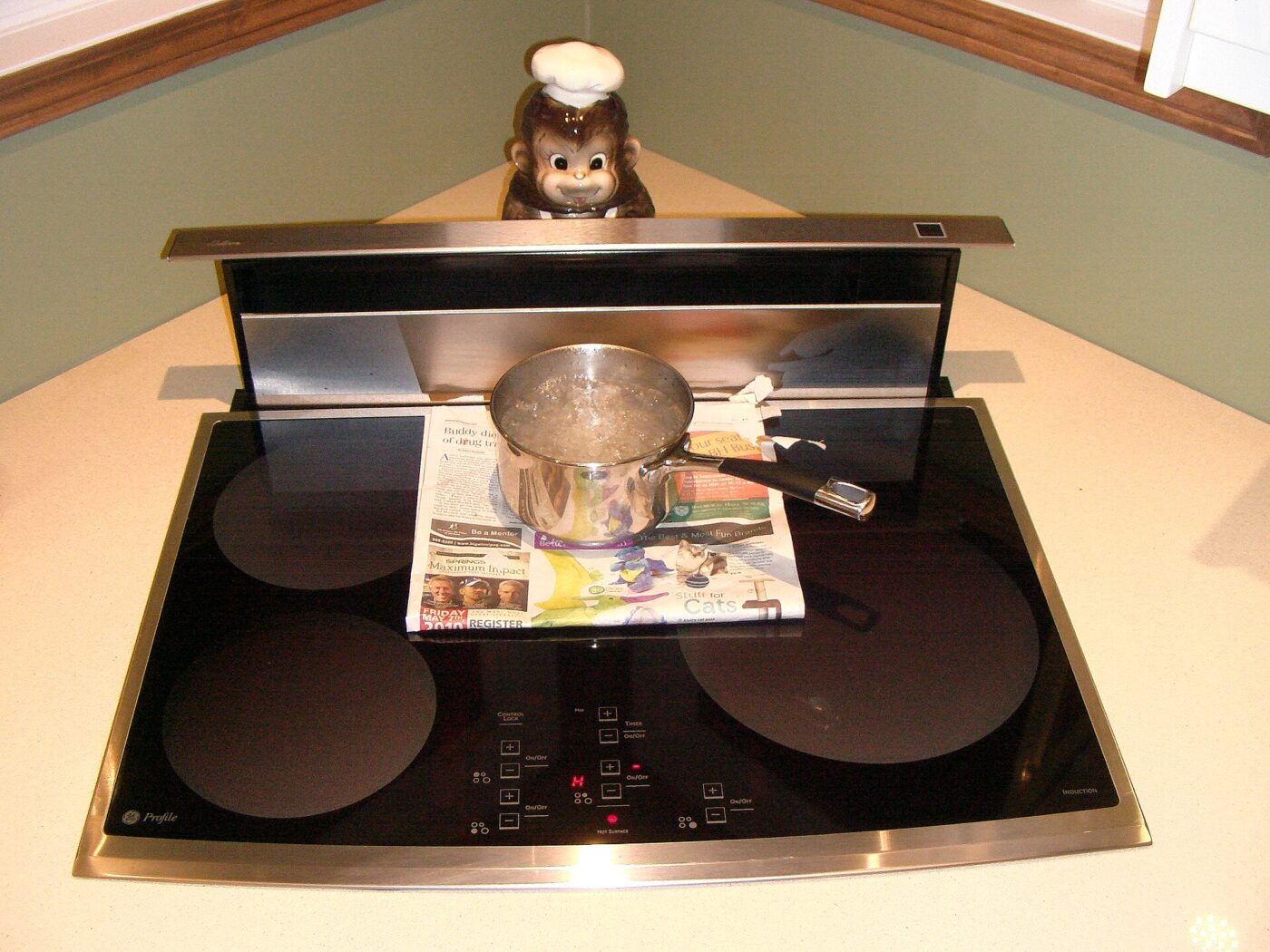
Induction heats the pan directly with a magnetic field, but several high-power burners running at once need more current than an ordinary 120-volt kitchen circuit can supply. Conventional induction ranges solve that with a 240-volt circuit. Battery ranges solve it by storing energy: Copper’s specifications list the Charlie at 12 amps and 120 volts from the wall, yet it offers four 2.8 kW cooking zones and a 4.55-cubic-foot oven.
Impulse pushes further on power. Its cooktop pairs a 3 kWh battery with “up to 10,000 watts of peak power per burner” and can run on a 120-volt, 15-amp circuit or a 240-volt circuit of 10 to 30 amps, according to the company, which says it boils water in under 40 seconds.
The payoff is avoided wiring work. Canary Media reported that more than 40 million U.S. households cook with gas, and each one that switches to a conventional induction range may face the panel and circuit upgrades described above.
The battery is there to replace a new 240-volt circuit, not to cut your power bill.
What they cost now
Prices have moved sideways to up. In July 2024 Canary Media reported Copper’s range at $5,999 before incentives, with Impulse at the same price, and both startups said the 30% federal credit for home batteries applied, bringing the price to $4,199. In December 2025 Canary put the two at about $6,000 and $7,000. In September 2026 Copper’s site lists $5,999 and Impulse’s lists $6,999.
That credit is gone. The IRS says the Residential Clean Energy Credit, which covered battery storage of at least 3 kWh, is not available for property placed in service after December 31, 2025. On a $5,999 range, the lost 30% equals about $1,800, by our calculation.
For scale, Canary called the 2024 price “steep” next to the best-reviewed conventional gas, electric and induction ranges. The battery models’ case rests on the wiring costs they avoid rather than on the sticker.
| Product | Battery | Power from the wall | Price, July 2024 | Price, Sept. 2026 |
|---|---|---|---|---|
| Copper Charlie range | 5 kWh | 120 V, 12 A | $5,999 | $5,999 |
| Impulse cooktop | 3 kWh | 120 V, 15 A or 240 V | $5,999 | $6,999 |
Who is buying them
Public housing is the anchor customer. Heatmap reported in October 2024 that the New York Power Authority’s board had approved a $32 million, seven-year contract award to Copper on July 30, 2024. A 100-stove pilot comes first; if it succeeds, the agencies will buy at least 10,000 stoves. NYPA expected the stove delivered for the program to cost below $3,000, and 12 other housing authorities with more than 300,000 units signed on to support the broader initiative.
California is building a market for the same kind of product. Canary Media reported in December 2025 that the California Public Utilities Commission had approved a plan to spend $115 million over six years through its California Market Transformation Administrator (CalMTA), aimed at plug-in heat pumps and 120-volt induction stoves, with and without batteries. Canary reported that CalMTA hopes to make affordable versions widely available by the end of the decade.
Retail demand is harder to measure. Canary reported in 2024 that Copper had sold “hundreds of units” and that Impulse had over 10,000 waitlist sign-ups; neither company publishes sales figures on the pages cited here.
Running costs: gas and power both rose
Switching fuels does not escape price increases. By our calculation from BLS index values, the consumer price index for electricity rose about 3.8% from August 2025 to August 2026, while the index for piped utility gas rose about 4.4%. EIA put the average U.S. residential electricity price at 18.34 cents per kWh in June 2026.
A battery range recharges from the wall like any appliance. Refilling Copper’s 5 kWh battery from empty at BLS’s August 2026 average of 19.6 cents per kWh would cost about $1, before charging losses, by our calculation.
A cheaper way to try induction first
For most households, a portable induction burner is the low-risk test. Single-burner units plug into a standard 120-volt outlet, so you can learn how induction cooks, and whether your pans work on it, before spending thousands. Cookware must be magnetic: if a magnet sticks firmly to the base, the pan will work.
Buy a battery range now if you want a full range, your kitchen lacks a 240-volt circuit and an electrician’s quote for adding one is high. Wait if price matters most: NYPA’s 2024 expectation of a program stove below $3,000 shows where volume buyers are pushing, and California’s program is designed to bring cheaper plug-in models to market.
What to watch next
- Results from New York’s 100-stove Copper pilot, which comes before the 10,000-unit order
- Product launches funded through California’s CalMTA plug-in appliance programs
- Whether Copper or Impulse cut list prices from $5,999 and $6,999
Where to start
Paid links: we earn a commission if you buy through the buttons below, at no extra cost to you. As an Amazon Associate I earn from qualifying purchases.
Induction starter gear compared
| Product type | Good fit for | Where to look |
|---|---|---|
| Portable induction cooktop (single burner) | Fits trying induction on one burner | See listings on AmazonOpens Amazon search results, not one listing: check the model on the product page. |
| Double-burner portable induction cooktop | Fits small kitchens without a range | See listings on AmazonOpens Amazon search results, not one listing: check the model on the product page. |
| Induction-ready cookware set | Fits pans that fail the magnet test | See listings on AmazonOpens Amazon search results, not one listing: check the model on the product page. |
Product types that fit the trend described above, not tested models. Check the exact listing before you buy. How we pick them.
Portable induction cooktop (single burner)
Where to look: Amazon
The cheapest way to learn induction before committing to a range. Check the wattage, the control steps and the minimum pan diameter the listing says it detects.
- Plugs into any 120-volt outlet
- Stores in a cabinet
- One pan at a time
- Less power than a full range
Double-burner portable induction cooktop
Where to look: Amazon
Closer to cooking a full meal. Because both zones draw from one outlet, check how the listing divides power when both are on.
- Two pans on one outlet
- Counter-top footprint
- Both burners share one circuit
- Wider than a single unit
Induction-ready cookware set
Where to look: Amazon
Aluminum, copper and glass pans without a magnetic base will not heat on induction. Test your pans with a magnet first and replace only the ones that fail.
- Works on any induction surface
- Also works on gas and electric
- Replaces pans you already own
- Quality varies by base
More: Energy and Sustainability trends and how the Trend Signal is scored.
Sources
- Charlie induction range product page — Copper
- The Impulse Cooktop — Impulse Labs
- Battery-powered induction stoves could be the future of clean cooking — Canary Media
- California plug-in heat pumps and induction stoves — Canary Media
- NYCHA induction stoves order with Copper — Heatmap
- Residential Clean Energy Credit — IRS
- CPI: Electricity in U.S. city average — U.S. Bureau of Labor Statistics
- CPI: Utility (piped) gas service in U.S. city average — U.S. Bureau of Labor Statistics
- Electric Power Monthly, Table 5.6.A — U.S. Energy Information Administration
- Average price: Electricity per kWh in U.S. city average — U.S. Bureau of Labor Statistics
Questions readers ask
How does a battery induction range work on 120 volts?
It charges a built-in battery from a standard outlet and draws on that stored energy to run high-power burners. Copper’s Charlie uses 12 amps at 120 volts, with a 5 kWh battery and four 2.8 kW cooking zones.
How much does a battery induction stove cost?
As of September 2026, Copper lists its Charlie range at $5,999 and Impulse lists its cooktop at $6,999. Canary Media reported in July 2024 that both were $5,999 before incentives.
Is there a tax credit for battery induction stoves in 2026?
Not the federal 25D credit that both startups said applied. The IRS says that credit, 30% for battery storage of at least 3 kWh, is not available for property placed in service after December 31, 2025. State or utility incentives may differ.
Do I need new pots for induction?
Only if yours are not magnetic. If a magnet sticks firmly to the bottom of a pan, it will work on induction; aluminum, copper and glass pans without a magnetic base will not.