For more than a decade, cursive was the part of elementary writing that quietly disappeared. State standards written around the Common Core in 2010 dropped it, and schools that kept it did so by choice. That is being reversed one statehouse at a time, and in 2026 Pennsylvania joined the list with a law that applies to public and private schools alike.
For parents the change is small in the school day and slightly awkward at home, because a generation of households has no handwriting materials in the drawer and no memory of which paper a third grader is supposed to use. The laws themselves are short and specific, the supporting research is narrower than the headlines suggest, and the products involved are the least glamorous items in the store.
Trend Signal
62/100 Steady momentum
- Emerging
- Rising
- Mainstream
- Peaking
- Cooling
Pennsylvania joined 18 other cursive states and the rule took effect in April 2026
Act 2 of 2026 became law in Pennsylvania on February 11, 2026, per its Senate sponsor, and took effect on April 12, 2026, per The 74, requiring cursive in the writing curriculum of public and private schools.
Our editorial reading of the cited data, not a forecast. How it is scored
By the numbers
- 18Other states the bill’s Senate sponsor said already require cursive instructionPennsylvania Senate
- Grades 1-6California grade range for cursive or joined italics under Assembly Bill 446California Legislature
- 19,700Handwriting practice kits recalled in February 2026 over lead in the pen nibsU.S. Consumer Product Safety Commission
- 36Participants in the 2024 EEG study comparing handwriting with typingFrontiers in Psychology
What the new state laws actually require

Pennsylvania’s version is Act 2 of 2026, which started as House Bill 17. Its Senate sponsor announced on February 11, 2026 that it had become law, and The 74 reports that it took effect on April 12, 2026, which is 60 days later. The two accounts of the effective date do not match: the sponsor’s release says the act took effect immediately, and we use the April 12 date the news coverage gives. The requirement itself is short. Cursive handwriting must be incorporated into the ongoing writing curriculum at public and private schools in the state, and the release does not name specific grades.
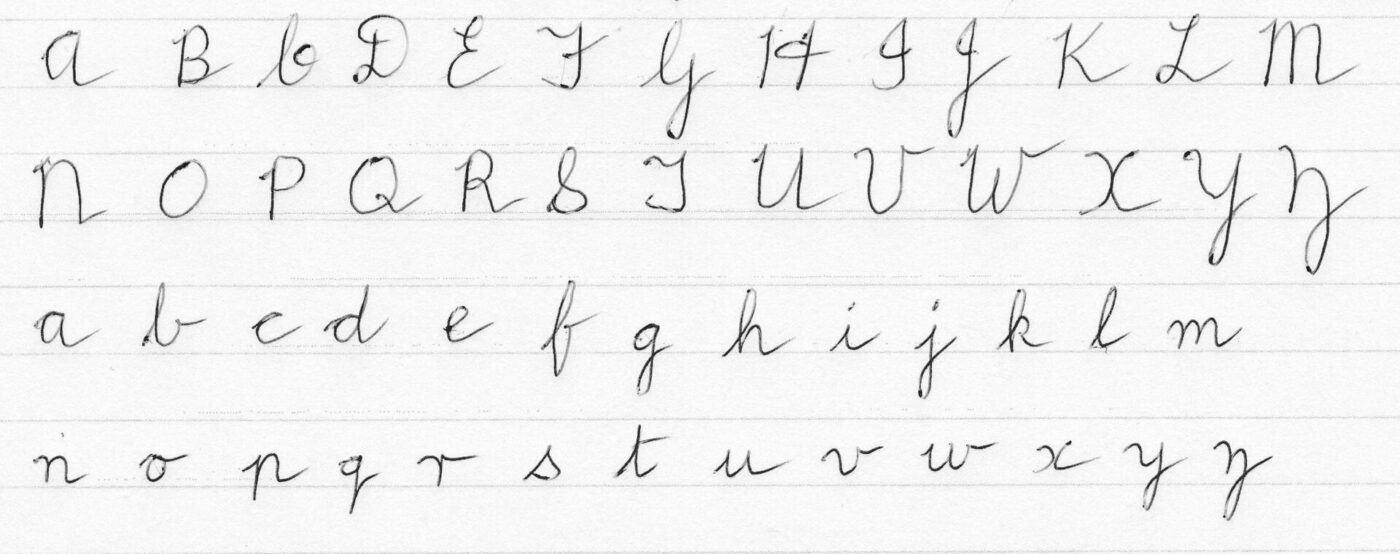
California got there first. Assembly Bill 446, chaptered as Chapter 804 on October 13, 2023, requires instruction in grades 1 through 6 to include handwriting, including cursive or joined italics in the appropriate grade levels. The wording is important for buyers: joined italics is a simplified connected script, so a workbook that teaches only traditional loops is not the only thing that satisfies the standard.
The counts vary by who is doing the counting, which is normal for curriculum mandates. The Senate sponsor’s release said Pennsylvania would join 18 other states requiring cursive; The 74 quotes one of the bill’s House sponsors saying at least 24 states have laws requiring cursive instruction. Either way, most states dropped the requirement after adopting Common Core standards in 2010, and the direction of travel since 2023 has been back toward it.
A cursive mandate is usually a line in a writing curriculum, not a separate subject with its own workbook list.
The research everyone cites, and what it does not cover
The study behind most of the coverage was published in Frontiers in Psychology on January 26, 2024 by F. R. Van der Weel and A. L. H. Van der Meer. Using a 256-channel EEG array, the researchers recorded brain activity while 36 university students wrote words by hand on a digital surface and typed the same words, and found widespread connectivity in theta and alpha bands during handwriting that did not appear during typing.
The authors conclude that children should be exposed to handwriting activities from an early age. That is a recommendation drawn from adult brain measurements in a laboratory, not a measurement of how well children spell, write or read after a year of cursive lessons. It is worth reading as one input rather than as proof that a workbook changes outcomes.
The arguments made in the statehouse were more mundane and easier to check. The 74 quotes the Pennsylvania sponsors on cognitive development, legal preparedness, reading historical sources in the original hand, and a cursive signature being harder to copy than a printed one.
What a cursive requirement changes in the supply cupboard
The classroom item that actually matters is paper. Handwriting instruction uses ruled paper with a dotted midline and a fixed rule height, which is not what a standard wide-ruled filler pack provides. Schools that dropped cursive a decade ago often no longer stock it, and the rule height a district uses in second grade is not the one it uses in fourth.
After paper, the list is short: a workbook that models each letter with numbered strokes and starting dots rather than a page of faint gray letters to trace, a pencil a child can actually hold, and something to stop the paper sliding. Grips and triangular pencil barrels exist for the same reason, and are cheap enough to try one of each.
One quiet advantage of a mandate is that materials are easy to find again. The workbook aisle has split into traditional loops, joined italics and the simplified continuous-stroke styles some districts prefer, and matching the school’s style matters more than the brand on the cover.
The recall that landed in the middle of the revival
On February 26, 2026 the Consumer Product Safety Commission announced a recall of about 19,700 children’s handwriting practice kits sold by TheKiddoSpace, covering both block-letter and cursive sets. Each kit shipped with reusable books, pens and colored pen grips, and was sold on Amazon.com and the company’s own store between February 2024 and February 2025 for $25 to $50.
The reason was not the paper or the books. CPSC said the pens in the kits contain levels of lead in the nib that exceed the federal lead content ban, and the remedy is free replacement pens and refills after buyers send photographic proof of disposal.
The lesson for a buyer is narrow and useful: the writing implement in an imported practice kit is a regulated children’s product, and a recall on one part does not always mean the whole kit is unusable. Checking the CPSC recall list for a brand before buying costs a minute, and it is one of the few checks a shopper can make on a marketplace listing without owning the product.
Who actually needs to buy something
Families in states with a new requirement are the obvious group, and mostly they need paper that matches the school’s rule height plus one workbook in the style the school teaches. Asking the teacher which style the district uses is faster than guessing from a cover, because a book in the wrong style teaches letter shapes a child will then have to unlearn.
Everyone else can wait. An older student who wants a legible signature is better served by 10 minutes of practice with an ordinary pen than by a boxed kit. If a household buys one thing on the strength of a mandate, make it the paper.
What to watch next
- Whether more states pass cursive requirements in their next sessions, and whether they specify grades the way California did.
- Guidance from state education departments on which handwriting style districts should teach, which decides what a matching workbook looks like.
- The CPSC recall list for imported handwriting and practice kits: by our count of the database on September 24, 2026, one seller drew ten separate notices on February 26, 2026.
Where to start
Paid links: we earn a commission if you buy through the buttons below, at no extra cost to you. As an Amazon Associate I earn from qualifying purchases.
Handwriting materials and what actually differs between them
| Product type | Good fit for | Where to look |
|---|---|---|
| Cursive handwriting workbook | Fits guided letter practice | See listings on AmazonOpens Amazon search results, not one listing: check the model on the product page. |
| Primary ruled handwriting paper | Fits school rule heights | See listings on AmazonOpens Amazon search results, not one listing: check the model on the product page. |
| Pencil grips for handwriting practice | Fits a shaky pencil grasp | See listings on AmazonOpens Amazon search results, not one listing: check the model on the product page. |
Product types that fit the trend described above, not tested models. Check the exact listing before you buy. How we pick them.
Cursive handwriting workbook
Where to look: Amazon
The one item worth matching to the school. California law calls for cursive or joined italics, so a workbook in the wrong style teaches letter shapes a child later has to unlearn.
- Models stroke order
- Cheap enough to replace
- Styles differ between districts
- Tracing pages get used up fast
Primary ruled handwriting paper
Where to look: Amazon
Ruled handwriting paper is the part most households lack, because standard filler paper has no midline. Check the rule height on a sheet the school already sent home before ordering a ream.
- Dotted midline guides letter size
- Works with any workbook
- Rule height changes by grade
- Not the same as wide-ruled filler paper
More: Education and Learning trends and how the Trend Signal is scored.
Sources
- Langerholc Cursive Handwriting Initiative Becomes Law — Pennsylvania Senate
- Cursive Handwriting Is Set for a Comeback in Pennsylvania Schools — The 74
- Assembly Bill 446, handwriting instruction — California Legislative Information
- Handwriting but not typewriting leads to widespread brain connectivity — Frontiers in Psychology
- TheKiddoSpace Recalls Children’s Handwriting Practice Kits — U.S. Consumer Product Safety Commission
Questions readers ask
Is cursive required in schools again?
In a growing number of states. Pennsylvania’s Act 2 of 2026 became law on February 11, 2026, according to its Senate sponsor, and took effect on April 12, 2026, according to The 74, requiring cursive in the writing curriculum of public and private schools. California has required handwriting instruction to include cursive or joined italics in grades 1 through 6 since Assembly Bill 446 was chaptered on October 13, 2023.
How many states require cursive instruction?
The counts disagree. Pennsylvania’s Senate sponsor said the state would join 18 others with a requirement, while The 74 quotes a House sponsor saying at least 24 states have laws on cursive instruction. Most states dropped the requirement after adopting Common Core standards from 2010.
Does handwriting help children learn?
The most cited recent study, published in Frontiers in Psychology on January 26, 2024, used EEG recordings from 36 university students and found widespread brain connectivity during handwriting that was absent during typing. Its authors recommend exposing children to handwriting early, but the study did not measure school outcomes for children.
What paper does cursive practice need?
Handwriting instruction uses ruled paper with a dotted midline and a set rule height rather than standard wide-ruled filler paper. Rule heights change by grade, so the practical test is to match a sheet the school has already sent home.
Are handwriting practice kits safe?
Check before buying. On February 26, 2026 the CPSC recalled about 19,700 TheKiddoSpace children’s handwriting practice kits sold on Amazon.com and the company store for $25 to $50, because the pens contained lead in the nib above the federal lead content limit.