
Collar hardware has quietly changed. An item tracker the size of a coin, a rechargeable GPS unit with a monthly fee, or both, now ride on collars that used to carry a rabies tag and a phone number. The marketing is about finding a pet; the systems underneath answer different questions, and only one of them answers the question a shelter asks.
The scale of that question is in the national shelter data. Shelter Animals Count, a data organization that collects intake and outcome figures from shelters and rescues across the United States, counted 5.8 million dogs and cats entering the system in 2025 in its annual data report for that year. Strays were 59% of intakes. Of the animals that came in, 638,000 were returned to owners, a 3% decrease from 2024, and among strays specifically 34% of dogs and 6% of cats went home.
Trend Signal
58/100 Steady momentum
- Emerging
- Rising
- Mainstream
- Peaking
- Cooling
Trackers are on collars everywhere while reunion numbers slipped
Shelter Animals Count reported 638,000 dogs and cats returned to owners in 2025, a 3% decrease from 2024, with 34% of stray dogs and 6% of stray cats in its data going home.
Our editorial reading of the cited data, not a forecast. How it is scored
By the numbers
- 5.8MDogs and cats entering U.S. shelters and rescues in 2025, a 2% decrease from 2024Shelter Animals Count
- 638,000Dogs and cats returned to owners in 2025, a 3% decrease from 2024Shelter Animals Count
- 34% vs 6%Share of stray dogs and stray cats returned to owners in 2025Shelter Animals Count
- 6 monthsMinimum age for a dog entering or returning to the United States under CDC rulesCenters for Disease Control and Prevention
What the shelter numbers show
The 2025 national figures from Shelter Animals Count describe a system that is slowly shrinking at the front door and holding steady at the back. Intakes fell 2% to 5.8 million, roughly 3 million cats and 2.8 million dogs, about 121,000 fewer animals than in 2024. Adoptions rose 1% to 4.2 million.
Reunions moved the other way. The 638,000 animals returned to owners in 2025 were 3% fewer than in 2024. Broken out, 19% of dog intakes ended in a return to the owner against 3% of cat intakes, and among strays the gap is starker still: 34% of dogs and 6% of cats. That gap is the most useful number in the dataset for an owner deciding what to buy, because it turns on whether an animal carries identification that survives being lost.
Two thirds of stray dogs, and almost all stray cats, do not get home from a shelter.
Three technologies, three different jobs
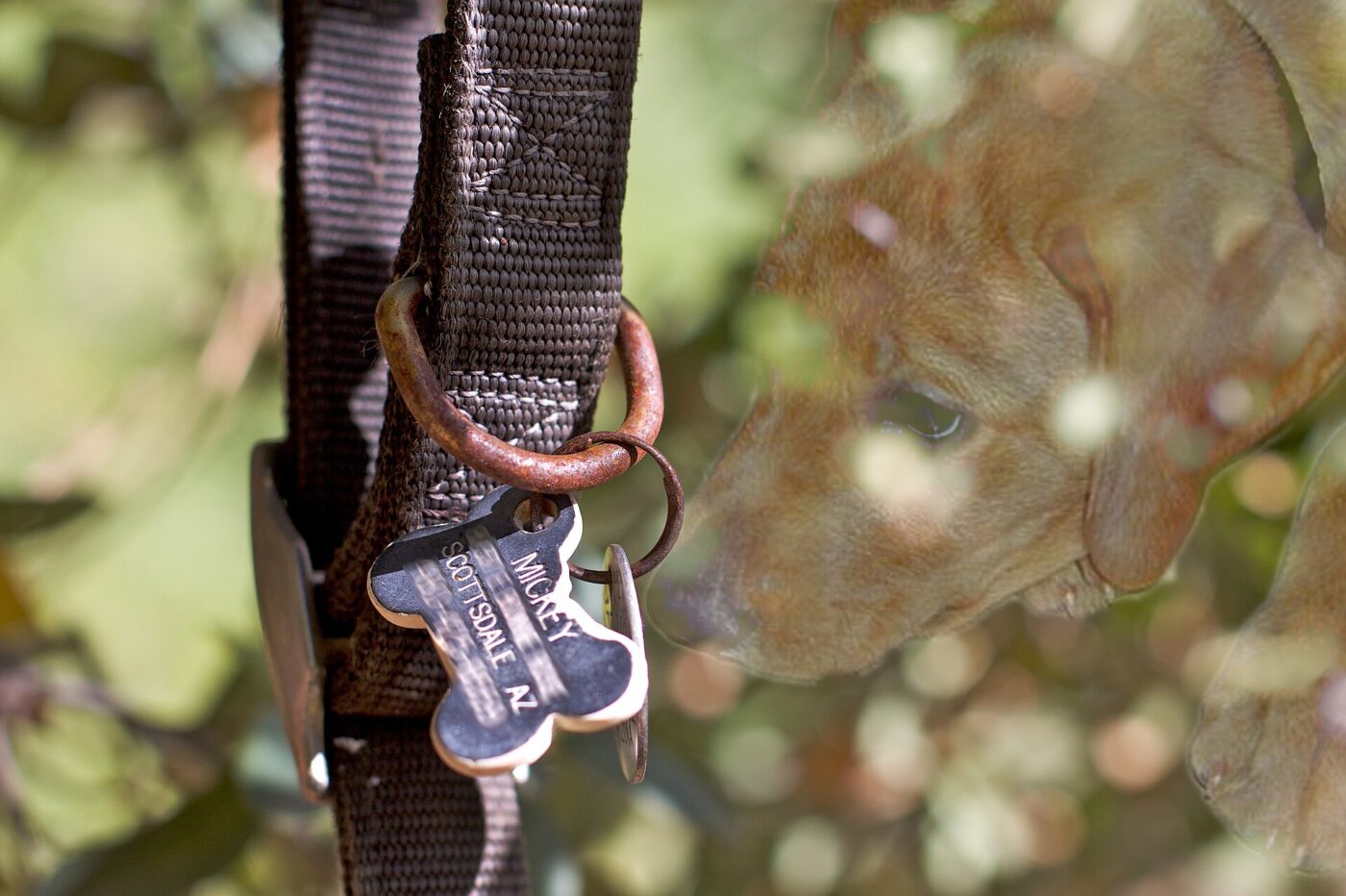
A microchip is a passive radio-frequency tag about the size of a grain of rice, implanted under the skin. It has no battery and no location function. It does one thing: when a shelter or a veterinary clinic passes a scanner over the animal, it returns a number, and that number is only useful if it leads to a current phone number in a registry. The American Animal Hospital Association’s Microchip Registry Lookup, as published in September 2026, accepts 9, 10 and 15-digit numbers, a reminder that several numbering schemes are in circulation.
An ID tag is the low-technology option and the only one a stranger can use. Anyone who catches a loose dog can read a phone number without a scanner, an app or an account. It is also the only one that is removed the instant the collar comes off.
A Bluetooth item tracker is a third thing again. Apple states on its AirTag page, as published in September 2026, that the tag is located through nearby devices in the Find My network in a process it calls anonymous and encrypted, works more than a year on a replaceable CR2032 coin cell, and is rated IP67 for water and dust. That design finds a tracker where other phones pass; it does not identify your animal, it does not work in a rural field with nobody in it, and it goes wherever the collar goes. A GPS collar unit is the heavier version, with its own location fix, a subscription and a battery to charge.
- Microchip: permanent identity, no battery, no location, requires a scanner and a current registry entry
- ID tag: readable by any stranger, removable with the collar, costs a few dollars
- Bluetooth tracker: location where other phones are nearby, a battery, no identity information
- GPS collar unit: independent location, a monthly fee and regular charging
The rule that made the chip non-optional for travel
Anyone who takes a dog out of the country has already met the requirement. CDC rules for dogs entering or returning to the United States state that a dog must have a microchip that can be detected with a universal scanner to identify it, must be at least six months old at the time of entry or return, and must be accompanied by a CDC Dog Import Form receipt, which requires a recent photo and the microchip number.
The sequence matters and catches people out. For a U.S.-vaccinated dog coming back from a high-risk country, the CDC says the microchip must be implanted before the rabies vaccine or the vaccine is invalid, that a first rabies vaccine requires the dog to be at least 12 weeks, or 84 days, old at the time of vaccination, and that the form must be completed at least 28 days afterward. Its page also states that USDA-endorsed export health certificates issued after July 31, 2025 are not accepted for re-entry.
None of that applies to a tracker. No border rule, no shelter procedure and no veterinary scanner asks about a Bluetooth tag, which is the clearest statement of where each technology sits in the system.
The step most owners skip

A microchip is a number, not a database entry. The AAHA Microchip Registry Lookup, which searches participating registries, warns that microchips are occasionally implanted but not registered to a specific pet, in which case the lookup returns only a list of companies that may have sold the chip, and that certain chips, particularly those beginning with 900, may not trace to a single provider. Finding the owner then depends on someone contacting manufacturers for trackback information on the purchaser.
The practical implication is a five-minute task most people never do twice: confirm the chip number, confirm which registry holds it, and confirm that the phone number on the record is the one in your pocket. Moving house, changing carrier or adopting from a rescue are the events that most often break the link. The tag deserves the same annual check, since engraving wears and an out-of-date number is the same as no tag.
What to buy, and in what order
Buy the tag first. It is the cheapest item here and the only one a stranger can act on without equipment or an account. For cats, a breakaway collar with a legible tag is a compromise between safety and identification, and the 6% stray return rate is the argument for making the attempt anyway.
Treat the microchip as infrastructure rather than a purchase. It is implanted by a clinic or a shelter, it never needs charging, and its value is entirely in the registry record behind it. If you travel with a dog, it is not optional.
Add a tracker last, and buy it for the problem you actually have. A Bluetooth tag suits a dense neighborhood full of phones and does little in open country. A GPS unit costs more and keeps costing, but it does not depend on other people’s devices. Neither replaces the chip, because neither survives a collar coming off.
What to watch next
- Shelter Animals Count mid-year and annual reports, for whether return-to-owner numbers keep slipping
- Whether shelters in your area publish scanning policies, which decide how quickly a chip becomes a phone call
- Battery and subscription terms on collar trackers, which are where the running cost hides
Where to start
Paid links: we earn a commission if you buy through the buttons below, at no extra cost to you. As an Amazon Associate I earn from qualifying purchases.
Pet identification options compared on what they actually do
| Product type | Good fit for | Where to look |
|---|---|---|
| Engraved pet ID tag | Fits a stranger finding your dog | See listings on AmazonOpens Amazon search results, not one listing: check the model on the product page. |
| Bluetooth tracker tag for a collar | Fits dense neighborhoods | See listings on AmazonOpens Amazon search results, not one listing: check the model on the product page. |
| GPS pet tracker for a collar | Fits open country | See listings on AmazonOpens Amazon search results, not one listing: check the model on the product page. |
Product types that fit the trend described above, not tested models. Check the exact listing before you buy. How we pick them.
Engraved pet ID tag
Where to look: Amazon
The only option a neighbor can act on immediately. Put the phone number on it rather than the pet name, and check once a year that it is still readable.
- Readable without any equipment
- Costs a few dollars
- Goes with the collar
- Engraving wears
Bluetooth tracker tag for a collar
Where to look: Amazon
Useful where other phones pass constantly and close to useless where they do not. Check which phone platform the network runs on before buying a holder.
- Long battery life
- No subscription on most systems
- Needs other phones nearby
- No identity information
GPS pet tracker for a collar
Where to look: Amazon
The answer for rural properties and dogs that roam. Budget for the subscription as a running cost, and check how long a charge lasts with live tracking on.
- Own location fix, no crowd needed
- Live tracking on a map
- Monthly fee
- Needs regular charging
More: Pets trends and how the Trend Signal is scored.
Sources
- 2025 annual data report — Shelter Animals Count
- Bringing a U.S.-vaccinated dog back from a high-risk country — Centers for Disease Control and Prevention
- Dog importation frequently asked questions — Centers for Disease Control and Prevention
- Microchip registry lookup tool — American Animal Hospital Association
- AirTag — Apple
Questions readers ask
Does an AirTag or Bluetooth tracker replace a microchip?
No. A Bluetooth tracker reports a location through nearby devices, carries no identity information and is attached to the collar. A microchip carries a number a shelter or clinic scanner reads on the animal itself, which is what CDC rules for dogs entering or returning to the United States require.
How many lost pets get home from a shelter?
Shelter Animals Count reported 638,000 dogs and cats returned to owners in 2025, 3% fewer than in 2024. Among strays, 34% of dogs and 6% of cats were returned to owners, against 19% of all dog intakes and 3% of all cat intakes.
Do I need a microchip to travel with a dog?
For entry or return to the United States, yes. CDC guidance states a dog must have a microchip detectable with a universal scanner, be at least six months old, and be accompanied by a CDC Dog Import Form receipt, and, for a dog returning from a high-risk country, that the microchip must be implanted before the rabies vaccine.
Why would a microchip fail to find the owner?
Usually because the record behind it is missing or stale. AAHA’s Microchip Registry Lookup warns that chips are sometimes implanted but never registered to a pet, in which case the search returns only a list of companies that may have sold the chip, and that some numbers beginning with 900 do not trace to a single provider.