We have not tested any washer named here. Everything below is read out of the installation documents the manufacturers publish themselves, and we name only products whose full instructions we downloaded and read on September 25, 2026 from the site of the company that makes them. Drain behavior is a property of plumbing, not of marketing copy.
Drain pump is one of the most searched qualifiers on portable washers, and it is worth understanding as a system rather than a checkbox. A pump does not make a machine better at washing. It changes where the machine can stand and what it can empty into, and it introduces a minimum height as well as a maximum — the part almost nobody expects.
Trend Signal
52/100 Steady momentum
- Emerging
- Rising
- Mainstream
- Peaking
- Cooling
The pump is what decides whether a sink counts as a drain
GE Appliances publishes a discharge height window of no less than 30 inches and no more than 8 feet above the washer base, a range only a pumped machine can serve.
Our editorial reading of the cited data, not a forecast. How it is scored
By the numbers
- 30 inMinimum drain discharge height above the washer base in GE’s installation instructionsGE Appliances
- 8 ftMaximum discharge height above the washer base in the same GE instructionsGE Appliances
- 5 inMaximum drain hose length GE allows inside the standpipe before siphoning is a riskGE Appliances
- 1-1/2 inMinimum standpipe inside diameter GE specifies, with the pipe open to atmosphereGE Appliances
Two ways a small washer gets rid of water
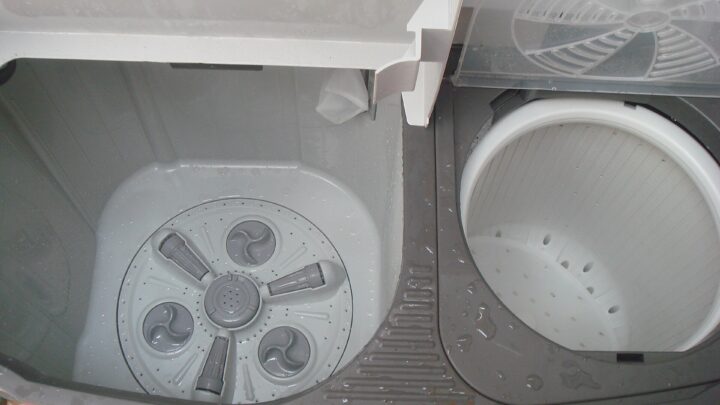
A gravity drain is a hose and nothing else. Water leaves the tub because the open end of the hose sits lower than the water inside, and it stops when the two levels match. That is why twin-tub and bucket-style machines ship with a short hose and a drain plug: they expect a floor drain, a shower tray, or a bucket you empty by hand. Put the end of a gravity hose in the sink and the machine will simply hold its water.
A drain pump is an electric pump in the base that pushes water out regardless of where the hose end sits, within limits the maker sets. That is what makes the sink route possible in an apartment with no laundry hookup, and it is why the qualifier turns up in the search box. It also means the drain path is powered hardware that can clog or fail. GE Appliances treats it as a live component: in the service warnings in its washer manual it lists the drain pump alongside the water valve and the drive motor as parts that must not be contacted while the appliance is energized.
Gravity drains down. A pump drains up, and only between two published heights.
The two heights in the instructions, and why there are two
GE’s installation instructions for the GNW128P portable and GNW128S stationary washers state that the discharge height must not be less than 30 inches, and no more than 8 feet above the base of the washer. The maximum is the one buyers expect: a pump can only lift so far. The minimum is the one that catches people out, and it exists because of siphoning.
The same document spells the mechanism out: placing the drain hose too far down the drain pipe can cause a siphoning action, no more than 5 inches of hose should be in the pipe, there must be an air gap around the hose, and a snug fit causes the same problem. A siphon does not announce itself. The machine fills, the water leaves by the path it is filling against, and the cycle never completes.
For height beyond the standard hose, GE lists a drain hose extension kit, part WH49X316, recommended for discharge heights from 60 to 96 inches. If you are draining into a standpipe rather than a sink, the instructions call for a pipe of at least 1-1/2 inches inside diameter that is open to atmosphere. Those are the four numbers to take to the tape measure.
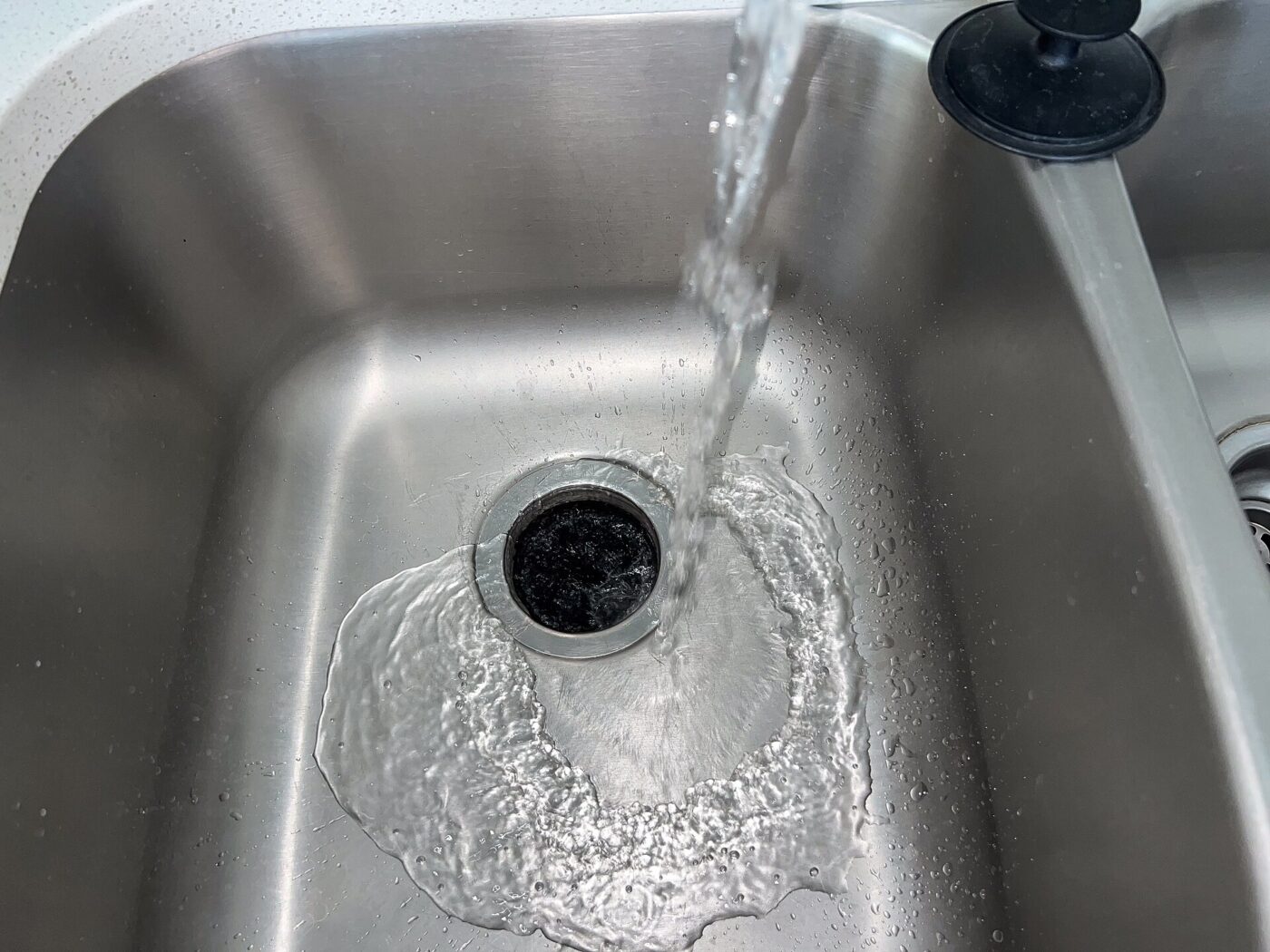
When the sink is the drain, it is also the tap
On the single-faucet setup, GE’s portable machine carries supply and drain together through one coupler clamped to the tap. Fill water comes in through the faucet adapter, which screws onto the thread left when you unscrew the aerator, and waste water goes back out through the drain leg of the same assembly. Only the cold inlet is connected; GE says the hot valve should not be connected and that the Water Temp control must be set to Cold, with the tap brought up to the temperature you want.
That arrangement has one obvious cost, the sink being unavailable for the whole cycle, and a less obvious one: the coupler and drain funnel collect lint, and GE’s care instructions describe unclamping both and cleaning them with a small brush and dish soap. Note which end of the machine you are measuring from. The instructions require a minimum of 30 inches from the drain hose insertion point to the base of the unit, not from the floor to the sink. On a tall washer on a tiled floor, a low bathroom basin can fail that test while looking like it passes.
What the safety and efficiency rules do and do not cover
Federal efficiency rules govern how much water and energy a washer uses, not where it puts the water afterwards. Under 10 CFR 430.32(g), machines built on or after January 1, 2018 must meet an integrated modified energy factor and an integrated water factor, set separately for compact top-loading machines under 1.6 cubic feet. A revised table applies to machines manufactured on or after March 1, 2028 and adds a water efficiency ratio in pounds per gallon per cycle. Neither table says anything about drain height.
The safety record is likewise silent on pumps. We searched the CPSC recall database by product name on September 25, 2026. Portable washing machine and portable washer each returned nothing. Washing machine returned seven records, one a toy and six full-size machines recalled between 2005 and 2022 for fire, shock or impact hazards.
So the pump is a convenience decision, not a safety one, on the published record. What the record does support is treating the electrical instructions strictly. GE requires an individual grounded 15 or 20 amp circuit at 115 volts and explicitly no extension cord — and every recall on file in this product family involved electricity or motion, not plumbing.
Efficiency rules cover the water bill. The drain window is set by the manufacturer alone.
How to check this before you order
Measure three things. First, the height from the floor to the rim of whatever will receive the water, minus the height of the washer base. Second, the clear distance from the tap to the spot the machine will stand, against the hose length in the specification. Third, the depth of your sink, because the drain leg has to sit inside it without kinking and without being wedged in tightly.
Then read the listing. A machine described as having a drain pump should publish a maximum lift; if it does not, ask for the installation manual, because every manufacturer that publishes one states it. A machine that mentions only a drain hose and a drain plug is a gravity machine, and it needs somewhere low to empty into.
What to watch next
- Whether more makers publish a maximum lift height in the specification block rather than only inside the manual, which would make the feature comparable at a glance
- New entries under washing machine in the CPSC recall database, searchable free by product name
- How the March 1, 2028 water efficiency ratio is reported for compact machines, the first federal water figure aimed at this size class
Where to start
Paid links: we earn a commission if you buy through the buttons below, at no extra cost to you. As an Amazon Associate I earn from qualifying purchases.
Drain types compared on what each one needs from your room
| Product type | Good fit for | Where to look |
|---|---|---|
| Portable washer with a drain pump | Fits a sink drain | See listings on AmazonOpens Amazon search results, not one listing: check the model on the product page. |
| Gravity drain twin tub washer | Fits a floor or shower drain | See listings on AmazonOpens Amazon search results, not one listing: check the model on the product page. |
| Washer drain hose extension kit | Fits a longer run to the drain | See listings on AmazonOpens Amazon search results, not one listing: check the model on the product page. |
Product types that fit the trend described above, not tested models. Check the exact listing before you buy. How we pick them.
Portable washer with a drain pump
Where to look: Amazon
The type to buy when the only place for the water is above the machine. GE publishes a window of 30 inches to 8 feet for its portable and stationary models; other makers publish their own, and they differ.
- Reaches a sink rim
- Empties fully on its own
- Has a minimum height too
- A pump can clog or fail
Gravity drain twin tub washer
Where to look: Amazon
Suits a bathroom with a shower tray or a floor drain. Simpler, and the limit is physics rather than a spec sheet.
- Nothing to fail in the drain path
- Usually lighter
- Will not empty into a sink
- You may have to lift the hose by hand
Washer drain hose extension kit
Where to look: Amazon
Extensions add distance, not pumping power. GE recommends its own extension for discharge heights from 60 to 96 inches, which is within the height window rather than beyond it.
- Cheap way to add reach
- Clamps are usually included
- Does not raise the maximum lift
- Adds a joint that can leak
More: Home and Kitchen trends and how the Trend Signal is scored.
Sources
- Owner’s Manual and Installation Instructions, GNW128P and GNW128S washers — GE Appliances
- GNW128PSMWW support and documentation — GE Appliances
- GNW128PSMWW installation page — GE Appliances
- GE Space-Saving 2.8 cu. ft. Portable Washer GNW128PSMWW — GE Appliances
- 10 CFR 430.32, clothes washer standards and compliance dates — eCFR
- Recall database query interface — CPSC SaferProducts
- Samsung Recalls Top-Load Washing Machines Due to Fire Hazard — CPSC
Questions readers ask
What does a drain pump do on a portable washing machine?
It pushes waste water upward so the machine can empty into a sink or a standpipe above the washer. A gravity drain has no pump and only works when the hose end is lower than the water in the tub.
Is there a minimum drain height as well as a maximum?
On GE Appliances’ portable and stationary washers, yes. Its installation instructions state that the discharge height must not be less than 30 inches and no more than 8 feet above the base of the washer, and warn that too low a hose position can start a siphon that empties the tub while it fills.
Why does the manual mention an air gap?
To prevent siphoning. GE’s instructions say no more than 5 inches of drain hose should sit inside the drain pipe, that there must be an air gap around the hose, and that a snug fit can cause a siphoning action. The standpipe must be at least 1-1/2 inches in inside diameter and open to atmosphere.
Does a drain pump make a washer use less water?
No. Water use is governed by the standards in 10 CFR 430.32(g), which set an integrated water factor for machines built on or after January 1, 2018 and add a water efficiency ratio for machines manufactured on or after March 1, 2028. Neither addresses how the water leaves the machine.