We have not tested any of the machines named here, and we are not going to pretend otherwise. What follows compares what the manufacturers publish in their own installation instructions against the federal product classes and the recall record. We name only models sold today by the company that makes them, with a full installation document or specification sheet on that company’s own site that we opened and read on September 25, 2026.
That constraint matters more than it sounds. Almost every decision a small-apartment buyer faces — will it reach my tap, will it drain into my sink, will it trip the outlet, is it big enough for a week of laundry — is answered by a number the maker already publishes and almost no listing repeats.
Trend Signal
58/100 Steady momentum
- Emerging
- Rising
- Mainstream
- Peaking
- Cooling
Federal efficiency standards are being written for the smallest washers for the first time
DOE’s direct final rule of March 15, 2024, confirmed in the Federal Register on October 21, 2024, creates a top-loading ultra-compact class under 1.6 cubic feet and a semi-automatic clothes washer class, with compliance required on March 1, 2028.
Our editorial reading of the cited data, not a forecast. How it is scored
By the numbers
- 20–120 psiWater pressure GE specifies for its portable washer in the installation instructionsGE Appliances
- 1.6 cu ftDOE capacity line between compact and standard-size top-loading clothes washers10 CFR 430.32
- 0 recordsPortable washing machine recalls in the CPSC database on September 25, 2026CPSC
- 663,500Units in the largest washing machine fire recall on file, Samsung, December 2022CPSC
What a portable washer actually plugs into
The single-faucet hookup is the point of the category and the source of most surprises. GE Appliances’ installation instructions for its portable GNW128P tell you to remove the aerator from the sink faucet, screw the supplied faucet adapter onto the exposed thread, then snap the hose connector onto it. If your aerator will not come off — because it is a recessed cage type, or part of a pull-out spray head — there is nothing for the adapter to grip, and that is a property of your tap, not of the washer.
The same document sets the supply conditions. Water pressure must be 20 psi minimum to 120 psi maximum. On the single-faucet setup only the cold inlet is connected, the hot valve is explicitly left unconnected, and GE instructs you to set the Water Temp control to Cold and bring the tap itself up to the wash temperature you want. That is exactly what DOE calls a semi-automatic clothes washer in 10 CFR 430.2: a machine identical to an automatic one except that the user regulates water temperature at the external faucet valves.
Power is stricter than people expect from something that rolls. GE specifies an individual, grounded 15 or 20 amp circuit, a 115-volt supply and a three-prong outlet, and says not to remove the ground prong, not to use an adapter and not to use an extension cord. In a studio where the only free outlet is across the room, that last line decides where the washer lives.
Check your faucet thread and your outlet before you check the capacity.
Drain height is the number the listings leave out

Portable washers that drain with a pump have both a ceiling and a floor, and only the ceiling gets advertised. GE’s instructions state that the discharge height must not be less than 30 inches and no more than 8 feet above the base of the washer, and that a standpipe must be at least 1-1/2 inches in inside diameter and open to atmosphere. GE sells a drain hose extension, part WH49X316, which it recommends for discharge heights from 60 to 96 inches.
The 30-inch minimum exists because of siphoning. The same document warns that placing the drain hose too far down the drain pipe can start a siphon, that no more than 5 inches of hose should sit inside the pipe, and that a snug fit causes the same problem. A washer that quietly empties itself while trying to fill will never finish a cycle, and the fault presents as a broken machine.
If you are routing into a kitchen sink, GE’s portable arrangement carries fill and drain together through one coupler clamped to the tap, which means the sink is occupied for the length of the cycle. Measure from the floor to the rim of your sink before you buy: it is the one dimension that settles whether a pumped-drain machine works in your apartment.
Capacity, and what the federal classes call it
Machines sold as portable cover a wide range. Magic Chef lists a 0.9 cubic foot compact portable top-load washer, MCSTCW09W2, at 17.7 inches wide and 31.5 inches high. GE’s portable GNW128P holds 2.8 cubic feet, a full-size drum on casters. The two have almost nothing in common except the word in the product name.
The federal rules draw the line at 1.6 cubic feet. Under 10 CFR 430.32(g), clothes washers made on or after January 1, 2018 must meet an integrated modified energy factor and an integrated water factor set separately for top-loading compact machines under 1.6 cubic feet and standard machines at or above it. The standards for machines manufactured on or after March 1, 2028 add a top-loading ultra-compact class under 1.6 cubic feet and a class for semi-automatic clothes washers, each with its own energy and water efficiency ratio.
| What the size means | Published example | Federal treatment |
|---|---|---|
| Under 1.6 cu ft | Magic Chef MCSTCW09W2, 0.9 cu ft | Top-loading compact today; ultra-compact class from March 1, 2028 |
| 1.6 cu ft and above | GE GNW128P, 2.8 cu ft | Top-loading standard-size |
| User sets temperature at the tap | GE single-faucet hookup | Semi-automatic clothes washer, 10 CFR 430.2 |
What the recall file shows, and what it does not
We searched the Consumer Product Safety Commission recall database by product name on September 25, 2026. A search on washing machine returned seven records. One is a toy; the other six are full-size machines recalled between 2005 and 2022. The largest is about 2.8 million Samsung top-load washers in November 2016, whose tops could detach during use; the largest fire case is about 663,500 Samsung washers in December 2022, which could short-circuit and overheat. Searches on portable washing machine and on portable washer returned nothing.
We read that as a useful absence rather than a clean bill of health: CPSC records a recall only when a firm agrees to one or the agency compels it, and this category is full of importers whose names change. What the file does show is that the hazards regulators have acted on here are electrical fire and injury from a moving drum — a reason to take GE’s dedicated-circuit instruction literally.
No recall on file for a product type is information about the file as much as about the product.
Who should buy now and who should wait
Buy now if your tap takes a standard removable aerator, you have a grounded outlet on its own circuit within the length of the cord, and you can measure at least 30 inches from the washer base to where the water has to go. Those three conditions are the whole decision, and all three are answerable in ten minutes with a tape measure.
Wait if your only water source is a pull-out spray faucet, because the adapter has nothing to thread onto and no accessory fixes that reliably. Wait too if you were counting on a washer-dryer combo to solve drying as well: that is a different machine with different rules.
One thing not to assume either way: nothing here says whether your building or your lease permits a portable washer. Rules on that vary by property and we cannot verify them, so treat the plumbing questions above as the physical half of the answer.
What to watch next
- Whether makers publish ultra-compact and semi-automatic ratings ahead of the March 1, 2028 compliance date, which would let buyers compare small machines on energy and water
- New entries under washing machine in the CPSC recall database, which is searchable by product name and free to check before you order
- Whether more portable models ship with a pump rather than a gravity hose, which is what decides if a sink is a usable drain
Where to start
Paid links: we earn a commission if you buy through the buttons below, at no extra cost to you. As an Amazon Associate I earn from qualifying purchases.
Portable washer types compared on the things that actually differ
| Product type | Good fit for | Where to look |
|---|---|---|
| Compact portable top-load washer | Fits a week of laundry | See listings on AmazonOpens Amazon search results, not one listing: check the model on the product page. |
| Twin tub portable washer | Fits the smallest spaces | See listings on AmazonOpens Amazon search results, not one listing: check the model on the product page. |
| Portable washer faucet adapter | Fits an awkward faucet | See listings on AmazonOpens Amazon search results, not one listing: check the model on the product page. |
Product types that fit the trend described above, not tested models. Check the exact listing before you buy. How we pick them.
Compact portable top-load washer
Where to look: Amazon
The type to buy if one machine has to replace a trip to the laundromat. Check the stated minimum and maximum drain heights against the rim of your sink before ordering.
- Real cycle programs
- Pump drain reaches a sink
- Needs its own circuit
- Occupies the tap for the cycle
Twin tub portable washer
Where to look: Amazon
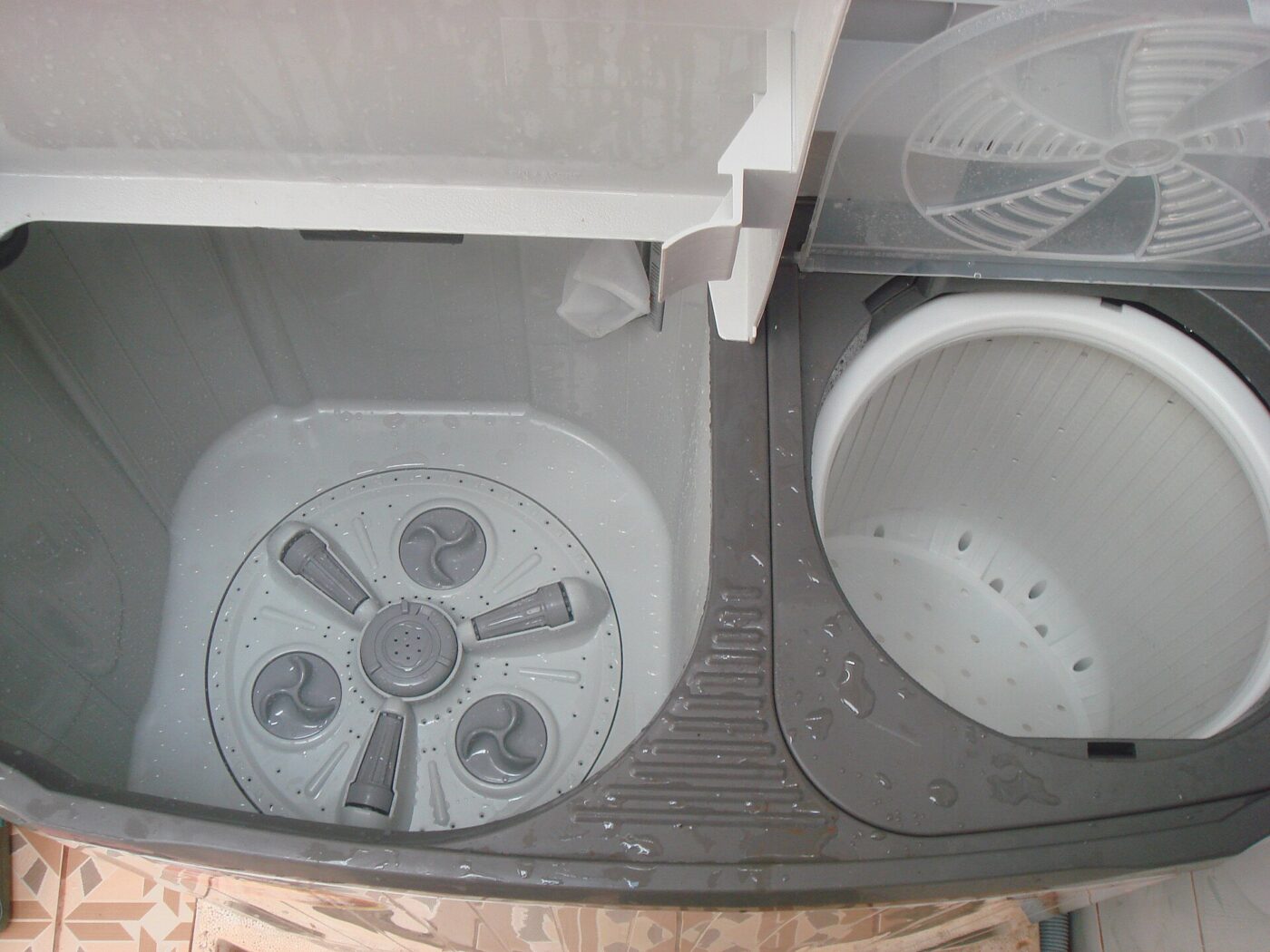
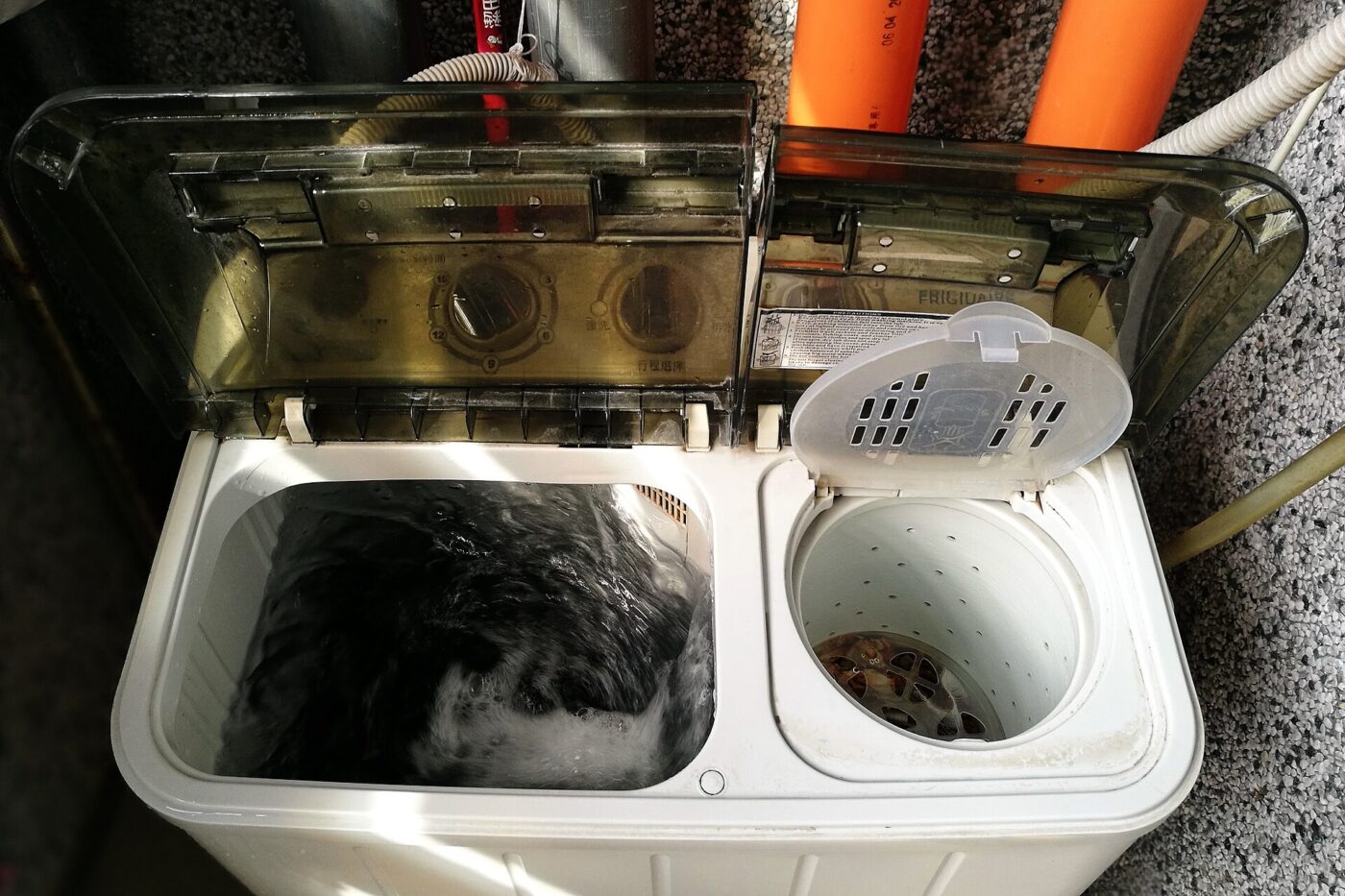
Suits a single person and a few days of clothes. Under 1.6 cubic feet these fall in the federal compact class, and DOE will set them a separate ultra-compact standard.
- Light enough to lift
- Wash and spin are separate
- You move the load by hand
- Gravity drain needs a low outlet
Portable washer faucet adapter
Where to look: Amazon
Worth checking first. GE’s instructions assume the aerator unscrews and the adapter threads onto what is underneath; if that is not your tap, no washer in this category connects.
- Cheap to try
- Sold in common thread sizes
- No adapter fits a pull-out sprayer
- Leaks if cross-threaded
More: Home and Kitchen trends and how the Trend Signal is scored.
Sources
- Owner’s Manual and Installation Instructions, GNW128P and GNW128S washers — GE Appliances
- GNW128PSMWW product support and documentation — GE Appliances
- 10 CFR 430.32, standards and compliance dates — eCFR
- 10 CFR 430.2, definitions and clothes washer classes — eCFR
- Residential clothes washer standards, March 1, 2028 compliance — Federal Register via GovInfo
- Recall database query interface — CPSC SaferProducts
- Samsung Recalls Top-Load Washing Machines Due to Fire Hazard — CPSC
- Compact Portable Top Load Washer MCSTCW09W2 — Magic Chef
Questions readers ask
Will a portable washing machine connect to any kitchen faucet?
Only to one whose aerator unscrews. GE Appliances’ installation instructions direct you to remove the aerator and screw the faucet adapter onto the thread underneath, using pliers if it is tight. Pull-out spray heads and recessed cage aerators leave nothing for the adapter to thread onto.
How high can a portable washer pump its water?
On GE’s portable and stationary models the published range is a discharge height of no less than 30 inches and no more than 8 feet above the base of the washer. GE also sells a drain hose extension, part WH49X316, for discharge heights from 60 to 96 inches. Other makers publish their own limits.
Do portable washers have to meet federal efficiency standards?
Yes, and the class depends on size. Under 10 CFR 430.32(g), top-loading machines under 1.6 cubic feet are the compact class and those at or above it are standard-size. Machines manufactured on or after March 1, 2028 fall under a revised table adding a top-loading ultra-compact class and a semi-automatic class.
Has any portable washing machine been recalled in the US?
Product-name searches of the CPSC recall database on September 25, 2026 for portable washing machine and for portable washer returned no records. A search on washing machine returned seven, of which one is a toy and the other six are full-size machines from Samsung, LG, GE and Maytag between 2005 and 2022.