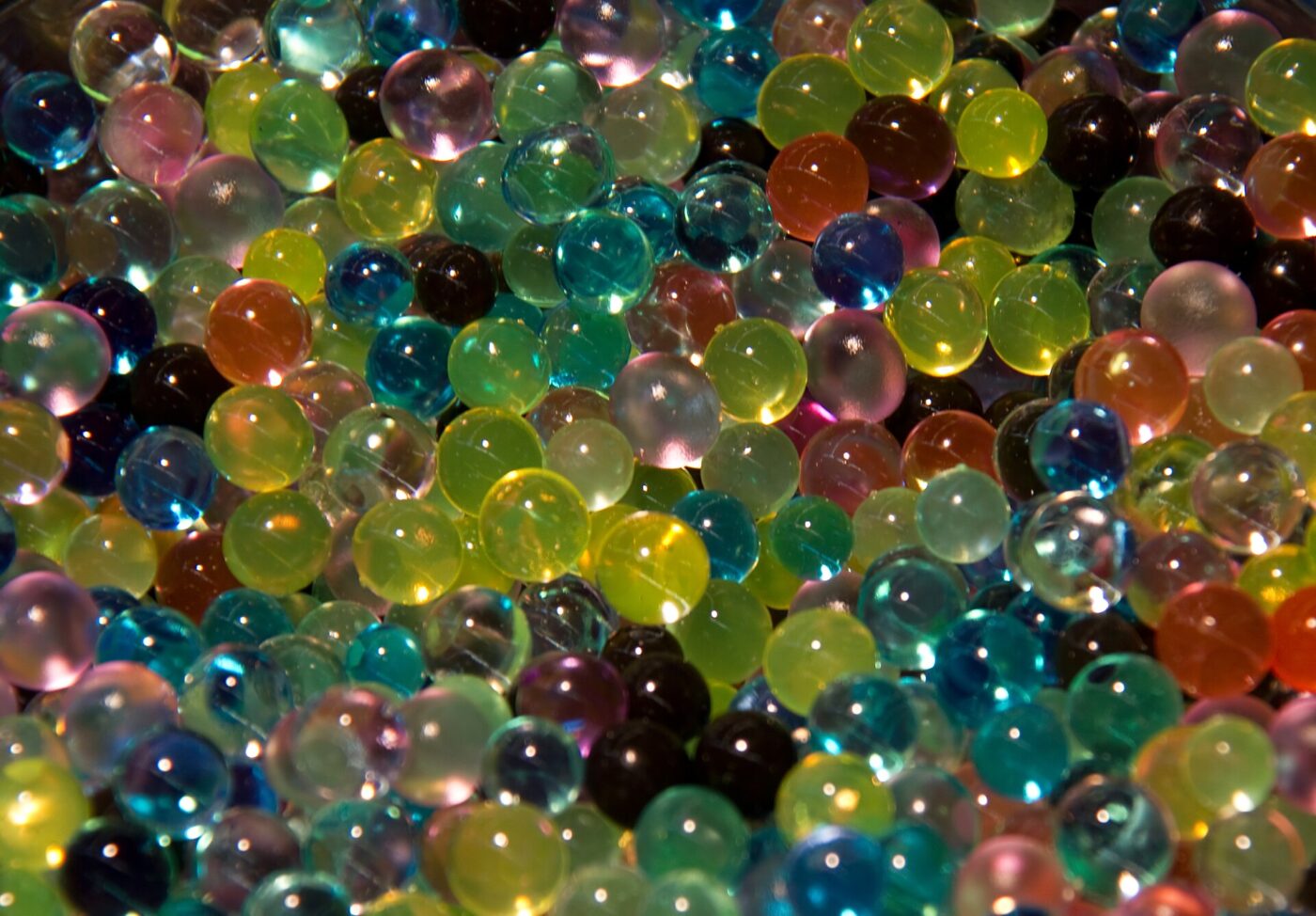
Search for water beads in 2026 and you will find two contradictory impressions: that they were banned, and that they are still on sale everywhere. Both are close to right. A federal safety standard for water bead toys took effect on March 12, 2026, and it is strict enough that most of the bead products sold as sensory toys before it cannot meet it. It is still not a ban.
The distinction matters at the shelf, because the rule draws a line through a category of sensory play rather than around one product. Here is what the standard requires, why the Consumer Product Safety Commission wrote it, how it is being enforced, and what has taken the beads’ place.
Trend Signal
28/100 Weak momentum
- Emerging
- Rising
- Mainstream
- Peaking
- Cooling
A size limit most bead toys cannot meet, plus recalls enforcing it
CPSC’s final rule, published December 12, 2025 at 90 FR 57820 and effective March 12, 2026, requires a water bead in a toy to pass through a 5.0 mm gauge when fully expanded. Three bead-filled squishy toys were recalled in September 2026, two of them because the beads expanded larger than the rule permits.
Our editorial reading of the cited data, not a forecast. How it is scored
By the numbers
- 5.0 mmGauge a fully expanded bead in a toy must pass through under the federal ruleU.S. CPSC
- 325 mcgAcrylamide limit, extractable from 100 small beads or one large beadU.S. CPSC
- ~7,000Water bead ingestion injuries in US emergency departments, 2018 through 2022U.S. CPSC
- 3CPSC recalls of bead-filled squishy toys in September 2026, two citing the toy ruleU.S. CPSC
What the rule actually says
This is a final rule, not a proposal. CPSC issued it under section 106(a) of the Consumer Product Safety Improvement Act of 2008, which makes ASTM F963 the mandatory toy standard, published it at 90 FR 57820 on December 12, 2025 and made it effective March 12, 2026. It amends 16 CFR part 1250 and covers water bead toys and toys containing beads, for children under 14. The core requirement is a size test: a bead small enough to fit the small parts cylinder must, once fully expanded, still pass through a 5.0 mm diameter funnel or sieve gauge. That rules out the classic jar of beads that swell to marble size.
Two further requirements follow. The product cannot exceed 325 micrograms of acrylamide extractable from 100 small beads or one large bead, which targets chemistry rather than the physical hazard. And it must carry a conspicuous warning on the product and the pack, worded to state that children have died and others have needed surgery.
Scope is where people get it wrong in both directions. The rule reaches beads that are neither accessible nor visible, including squeeze and squishy toys with beads sealed inside, which is why the September 2026 recalls involve novelty food-shaped squishies. It does not reach beads sold for decorative, agricultural, air freshener, cat litter or first aid uses, so the same polymer remains legal in a vase of flowers.
It is a performance limit on beads in toys, not a ban on the material.
Why the agency wrote it
The hazard is specific to how these polymers behave after swallowing. A dry bead looks harmless; CPSC says that once swallowed the beads can expand inside the body, causing intestinal blockages, internal injuries and in some cases death. Consumer Reports, in a December 15, 2025 statement, noted the problem that follows: the blockages are often invisible to X-rays.
The injury record pushed it over the line, and three estimates circulate. CPSC’s March 19, 2024 warning, which put water beads alongside narcotics as a growing risk to young children, says nearly 7,000 water bead ingestion injuries were treated in US emergency departments from 2018 through 2022. Its information center cites about 7,800 emergency room visits from 2016 through 2022. The rule itself uses a lower figure, 6,300 for 2017 through 2022, with a footnote explaining that it leaves out rashes, allergic reactions and gel blaster projectiles. CPSC also knows of a 10-month-old girl who died in 2023.
CPSC also lists a 2023 recall of Buffalo Games Chuckle & Roar Ultimate Water Beads Activity Kits in which an infant died, and a 2017 recall of Target-sold water absorbing toys.
How it is being enforced
Three September 2026 recalls landed on a product almost nobody would file under water beads. On September 3, about 7,200 OKK Trading Rainbow Mystery Squishy Bun Toys were recalled, and on September 17 about 276 of the same product sold by Toyworld168 followed; both notices state that the water beads inside the dumpling-shaped toys expand larger than permitted. A third, about 8,000 GIHNJSI Squeezy Dumplings sold on Amazon, was announced on September 3 over the beads inside.
That is the practical reach of the standard. The hazard is not only the jar of beads a parent decides to buy; it is the sealed novelty squishy, priced at about $3 in the Toyworld168 notice, that splits and releases beads a toddler finds on the floor. CPSC lists the outcomes as ingestion, choking and intestinal obstruction.
CPSC has also issued warnings on products it could not negotiate a recall for, including squishy bun toys and loose beads flagged for chemical toxicity. Those sit on the agency’s water bead information center alongside the recalls.
Enforcement is landing on sealed novelty squishies, not only on jars of loose beads.
What is on the shelf instead
Sensory play itself is not in retreat. Circana said on August 12, 2026 that sensory toys were among the drivers of a US toy market up 17% in dollars in the first half of 2026. The demand did not disappear when the beads became harder to sell; it moved.
What moved into the space is duller and older: kinetic and molding sands, rice and pasta fillers, water tables, dough sets and the bins and trays they live in. None has the visual appeal of a jar of beads, and none expands after swallowing.
A second effect is on labeling. Compliant bead products have to carry the strongly worded warning, so a bead toy sold without one after March 12, 2026 is a signal in itself. The same goes for a listing that markets decorative or agricultural beads as a children’s activity: those are the uses the rule exempts.
What to check before buying a sensory toy
The checks are short because the rule is narrow. Most come down to reading whether a product is sold as a toy and whether it carries the paperwork that goes with that. A recall or a warning tells you only which products CPSC has already found to fail; it is not a list of what is safe for a child.
The judgment call is about hidden beads. The September 2026 recalls covered squishy toys whose filling is not visible in a listing photograph, so an unbranded one from an unfamiliar seller is where the rule offers least protection in practice.
- Look for the required warning text on any bead product sold for children; after March 12, 2026 it is mandatory.
- Treat decorative, floral, agricultural and cat litter beads as outside the toy rule, because they are.
- Assume any squishy or squeeze toy may be bead-filled, and keep split ones away from children under three.
- Check the CPSC water bead information center for recalls and warnings before buying an unfamiliar brand.
- For under-threes, sand, dough and water play cover the same textures without a material that expands after swallowing, though each carries its own choking risk.
What to watch next
- Further CPSC recalls citing oversized water beads, which would show whether non-compliant stock is still moving.
- Whether major retailers reinstate bead kits in compliant form or keep the shelf space for sand and dough.
- The CPSC water bead information center, which lists recalls and the warnings issued where no recall was agreed.
Where to start
Paid links: we earn a commission if you buy through the buttons below, at no extra cost to you. As an Amazon Associate I earn from qualifying purchases.
Sensory play types that do not rely on expanding beads
| Product type | Good fit for | Where to look |
|---|---|---|
| Sensory bin kit without water beads | Fits toddlers and preschoolers | See listings on AmazonOpens Amazon search results, not one listing: check the model on the product page. |
| Kinetic play sand set | Fits mess-controlled play | See listings on AmazonOpens Amazon search results, not one listing: check the model on the product page. |
| Sensory table with a lid | Fits shared or group use | See listings on AmazonOpens Amazon search results, not one listing: check the model on the product page. |
Product types that fit the trend described above, not tested models. Check the exact listing before you buy. How we pick them.
Sensory bin kit without water beads
Where to look: Amazon
A bin kit is only as good as its filler list, which the water bead rule made worth reading. Check the age grade and whether anything in it swells in water.
- Fillers are visible and named
- Cheap to refill
- Small fillers still choke
- Quality varies by seller
Kinetic play sand set
Where to look: Amazon
Molding sand covers most of what parents wanted from beads, with a texture that stays put. Check the weight, since listings quote very different quantities at similar prices.
- Holds shape and clumps
- Does not expand after swallowing
- Sticks to fabric
- Dries out if left open
Sensory table with a lid
Where to look: Amazon
A table with a latching lid turns loose play into something you can close and walk away from. Check the basin depth and the height against the child using it.
- Contains the mess
- Works with sand or water
- Takes floor space
- Standing water needs supervision
More: Collectibles and Toys trends and how the Trend Signal is scored.
Sources
- Water Bead Toys Business Guidance — U.S. Consumer Product Safety Commission
- Safety Standard for Toys: Requirements for Water Beads, final rule, 90 FR 57820 — Federal Register
- Water Beads Information Center — U.S. Consumer Product Safety Commission
- CPSC Warns that Narcotics and Water Beads Are Growing Risks Facing Young Children — U.S. CPSC
- Toyworld168 Recalls Rainbow Mystery Squishy Bun Toys — U.S. CPSC
- Recalls and Product Safety Warnings — U.S. Consumer Product Safety Commission
- A New Federal Safety Standard for Water Bead Toys Now in Effect — Keller and Heckman
- Statement: New Product Safety Rules for Water Beads, Neck Floats — Consumer Reports Advocacy
- US Toy Industry Posts Strongest First Half in Six Years — Circana
Questions readers ask
Are water beads illegal now?
No. Under a CPSC final rule effective March 12, 2026, a water bead in a toy for children under 14 must pass through a 5.0 mm gauge when fully expanded, stay within an acrylamide limit of 325 micrograms extractable from 100 small beads, and carry a specific warning. Beads sold for decorative, agricultural, air freshener, cat litter and first aid uses are outside the rule.
Why are water beads dangerous?
CPSC says swallowed beads can expand inside the body and cause intestinal blockages and internal injuries, and in some cases death. It reports nearly 7,000 ingestion injuries in US emergency departments for 2018 through 2022, about 7,800 emergency room visits for 2016 through 2022, and 6,300 for 2017 through 2022 in the rule itself. A 10-month-old girl died in 2023.
Does the rule cover squishy toys with beads inside?
Yes. CPSC guidance says the requirements apply to beads provided in toys whether they are accessible or not. Two September 2026 recalls of Rainbow Mystery Squishy Bun Toys were issued because the sealed beads expanded larger than permitted.
What can replace water beads for sensory play?
Kinetic and molding sands, dough, rice and pasta fillers and water tables cover the same textures without a material that expands after swallowing. Circana reported sensory toys among the growth drivers of a US toy market up 17% in dollar sales in the first half of 2026.