The baby walker is one of the oldest products in the nursery and one of the most argued about. In the United States it is still legal to sell one, but only if it meets a federal standard written around a single scenario: a child rolling toward a staircase. That standard, ASTM F977-22e1, became mandatory through 16 CFR part 1216 on February 25, 2023, after ASTM approved the revision on June 15, 2022 and notified CPSC on August 29, 2022.
What has changed since is not the rule but who is selling walkers. Searching CPSC’s recalls database on September 24, 2026 returns six walker recalls posted since June 2025, all for products sold only online, four on Amazon and one each on Walmart.com and Target.com, in volumes from 70 units to 2,650. The hazard wording is close to identical across them, which tells you exactly which two tests the cheap imports are failing.
Trend Signal
52/100 Steady momentum
- Emerging
- Rising
- Mainstream
- Peaking
- Cooling
A settled category with a steady stream of non-compliant imports
Our search of the CPSC recalls database on September 24, 2026 returns four infant walker recalls posted since January 1, all for online-only models that can fit through a standard doorway and fail to stop at the edge of a step.
Our editorial reading of the cited data, not a forecast. How it is scored
By the numbers
- 4Infant walker recalls in the CPSC database, January 1 to September 24, 2026, our countCPSC
- 3,600ED-treated injuries, walkers, jumpers and exercisers, children under five, 2024CPSC
- 1,310Walkers recalled on August 6, 2026 that could fit through a standard doorwayCPSC
- Feb 25, 2023Date ASTM F977-22e1 became the mandatory US standard for infant walkersFederal Register
What the federal standard requires of a walker
16 CFR part 1216 has applied to infant walkers manufactured or imported on or after December 21, 2010. It works by incorporating an ASTM specification, and since February 25, 2023 that has been ASTM F977-22e1, adopted through a direct final rule published on November 29, 2022. The Juvenile Products Manufacturers Association filed the only comment, in support.
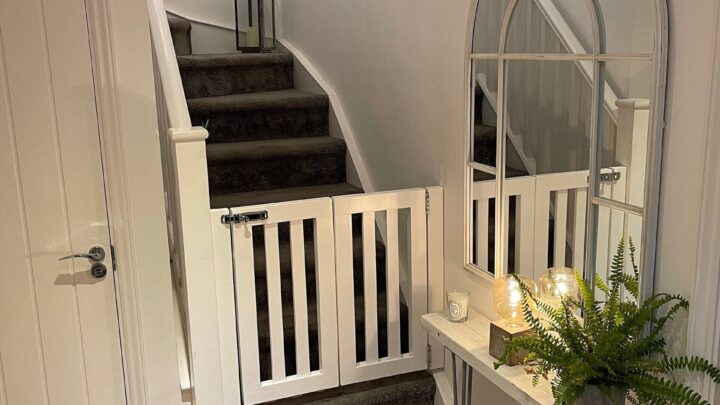
The centerpiece is the prevention of falls down steps requirement. CPSC describes the test method plainly: the walker is placed a set distance from the edge of a test platform with a dummy in the seat, an eight-pound weight is attached, and when the weight is released the walker accelerates toward the edge. It is run forward, rearward and sideways. A second test simulates a child leaning over the edge with a Federal Aviation Administration crash test dummy, and is repeated after the step tests with a 17-pound force applied.
Width matters too, because the practical defense against stairs is a frame too wide to pass through a normal doorway. Recall notices phrase the failure exactly that way.
A compliant walker is wide, stops at a step edge and cannot let a child slip through the leg openings.
Four walker recalls in 2026, all sold only online
On August 6, 2026 CPSC announced a recall of about 1,310 Wnttmt infant walkers sold on Amazon between February and March 2026 for $65 to $75. The hazard notice says the walkers can fit through a standard doorway and fail to stop at the edge of a step, and that the leg openings allow the child to slip down until the head can become entrapped. No incidents were reported.
That wording is not unique. On December 11, 2025 about 2,650 Uuoeebb walkers were recalled, sold on Amazon from December 2024 through September 2025 for $60 to $90, with the same two failures listed. On our own count from the CPSC recalls database, four walker recalls were posted between January 1 and September 24, 2026 and two in 2025, in quantities of roughly 70, 90, 243, 1,310, 1,500 and 2,650 units, at prices from $60 to $90.
Two things follow for a buyer. The failures are structural rather than cosmetic, so a product photograph cannot tell you much. And the remedies are consistently a refund conditional on destroying the walker, which means a recalled model is not supposed to reach the secondhand market.
What the injury numbers say, and what they do not

CPSC groups baby walkers with jumpers and exercisers in its nursery products report, so the published estimates cover all three. Emergency department-treated injuries among children under five were estimated at 2,200 in 2022, 2,700 in 2023 and 3,600 in 2024. Over the same period the all-product total went from 64,200 to 70,000.
The caveat is in the report itself. CPSC states that there was no statistically significant year-over-year increase from 65,000 injuries in 2023 to 70,000 in 2024, and that the increases seen in nine product groups, including baby walkers, jumpers and exercisers, were non-significant. Read honestly, the category has drifted upward over three years without a clean statistical signal in the most recent one.
Fatalities are rarer still. Of 537 nursery product deaths reported for 2020 through 2022, one involved baby walkers, jumpers or exercisers, an annual average CPSC rounds to zero. Falls remain the leading injury cause across all nursery products, and CPSC puts about 79 percent of injuries as involving the head, ears, eyes, face and mouth.
| Year | Walkers, jumpers and exercisers | All nursery products |
|---|---|---|
| 2022 | 2,200 | 64,200 |
| 2023 | 2,700 | 65,000 |
| 2024 | 3,600 | 70,000 |
The stationary alternative, and what it changes
The product most often bought instead is a stationary activity center: the same seat and toy tray, mounted on a fixed base that bounces or rotates but does not travel. Because it has no wheels, the step-fall scenario that drives the walker standard does not apply, and the shopping decision moves to seat height adjustment, whether the seat rotates, and how much floor space the base takes when it is not in use.
The trade runs both ways. A walker moves with the child, which is the appeal and the hazard. A stationary center keeps the child in one place, which suits a room with a step. CPSC’s injury data treats the two as one group precisely because families use them interchangeably.
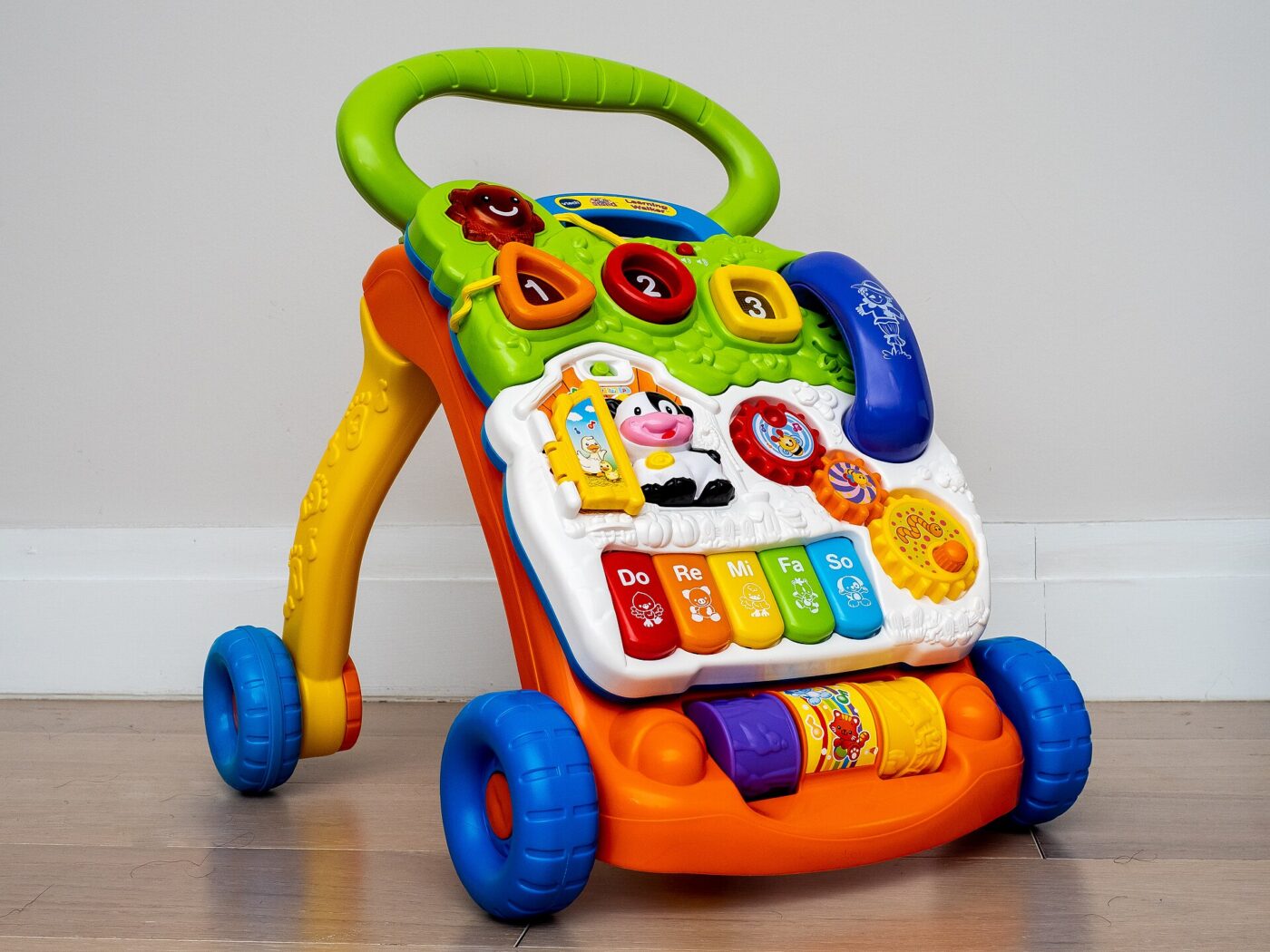
A third option in the same price range is a push-along sit-to-stand walker, which the child holds rather than sits inside. That design falls outside 16 CFR part 1216, so the checks are different: wheel resistance and base weight, because a light push toy runs away on a hard floor.
How to read a walker or activity center listing
For a seated walker, the first question is the overall width. The standard’s practical defense is a frame too wide for a normal doorway, so a listing that emphasizes a compact or narrow footprint is describing the exact property the recalls cite. The second is the leg opening: the December 2025 and August 2026 notices describe openings that let a child slip down until the head becomes entrapped.
Check the brake or grip mechanism claims against the step-fall requirement rather than against marketing copy. CPSC’s test releases the walker toward a platform edge under an eight-pound pull, so friction pads that only work at walking pace are not what the standard measures.
For stationary centers the checks are height settings, a seat that comes out to wash, and a base footprint you can live with. For any of the three types, look up the brand in the CPSC recall database first, since almost every recent walker recall involves a marketplace name most shoppers will not recognize.
Width, leg openings and step-edge behavior are the three things the standard actually measures on a walker.
What to watch next
- The CPSC recall database for infant walkers, which held six recalls posted since June 2025 with near-identical hazard wording when we searched it on September 24, 2026.
- Whether ASTM notifies CPSC of a further F977 revision, which would become mandatory 180 days later by operation of law.
- The next CPSC nursery products report, to see whether the walkers, jumpers and exercisers injury estimate keeps drifting up.
Where to start
Paid links: we earn a commission if you buy through the buttons below, at no extra cost to you. As an Amazon Associate I earn from qualifying purchases.
Seated walkers, stationary centers and push toys compared
| Product type | Good fit for | Where to look |
|---|---|---|
| Stationary activity center | Fits a fixed spot in one room | See listings on AmazonOpens Amazon search results, not one listing: check the model on the product page. |
| Sit-to-stand push walker | Fits early standing and cruising | See listings on AmazonOpens Amazon search results, not one listing: check the model on the product page. |
| Padded floor play mat | Fits floor time without wheels | See listings on AmazonOpens Amazon search results, not one listing: check the model on the product page. |
Product types that fit the trend described above, not tested models. Check the exact listing before you buy. How we pick them.
Stationary activity center
Where to look: Amazon
The closest substitute for a seated walker, and the one the step-fall test at the center of the federal standard does not apply to. Check the height settings against your child rather than the age range on the box.
- No travel, so no step-fall scenario
- Seat usually washable
- Large footprint
- Outgrown quickly
Sit-to-stand push walker
Where to look: Amazon
Not covered by 16 CFR part 1216, because the child walks behind it rather than sitting in it. Wheel resistance and base weight are the two specifications that decide whether it is usable on tile or laminate.
- Child controls the pace
- Folds or stores small
- Can run away on hard floors
- Needs supervision
Padded floor play mat
Where to look: Amazon
The plainest option, and the one CPSC data has nothing to say about. Thickness and whether the mat folds are the two things that change day to day.
- No mechanism to fail
- Cheap to replace
- Needs more adult attention
- Takes floor space
More: Baby and Parenting trends and how the Trend Signal is scored.
Sources
- 16 CFR part 1216, Safety Standard for Infant Walkers — eCFR
- Safety Standard for Infant Walkers, direct final rule, November 29, 2022 — Federal Register via GovInfo
- Wnttmt baby walkers recalled, August 6, 2026 — CPSC
- Uuoeebb infant walkers recalled, December 11, 2025 — CPSC
- Recalls database — U.S. Consumer Product Safety Commission
- Injuries and Deaths Associated With Nursery Products, 2025 report — CPSC
Questions readers ask
Are baby walkers banned in the United States?
No. Infant walkers are legal to sell in the US but must comply with 16 CFR part 1216, which has incorporated ASTM F977-22e1 since February 25, 2023. The standard includes tests for preventing falls down steps and requirements for labeling and instructions.
What do recalled baby walkers have in common?
Almost all of them fail the same two points. CPSC notices for the December 11, 2025 and August 6, 2026 recalls both state that the walkers can fit through a standard doorway and fail to stop at the edge of a step, and that leg openings allow a child to slip down until the head can become entrapped.
Are stationary activity centers covered by the walker standard?
No. 16 CFR part 1216 applies to infant walkers. A stationary center has no wheels, so the step-fall test that shapes the walker standard does not apply. CPSC still counts walkers, jumpers and exercisers together in its injury estimates, which were 3,600 emergency department visits for children under five in 2024.
Is a sit-to-stand push walker the same thing?
Not for regulatory purposes. A push walker supports a standing child from the front rather than carrying a seated one, so it falls outside 16 CFR part 1216. The practical checks are wheel resistance and base weight, since a light push toy accelerates on hard flooring.