Diapers are the clearest fixed cost of a first year, and for five years the direction was only up. The Bureau of Labor Statistics tracks a producer price index for disposable diapers and similar products made from purchased sanitary paper stock. It was flat at 93.5 between 2019 and August 2021, on a December 2003 base. Then it rose in steps: 98.9 in September 2021, 103.7 by October 2022, 108.5 in October 2025 and a peak of 108.6 in March 2026.
In June 2026 that index fell to 105.3, and it was still 105.3 in August 2026. That is a 3.1 percent drop from the peak and the first meaningful decline in the series since before the pandemic. This is a factory-gate measure, not a shelf price, but it is the cleanest public read on where the category is heading, and the two companies that dominate the aisle are saying the same thing in their filings.
Trend Signal
30/100 Weak momentum
- Emerging
- Rising
- Mainstream
- Peaking
- Cooling
Producer prices turned down in June 2026 as volumes carried the category
The BLS producer price index for disposable diapers fell from 108.6 in March 2026 to 105.3 in June 2026 and held there through August, while Kimberly-Clark reported net price down 0.5 percent in the first quarter of 2026.
Our editorial reading of the cited data, not a forecast. How it is scored
By the numbers
- 3.1%Fall in the diaper producer price index from its March 2026 peak to August 2026BLS via FRED
- +12.6%Change in the same index between August 2021 and August 2026BLS via FRED
- 0.5%Kimberly-Clark net price change in the first quarter of 2026, with volume up 2.6 percentKimberly-Clark 10-Q
- 3,606,400Provisional US births in 2025, down about 1 percent from 2024CDC NCHS
Six years of diaper prices in one index
The series worth watching is PCU3222913222912, the producer price index for disposable diapers and similar products made from purchased sanitary paper stock. It is monthly, not seasonally adjusted, and indexed to December 2003. It changes in visible steps rather than noise, because a handful of manufacturers reset list prices a few times a year.
Three of those steps did most of the damage. September 2021 took the index from 93.5 to 98.9. A second climb through 2022 ended at 103.7 in October, where it then sat almost unchanged for nearly two years. A third phase began in September 2024 and ran to 108.5 by October 2025. The annual average went from 93.5 in 2020 to 106.5 in 2025.
Then it broke. The index slipped from 108.6 in May 2026 to 105.3 in June and held that level through August 2026, leaving it 0.8 percent below August 2025. For a series that had spent six years going up or sideways, a three-month plateau after a drop reads to us as a deliberate reset rather than a rounding artifact. The percentage changes here are our arithmetic from the published index levels.
| Month | Diaper producer price index | Change |
|---|---|---|
| August 2021 | 93.5 | Unchanged since 2019 |
| October 2022 | 103.7 | +10.9% from August 2021 |
| August 2024 | 103.7 | No change in almost two years |
| October 2025 | 108.5 | +4.6% from August 2024 |
| March 2026 | 108.6 | Series peak |
| August 2026 | 105.3 | –3.1% from the peak |
Why the two biggest makers stopped taking price
Kimberly-Clark, which makes Huggies and Pull-Ups, reported net sales of $4.2 billion for the three months ended March 31, 2026, up 2.7 percent. The drivers table shows how that was built: volume up 2.6 percent, mix and other up 0.4, net price down 0.5, divestitures and business exits down 1.8, currency up 2.0. Growth came from selling more, while the company gave a little back on price.
North America is where the diaper aisle sits, and it went backwards on the headline: net sales of $2,651 million against $2,668 million a year earlier, a 0.6 percent decline. The filing attributes that to the exit of the private label diaper business in the United States, offset by organic sales growth of 1.8 percent with volume up 1.9 percent, driven in part by baby and child care.
Procter and Gamble, which makes Pampers and Luvs, finished fiscal 2026 on June 30, 2026 with baby, feminine and family care net sales of $20.4 billion, up 1 percent. The filing credits that entirely to favorable foreign exchange of 2 percent against a unit volume decrease of 1 percent, and names no pricing contribution for the segment at all, where it credits Beauty with higher pricing of 1 percent. Organic sales fell 1 percent. Baby care net sales rose low single digits overall, but the company attributes a North American volume decline to competitive activity, which is the polite phrasing for a price fight.
Both leaders are now buying volume rather than pushing price, which is what a producer price index turning down looks like from the inside.
Fewer babies is the deeper trend
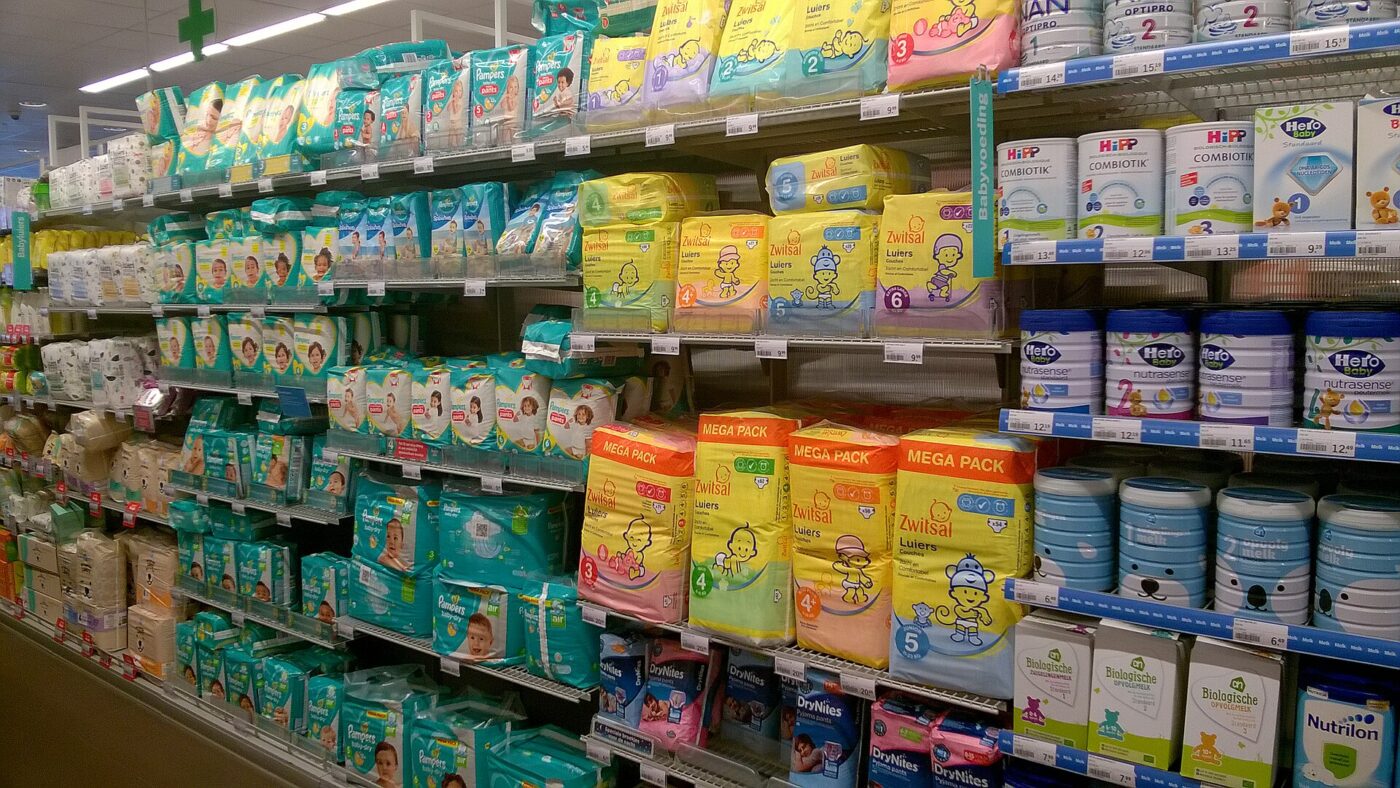
Diapers are one of the few categories where the customer base can be counted directly. CDC’s National Center for Health Statistics reported on April 9, 2026 that the provisional number of US births in 2025 was 3,606,400, a 1 percent decline from 2024. The general fertility rate also fell slightly, to 53.1 births for every 1,000 females aged 15 to 44.
A category losing roughly one percent of its new customers every year cannot grow on volume unless it takes share, and the two leaders are each other’s only meaningful rival at the top end. That is the structural reason the price fight arrived in 2026 rather than 2024: when the pie stops growing, the cheapest way to add volume is to be a little cheaper.
The rest of the baby aisle shows the same pressure. BLS reported that the consumer price index for infants’ and toddlers’ apparel was down 3.4 percent over the twelve months to August 2026, one of the steeper declines in the apparel tables.
What this means at the shelf

A producer price index is not a receipt. Retailers set their own margins, promotions move faster than list prices, and pack sizes change what a household actually pays. What the index does tell you is the direction of the wholesale cost underneath every promotion, and that turned down in June 2026.
The practical consequence is that the usual advice to stock up hard on the biggest box loses some of its edge. When list prices only ever rise, buying forward is a hedge. When the underlying index has fallen 3.1 percent from a peak and both leaders are competing on price points, a very large forward buy locks in the old price and the old size at the same time.
Count per box is the number that matters, not the price on the shelf: two boxes at the same price can differ by twenty or thirty diapers. Kimberly-Clark’s exit from the US private label business also means some store-brand diapers have changed manufacturer, so a familiar pack is not guaranteed to be the product it was in 2024.
What could push diaper prices back up
The obvious risk is input costs. The index is built on sanitary paper stock, and the 2021 and 2022 step changes followed pulp and resin cost increases. A renewed run in those inputs would show up in the same series within a couple of quarters, because that is how quickly the previous cycles moved.
The second risk is the end of the promotional phase. Procter and Gamble attributed a North American baby care volume decline to competitive activity; a company that decides the fight is unprofitable can stop discounting quickly. Kimberly-Clark’s first quarter 2026 net price was down only 0.5 percent, which is a nudge rather than a structural cut.
The third is arithmetic. Gross margin at Procter and Gamble fell 100 basis points in fiscal 2026 to 50.2 percent of net sales, with unfavorable product mix the largest single contributor. Margin pressure of that kind usually resolves through price.
Treat the June 2026 drop as a pause in a long climb, not a reversal of it.
What to watch next
- The monthly reading of BLS series PCU3222913222912, to see whether 105.3 holds or steps down again.
- Kimberly-Clark’s next quarterly net price line, which has been the clearest early signal of the change in direction.
- The next CDC provisional birth report, since the size of the customer base sets the ceiling on volume growth.
Where to start
Paid links: we earn a commission if you buy through the buttons below, at no extra cost to you. As an Amazon Associate I earn from qualifying purchases.
Diaper formats to compare on cost per change
| Product type | Good fit for | Where to look |
|---|---|---|
| Bulk box of disposable diapers | Fits a stock-up shopper | See listings on AmazonOpens Amazon search results, not one listing: check the model on the product page. |
| Overnight diapers | Fits long overnight stretches | See listings on AmazonOpens Amazon search results, not one listing: check the model on the product page. |
| Cloth diaper starter set | Fits a reusable-first household | See listings on AmazonOpens Amazon search results, not one listing: check the model on the product page. |
Product types that fit the trend described above, not tested models. Check the exact listing before you buy. How we pick them.
Bulk box of disposable diapers
Where to look: Amazon
The cheapest per change, with the caveat that babies change size faster than a large box empties. With the producer price index falling rather than rising, the case for buying many months ahead is weaker than it was.
- Lowest price per diaper
- Fewer reorders
- Locks in one size
- Needs storage space
Overnight diapers
Where to look: Amazon
A premium format within the same category. Compare the weight range rather than the size number, since sizing differs between brands.
- Designed for longer wear
- Fewer night changes
- Higher price per diaper
- Sold in smaller counts
Cloth diaper starter set
Where to look: Amazon
The only option in the aisle whose cost does not track the producer price index. The trade is upfront spending and washing, so the arithmetic depends on your water and energy costs.
- One-off purchase
- Not exposed to the price index
- Laundry load and water cost
- Bigger upfront outlay
More: Baby and Parenting trends and how the Trend Signal is scored.
Sources
- Producer Price Index by Industry: Disposable Diapers and Similar Disposable Products — BLS via FRED
- Kimberly-Clark Corporation Form 10-Q for the quarter ended March 31, 2026 — SEC EDGAR
- Procter and Gamble Form 10-K for fiscal 2026 — SEC EDGAR
- U.S. Births down 1% in 2025 — CDC National Center for Health Statistics
- Consumer Price Index, detailed expenditure categories, August 2026 — U.S. Bureau of Labor Statistics
Questions readers ask
Are diapers getting cheaper in 2026?
At the factory gate, yes, modestly. The BLS producer price index for disposable diapers fell from a peak of 108.6 in March 2026 to 105.3 in June 2026 and held there through August 2026, which is 0.8 percent below August 2025 and 3.1 percent below the peak. Shelf prices depend on retailer margins and promotions on top of that.
How much did diaper prices rise since 2021?
The producer price index for disposable diapers was 93.49 in August 2021 and 105.264 in August 2026, an increase of 12.6 percent on our arithmetic. Most of that came in two steps, one in September 2021 and one through 2022, followed by a flat stretch from October 2022 to August 2024.
Why are the big diaper brands cutting prices?
Both leaders are chasing volume in a category with fewer customers. Kimberly-Clark reported net price down 0.5 percent with volume up 2.6 percent in the first quarter of 2026, and Procter and Gamble named no pricing contribution in baby, feminine and family care for fiscal 2026, attributing a North American baby care volume decline to competitive activity.
Does the falling birth rate affect diaper prices?
It shapes the strategy behind them. CDC reported a provisional 3,606,400 US births in 2025, down about 1 percent from 2024, with the general fertility rate at 53.1 per 1,000 women aged 15 to 44. A category that loses customers each year has to take share to grow volume, and price is the usual lever.