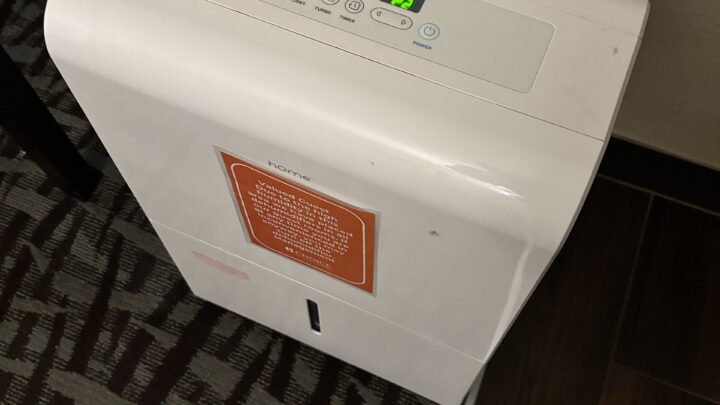
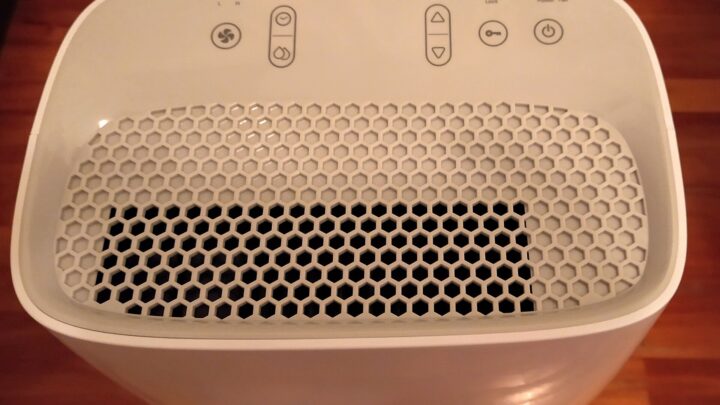
This is the single most useful thing anyone can tell a dehumidifier buyer, and almost nobody does: the pint rating on the box changed meaning in 2019, and a number from before that date cannot be compared with a number from after it. We have tested nothing here. Everything below comes from the Federal Register rules that made the change, the ENERGY STAR pages that document its effect, and manufacturer listings read on September 25, 2026. The products named are here because their makers publish a capacity figure together with the condition it was measured at, which is the only thing this article compares, and each brand was run past the CPSC recall database on the same date.
It matters most in a basement, because a basement is exactly the room the change was designed around. The old test ran at 80 degrees F, a condition DOE and commenting parties agreed was well above how these machines are actually used. The new one runs at 65 degrees F, which DOE selected from its own analysis of average ground temperature during the dehumidification season.
Trend Signal
58/100 Steady momentum
- Emerging
- Rising
- Mainstream
- Peaking
- Cooling
The rating scale moved in 2019 and the shelf still reflects it
DOE moved the portable dehumidifier test from 80 degrees F to 65 degrees F dry bulb and said in the rule that this would produce a lower measured capacity; ENERGY STAR maps an old 70-pint unit to roughly 40 to 45 pints today.
Our editorial reading of the cited data, not a forecast. How it is scored
By the numbers
- 65 vs 80Dry-bulb test temperature in degrees F for portable units, new procedure against oldFederal Register 80 FR 45802
- 70 to 40How ENERGY STAR maps an old 70-pint rating onto the capacity scale used from 2020ENERGY STAR
- 2.80Minimum integrated energy factor in L per kWh for a portable above 50 pints a dayFederal Register 81 FR 38338
- 3.30Integrated energy factor ENERGY STAR Version 6.0 requires of the same size classENERGY STAR
The test changed, the machine did not
On July 31, 2015, DOE published a final rule rewriting the dehumidifier test procedure. It lowered the dry-bulb test temperature for portable dehumidifiers to 65 degrees F, paired with a 56.6 degrees F wet bulb corresponding to 60 percent relative humidity. The previous condition, carried over from AHAM DH-1-2008, was 80 degrees F at the same 60 percent.
DOE did not hide the consequence. The rule states that dehumidifiers will extract less condensate at the lower dry-bulb temperature than at the previous 80 degrees F, and that this will result in a lower measured capacity, while arguing that the cooler condition is more representative of how the product is used. DOE also noted that a 65 degree condition reflects both basements, where it expects average ground temperature during the dehumidification season to be close to that figure, and above-grade living spaces.
The standards rule followed on June 13, 2016 and required compliance from June 13, 2019. It replaced the old energy factor with the integrated energy factor, which counts the energy a unit uses once it has cycled off, and rebuilt the portable classes around the new scale: 25.00 pints a day or less, 25.01 to 50.00, and 50.01 or more. A footnote says in one line what most shoppers never learn, that the test conditions for the new classes differ from those for the old ones.
Cooler air holds less water, so the same hardware measures fewer pints. Nothing about the machine got worse.
Old rating to new rating, as ENERGY STAR maps it
ENERGY STAR publishes a rough correlation between the pre-2020 ratings and the ones in use from 2020, with the caveat that the actual change varies by model and that manufacturers can give a more reliable comparison for a specific unit. This is the table to keep.
Read it once and a lot of confusing listings make sense. A 70-pint unit bought in 2015 is roughly a 40 to 45 pint unit on the current scale, which is why a replacement that looks two sizes smaller can be the right one. Manufacturers occasionally say so outright: Ivation’s listing for its 1,500 square foot ENERGY STAR model describes the unit as a 20-pint that was previously classified as 30-pint.
| Old portable rating through 2019 | Approximate new rating from 2020 |
|---|---|
| 30 pints a day | 20 pints a day |
| 40 pints a day | 25 pints a day |
| 50 pints a day | 30 pints a day |
| 60 pints a day | 35 pints a day |
| 70 pints a day | 40 to 45 pints a day |
| 90 pints a day | 55 pints a day |
Square feet is a number nobody has to defend

Once you know the pint scale moved, the coverage claims on retail listings start to look strange, and they should. Nothing in the federal rules measures or governs a square-foot figure, and within a single brand it does not scale with capacity in any consistent way.
One current line makes the point without our help. hOmeLabs sells an 8-pint compact rated for up to 1,800 square feet and a 40-pint model with a pump rated for up to 6,000 square feet. Five times the water removal buys a bit over three times the claimed coverage. On one of the two 25-pint listings the same maker was running on September 25, 2026, the product title says 25 pints and 3,500 square feet while the description below it says the unit removes up to 22 pints a day and suits spaces up to 3,000 square feet.
The condition attached to those pint figures is the other half of the problem. hOmeLabs quotes its ratings at 80 degrees F and 60 percent relative humidity, with a separate maximum at 95 degrees F and 90 percent. The page states both clearly, but neither is the 65 degree condition the federal product classes are built on, so they cannot be lined up against a DOE class without conversion.
Compare pints only against pints measured at the same stated condition.
Efficiency is where a basement unit actually costs you
A dehumidifier in a damp basement runs for months, which makes the efficiency figure more consequential than the purchase price. Since June 13, 2019 the minimum integrated energy factor has been 1.30 liters per kilowatt-hour for portables of 25.00 pints a day or less, 1.60 for the 25.01 to 50.00 class, and 2.80 for 50.01 pints a day or more. Whole-home units are regulated by case volume instead, at 1.77 and 2.41.
ENERGY STAR sits above that floor. Under the Version 6.0 criteria, effective October 1, 2025, a certified portable needs 1.70 in the smallest class, 2.01 in the middle and 3.30 above 50 pints. EPA states that a certified dehumidifier removes the same amount of moisture as a similarly sized conventional unit while using about 20 percent less energy.
- Minimum integrated energy factor, 25.00 pints a day or less: 1.30 L per kWh, with ENERGY STAR at 1.70
- Minimum for 25.01 to 50.00 pints a day: 1.60 L per kWh, with ENERGY STAR at 2.01
- Minimum for 50.01 pints a day or more: 2.80 L per kWh, with ENERGY STAR at 3.30
How to size one without guessing
Measure first. A humidity meter costs very little and tells you whether the basement sits above the band the EPA advises, which is below 60 percent relative humidity and ideally between 30 and 50 percent.
Then treat the pint figure as the only comparable number on the page, and make sure you are comparing like with like. If a listing gives a condition, check that it is 65 degrees F and 60 percent relative humidity before you line it up against a DOE class. If it gives 80 degrees F, use the ENERGY STAR correlation table to translate it down. If it gives only square feet, you have no measurement at all.
Finally, run the model past the recall database. Our own count from the CPSC recall service on September 25, 2026 found 18 records, 12 distinct recalls and about 12.1 million United States units between 2001 and 2023, with 17 of the 18 describing overheating or fire. The most recent, notice 23-262 of August 16, 2023, covered about 1.56 million units across 42 Kenmore, GE, SoleusAir, Norpole and Seabreeze models built between January 2011 and February 2014.
What to watch next
- Whether retail listings start quoting capacity at 65 degrees F, which would end the confusion between the two scales
- The next revision of the ENERGY STAR dehumidifier specification after Version 6.0
- New CPSC notices in this category, where the last landed in August 2023
Where to start
Paid links: we earn a commission if you buy through the buttons below, at no extra cost to you. As an Amazon Associate I earn from qualifying purchases.
Basement dehumidifier types, compared on the specifications that are actually measured
| Product type | Good fit for | Where to look |
|---|---|---|
| Large-capacity basement dehumidifier | Fits a basement that stays damp all season | See listings on AmazonOpens Amazon search results, not one listing: check the model on the product page. |
| Basement dehumidifier with a built-in pump | Fits a basement with no floor drain | See listings on AmazonOpens Amazon search results, not one listing: check the model on the product page. |
| Basement humidity meter | Fits checking the room first | See listings on AmazonOpens Amazon search results, not one listing: check the model on the product page. |
Product types that fit the trend described above, not tested models. Check the exact listing before you buy. How we pick them.
Large-capacity basement dehumidifier
Where to look: Amazon
The class where the ENERGY STAR level sits furthest above the legal minimum, at 3.30 against 2.80 liters per kilowatt-hour, so certification changes the running cost rather than just the sticker.
- Capacity measured under a federal test
- Widest efficiency gap above the floor
- Drain hose port is standard
- Rated pints look smaller than pre-2019 units
- Runs for months
- Compressor noise
Basement dehumidifier with a built-in pump
Where to look: Amazon
Gravity drainage needs the drain to sit below the unit. Where it does not, a pump model is the alternative, and makers publish the hose length supplied.
- Lifts water to a sink or window
- Long hose often supplied
- No tank to carry
- More to go wrong
- Usually the loudest option
- Costs more than a gravity drain
Basement humidity meter
Where to look: Amazon
The EPA band is below 60 percent and ideally 30 to 50 percent relative humidity. A week of readings is worth more than any square-foot claim on a listing.
- Cheap
- Shows whether you need a machine
- Confirms it is working afterwards
- Removes no water
- Consumer accuracy varies
More: Home Improvement trends and how the Trend Signal is scored.
Sources
- Test Procedures for Dehumidifiers, 80 FR 45802 — GPO
- Energy Conservation Standards for Dehumidifiers, 81 FR 38338 — GPO
- Dehumidifier Testing and Capacity — ENERGY STAR
- Dehumidifiers Key Efficiency Criteria, Version 6.0 — ENERGY STAR
- Dehumidifiers overview — ENERGY STAR
- Gree Recalls 1.56 Million Dehumidifiers — CPSC
- A Brief Guide to Mold, Moisture and Your Home — US EPA
- 1,500 sq ft ENERGY STAR Dehumidifier — Ivation
- 40 Pint Dehumidifier with Pump — hOmeLabs
- Dehumidifier 3,500 Sq Ft Wi-Fi 25 Pint listing — hOmeLabs
Questions readers ask
Why did dehumidifier pint ratings get smaller?
DOE moved the portable dehumidifier test from 80 degrees F dry bulb to 65 degrees F at 60 percent relative humidity, with compliance required from June 13, 2019. Cooler air holds less water, and the 2015 rule states directly that this results in a lower measured capacity.
What size replaces my old 70-pint dehumidifier?
ENERGY STAR maps an old 70-pint rating to roughly 40 to 45 pints on the scale used from 2020, and notes the exact change varies by model. A unit that looks two sizes smaller can be the correct replacement.
What efficiency must a basement dehumidifier meet?
Since June 13, 2019 a portable above 50 pints a day must reach an integrated energy factor of 2.80 liters per kilowatt-hour. ENERGY STAR Version 6.0, effective October 1, 2025, requires 3.30 for the same class.
How humid should a basement be?
The EPA advises keeping indoor humidity below 60 percent and ideally between 30 and 50 percent relative humidity. Measuring before buying tells you whether a large unit is needed at all.