We have not tested any kettle named here, and no kettle on this page is called safe. What follows is a reading of exactly what three manufacturers publish about the materials in their kettles, on their own United States product pages, all read on October 1, 2026, set against the FDA’s published position on BPA and our own query of the Consumer Product Safety Commission recall database the same day. Our selection rule: electric kettles currently sold in the US by the company that makes them, with a published materials line we could read in full.
The phrase people type is no plastic, and no maker sells a kettle described that way. What they publish instead are three different partial claims, and the difference between them is exactly the part of the question being asked. We covered temperature control in small kettles separately in travel kettles with temperature control, and this article does not repeat it.
Trend Signal
58/100 Steady momentum
- Emerging
- Rising
- Mainstream
- Peaking
- Cooling
Shoppers search on materials and the published claims stop short
Of the three kettles we checked on October 1, 2026, Cosori limits its food-grade stainless claim to the kettle, lid and spout, Fellow names 304 18/8 steel plus a BPA-free plastic handle and lid pull, and SharkNinja publishes only the line BPA Free: Yes.
Our editorial reading of the cited data, not a forecast. How it is scored
By the numbers
- 7 of 18Kettle recalls on the CPSC file whose hazard statement names the handle, October 1, 2026CPSC
- 304 18/8Stainless steel grade Fellow publishes for the Stagg EKG Pro bodyFellow
- 4,600Units in the Macy’s Arch Studio tea kettle handle recall of April 16, 2026CPSC
- 1,200 WRated power Cosori publishes for the CO108-NK gooseneck kettle at 120 voltsCosori
What no plastic means on the three kettles we could check

Cosori makes the narrowest and clearest claim. Its Original Electric Gooseneck Kettle page, model CO108-NK, states that the kettle, lid and spout are made of food-grade stainless steel. That is a list of three parts, not a statement about the whole product, and it leaves open what the water-level window, the seals and the base contacts are made of.
Fellow is the most detailed. Its Stagg EKG Pro page lists Materials as 304 18/8 stainless steel, BPA-free plastic handle and lid pull, with an optional wooden handle and lid pull in walnut or maple, and notes that the Studio Edition uses glass and metal touch points. Naming the alloy grade and naming the plastic parts tells you directly that plastic exists on the kettle, on the handle and lid pull rather than in the body.
SharkNinja publishes the least. The Ninja Precision Temperature Electric Kettle KT200 specification block lists BPA Free: Yes alongside 120 volts, 1,500 watts, 12.5 amps, a 7-cup capacity and a one-year warranty, with no materials line for the parts that hold water. A buyer searching the exact phrase no plastic contact with water will not find an answer there.
Read which parts a materials claim covers, not just the words food-grade.
BPA-free is a claim, not a certification
There is no US mark that certifies a kettle as BPA-free, and no agency issues one. The FDA regulates substances that come into contact with food, and its published page on bisphenol A states that FDA’s current perspective, based on its most recent safety assessment, is that BPA is safe at the current levels occurring in foods. The same page records that FDA amended its food additive regulations to no longer provide for BPA-based materials in baby bottles, sippy cups and infant formula packaging, because those uses had been abandoned by industry.
So BPA-free on a kettle page is a manufacturer statement about what that manufacturer chose to use. It is worth having, but it is not third-party verified the way a plumbing product’s lead content is under NSF/ANSI 372, a mark we traced for a plumbed countertop appliance in countertop ice makers and water lines.
Two of the three pages also carry a California Proposition 65 warning. Fellow lists Warnings: CA Prop 65 in the Stagg EKG Pro specification block, and Cosori carries the standard Proposition 65 cancer and reproductive harm wording on the CO108-NK page. A Prop 65 warning is a state disclosure requirement rather than a finding about one kettle, and its presence or absence is not a quality signal either way. The same labeling logic turns up in bisphenol rules on receipt paper.
The certifications on the page are about electricity, not materials
Fellow lists product certifications for the Stagg EKG Pro as ETL compliance, FCC certified, CSA certified and UL compliance. Those four cover electrical safety and electromagnetic interference. None is a food-contact or materials certification, and none says anything about what the water touches.
That matters because a listing stacking certification logos can look like it is answering the materials question. The logos are worth having, and an unlisted heating appliance is worth avoiding, but they are evidence about the cord, the element and the switch.
The standard for water-contact lead content, NSF/ANSI/CAN 372, applies to plumbing products rather than countertop appliances, and a kettle you fill at the tap is not a plumbing fitting. If the water going into the kettle is your concern rather than the kettle, the certification that does exist is the one we explained in water filter certification.
ETL, UL, CSA and FCC marks describe the electrics, not the steel.
The failure the recall file keeps repeating is the handle
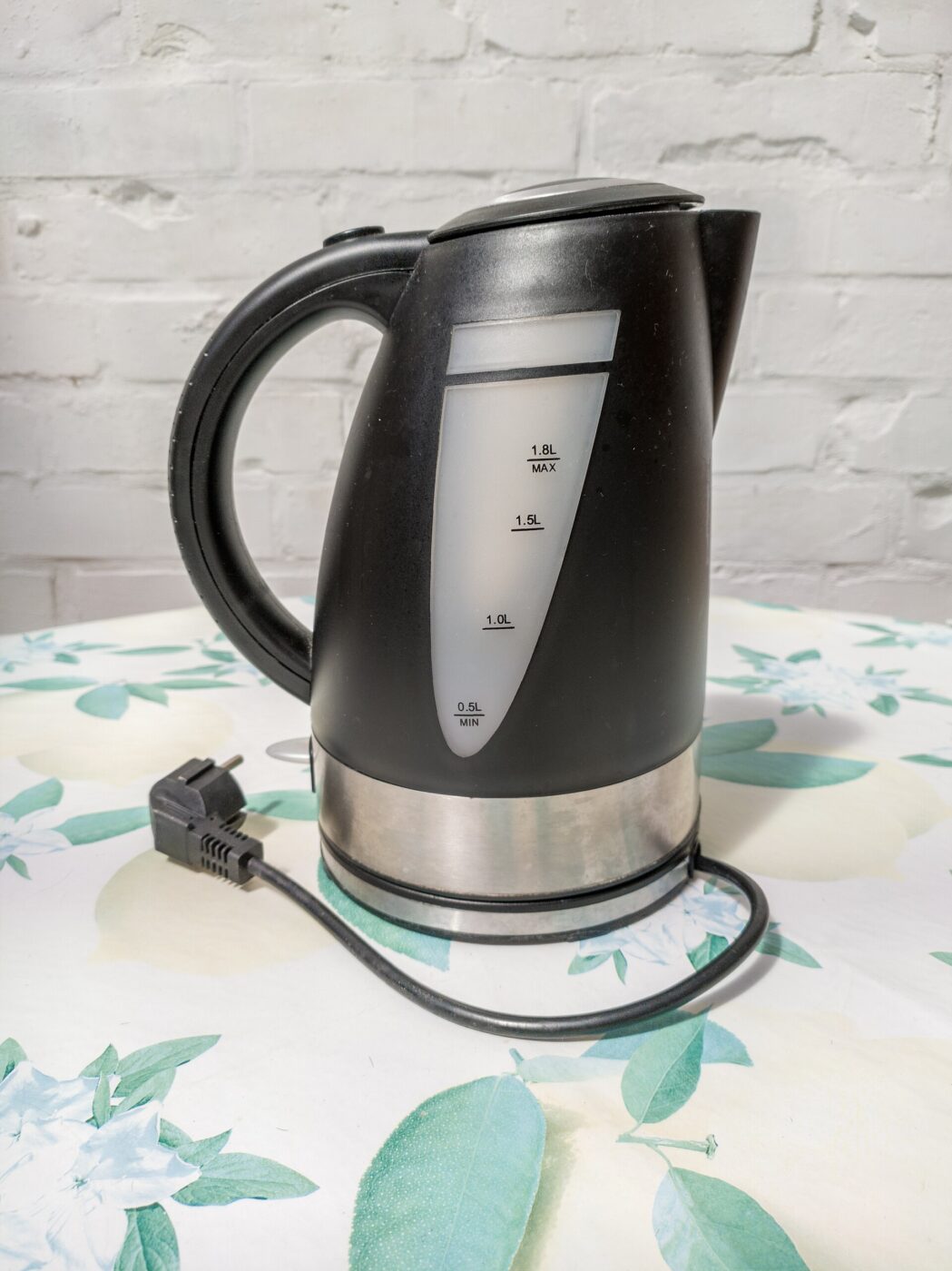
We queried the CPSC recall database on October 1, 2026, matching product names as a substring. A search on kettle returned 18 records, running from 1984 to May 14, 2026. Seven of those 18 name the handle in the hazard statement, and both 2026 entries are handle failures.
The most recent is ZWILLING J. A. Henckels, which recalled about 113,440 US units of the Enfinigy and Enfinigy Pro 1.5 l electric kettles on May 14, 2026 because the handle can loosen and separate from the kettle, spilling hot contents. On April 16, 2026, Macy’s recalled about 4,600 Arch Studio tea kettles because the handle can detach during use when heated. The pattern is old: Whirlpool recalled about 40,200 KitchenAid electric kettles in February 2018 for a handle that can loosen and separate, and Capresso recalled about 15,000 water kettles in September 2005 for a handle that can detach from the glass carafe.
That is the hazard worth checking for, and it has nothing to do with plastic in the water. A recall notice tells you which products were found to fail, not which ones will not, so none of this makes any kettle safe. It does suggest the joint between handle and body deserves the attention the materials debate usually gets.
How to read a kettle listing
Start by asking which parts a materials claim covers. Cosori names three; Fellow names an alloy grade and the plastic components; SharkNinja names none. A single phrase such as BPA free with no parts list tells you something about the marketing and nothing about the build.
Then check the published electrical figures, which decide whether the kettle fits your outlet and how fast it works. SharkNinja publishes 1,500 watts and 12.5 amps for the KT200 and says it boils one cup in as little as 90 seconds; Cosori publishes 1,200 watts for the CO108-NK; Fellow publishes 1000 to 1200 W for the Stagg EKG Pro.
Then check the temperature controls. Fellow publishes 104 degrees F to 212 degrees F for the Stagg EKG Pro, Cosori five presets at 170, 180, 195, 205 and 212 degrees F with a 60-minute hold, and SharkNinja seven presets with a 30-minute hold. Finally, search the CPSC database for the brand. If tea rather than coffee is the use case, the market side is in matcha prices.
What to watch next
- Whether any maker publishes a complete wetted-parts list rather than naming two or three components
- New entries under kettle in the CPSC database, where seven of the 18 existing records involve the handle
- Whether BPA-free claims start naming a test method, which none of the three pages does today
Where to start
Paid links: we earn a commission if you buy through the buttons below, at no extra cost to you. As an Amazon Associate I earn from qualifying purchases.
Electric kettle types compared on published materials and power
| Product type | Good fit for | Where to look |
|---|---|---|
| Stainless steel electric kettle | Fits a materials-first shopper | See listings on AmazonOpens Amazon search results, not one listing: check the model on the product page. |
| Gooseneck kettle with temperature control | Fits pour-over brewing | See listings on AmazonOpens Amazon search results, not one listing: check the model on the product page. |
| Glass electric kettle | Fits fast boiling | See listings on AmazonOpens Amazon search results, not one listing: check the model on the product page. |
Product types that fit the trend described above, not tested models. Check the exact listing before you buy. How we pick them.
Stainless steel electric kettle
Where to look: Amazon
Fellow publishes 304 18/8 stainless steel for the Stagg EKG Pro and names the BPA-free plastic handle and lid pull separately. Cosori limits its claim to the kettle, lid and spout.
- Alloy grade is sometimes published
- No visible plastic in the body
- Claims often cover only three parts
- No third-party materials mark exists
Gooseneck kettle with temperature control
Where to look: Amazon
Cosori publishes five presets at 170, 180, 195, 205 and 212 degrees F with a 60-minute hold; Fellow publishes a 104 to 212 degree F range. Compare hold times, which differ more than the ranges.
- Published preset temperatures
- Hold function is usually timed
- Slower than a wide-spout kettle
- Smaller capacity
Glass electric kettle
Where to look: Amazon
SharkNinja publishes 1,500 watts and 12.5 amps for the KT200 and a boil time of as little as 90 seconds for one cup. Seven of 18 kettle recalls involve the handle, so check that joint.
- Highest published wattage
- Water level is visible
- Glass and handle joints are a known failure point
- Heavier when full
More: Food and Drink trends and how the Trend Signal is scored.
Sources
- Original Electric Gooseneck Kettle CO108-NK — Cosori
- Stagg EKG Pro materials and certifications — Fellow
- Precision Temperature Electric Kettle KT200 — SharkNinja
- Bisphenol A (BPA): Use in Food Contact Application — FDA
- ZWILLING Recalls Electric Water Kettles — CPSC
- Macys Recalls Arch Studio Tea Kettles — CPSC
- Whirlpool Recalls KitchenAid Electric Kettles — CPSC
- Recall database web service — CPSC
Questions readers ask
Is there an electric kettle with no plastic at all?
None of the three pages we read on October 1, 2026 claims that. Cosori says the kettle, lid and spout of the CO108-NK are food-grade stainless steel; Fellow lists 304 18/8 stainless steel plus a BPA-free plastic handle and lid pull for the Stagg EKG Pro; SharkNinja publishes only BPA Free: Yes for the KT200. Each is a partial claim, and none covers every component.
Does BPA-free mean a kettle is certified?
No. There is no US certification mark for BPA-free. The FDA regulates food-contact substances and its published position is that BPA is safe at the current levels occurring in foods, while its food additive regulations no longer provide for BPA-based materials in baby bottles, sippy cups and infant formula packaging because those uses were abandoned.
What do the UL and ETL marks on a kettle cover?
Electrical safety, not materials. Fellow lists ETL compliance, FCC certified, CSA certified and UL compliance for the Stagg EKG Pro. Those marks concern the electrics and electromagnetic interference. The standard that governs lead content in water-contact products, NSF/ANSI/CAN 372, applies to plumbing products rather than countertop kettles.
What goes wrong with electric kettles most often?
On the recall record, the handle. Our query of the CPSC database on October 1, 2026 returned 18 kettle records, seven of which name the handle in the hazard statement, including both 2026 entries: ZWILLING recalled about 113,440 US electric kettles in May 2026 for a handle that can loosen and separate, and Macy’s recalled about 4,600 tea kettles in April 2026 for a handle that can detach when heated.