Matcha has spread from specialty cafes into lattes, baked goods and ready-to-drink products, and Japan’s trade data show how fast. According to Japan’s Ministry of Agriculture, Forestry and Fisheries (MAFF), green tea exports reached a record ¥72.1 billion in 2025, up 98.2% from 2024, with the gain led by powdered tea including matcha used as an ingredient in lattes and sweets.
The surge did not stop there. MAFF’s figures for January through July 2026 show green tea exports of ¥58.2 billion, up 80.9% on the same months of 2025, with the United States, Germany and the U.K. accounting for the biggest increases. That much demand for a crop that needs weeks of shading and specialized processing has pushed leaf prices up in Japan, and a U.S. coffee trade outlet noted in January 2026 that matcha costs had escalated.
Trend Signal
82/100 Strong momentum
- Emerging
- Rising
- Mainstream
- Peaking
- Cooling
Japan green tea exports up 81% in early 2026
Japan’s farm ministry reported green tea exports of ¥58.2 billion for January through July 2026, up 80.9% from a year earlier, after a record ¥72.1 billion in 2025 led by powdered tea including matcha.
Our editorial reading of the cited data, not a forecast. How it is scored
By the numbers
- ¥72.1BJapan green tea exports in 2025, a record, up 98.2% from 2024Japan MAFF
- +80.9%Japan green tea exports, January to July 2026 vs the same months of 2025Japan MAFF
- 85%Share of 2025 green tea shipments from Japan to the U.S., by weight, that was powderedJapan MAFF
- 3.2xGrowth in Japan’s tencha (matcha leaf) production, 2025 vs 2014Japan MAFF
What the export numbers show
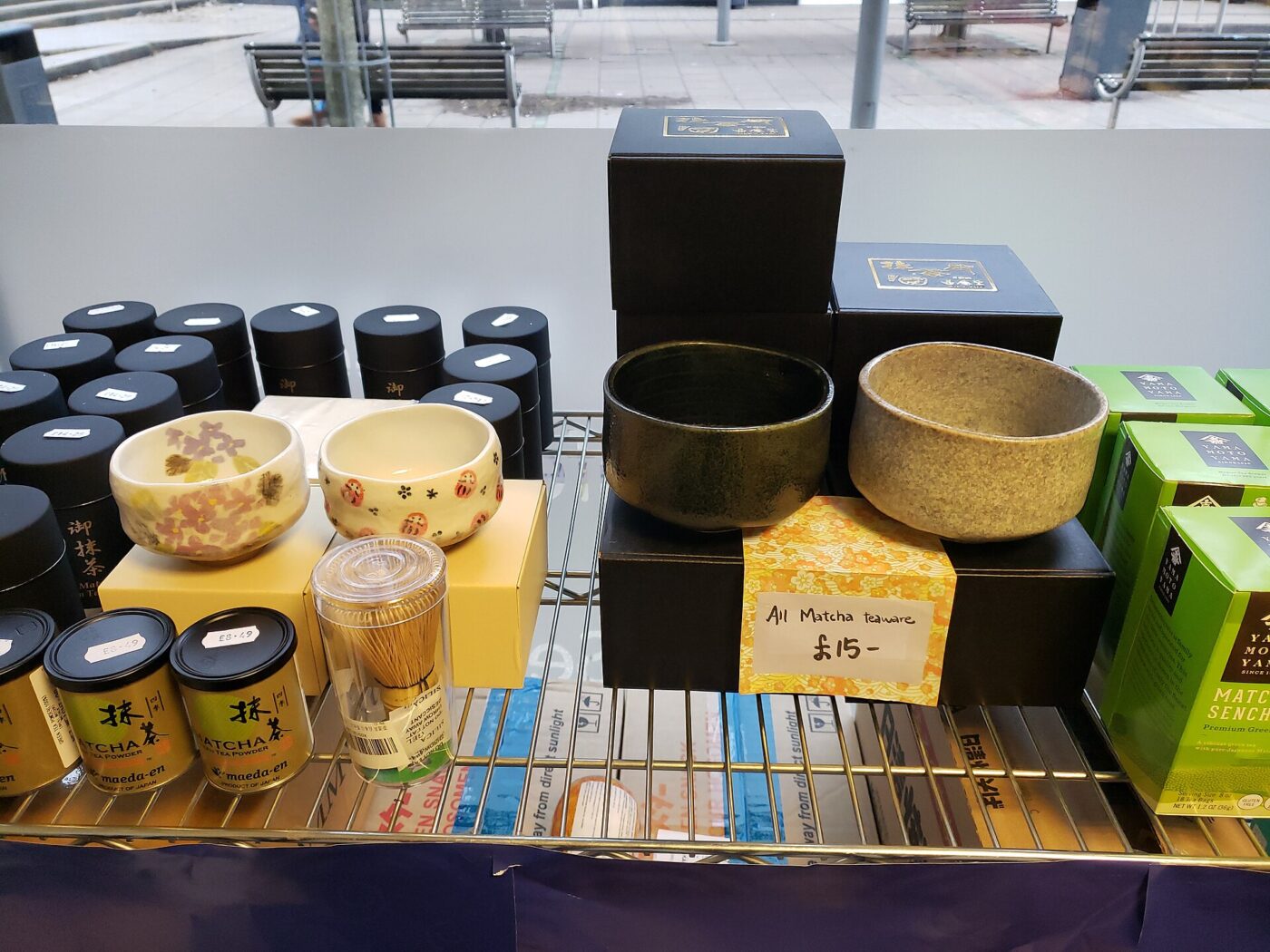
MAFF counts matcha within “powdered” green tea, a trade category that also includes other tea ground into powder by mills. In 2025, powdered tea made up 8,718 of the 12,612 metric tons of green tea Japan exported, or 69% of volume, and ¥60.4 billion of the ¥72.1 billion in value, or 84%. Powdered tea sold for an average of ¥6,927 a kilogram, about 2.3 times the ¥3,007 for other green tea.
The United States is the largest buyer. In 2025 it took 4,431 metric tons worth ¥29.3 billion, which MAFF describes as about 30% of Japan’s green tea export volume, and 85% of that weight was powdered. MAFF’s 2025 export summary credits strong demand for green tea and beef for lifting Japan’s total food and farm exports to the U.S. 13.7% to ¥276.2 billion, even after U.S. tariff measures took effect in April 2025.
| Market | 2025 green tea from Japan, metric tons | Share that was powdered |
|---|---|---|
| United States | 4,431 | 85% |
| EU and U.K. | 2,393 | 78% |
| Taiwan | 1,589 | 12% |
| All markets | 12,612 | 69% |
Powdered tea, the category that includes matcha, is what the U.S. is buying more of, not loose-leaf sencha.
Why leaf prices are climbing
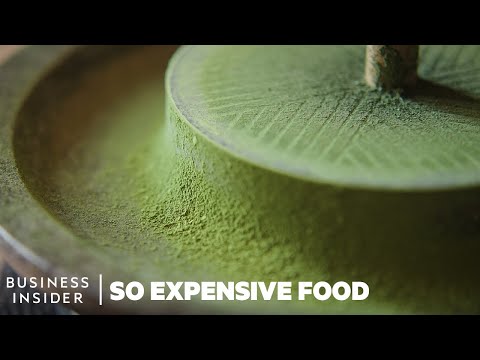
Matcha starts as tencha. Growers shade the tea bushes for about two to three weeks before harvest, then steam the leaves and dry them without rolling; matcha is tencha ground into a fine powder with stone mills. Tencha made up 8.6% of Japan’s rough-tea output in 2025, per MAFF, and production has grown about 3.2 times since 2014 as growers responded to demand. Kagoshima is now the largest tencha-producing prefecture.
Supply growth has not been enough to hold prices down. MAFF reports that tencha averaged ¥8,562 a kilogram across all 2025 harvests, about 4.9 times the ¥1,746 for sencha, the everyday green tea. In spring 2026, first-flush tea overall traded at about double the prior year’s price in Kagoshima and about 70% higher in Shizuoka.
Those costs are reaching U.S. buyers. Daily Coffee News, covering the Alfred chain’s espresso-free matcha cafe in Los Angeles, which opened in late 2025, noted that matcha costs have escalated because of traditional production constraints and booming demand. IWSR, the drinks-market analyst, listed matcha-based ready-to-drink products among the tea innovations it tracked in July 2026, another sign the ingredient is spreading beyond cafes.
Tariffs are not the main driver
The U.S. removed one cost layer in November 2025. An executive order signed November 14, effective for goods entered from November 13, 2025, added green tea in both small and bulk packings to the list of products not subject to the reciprocal tariff, along with black tea, mate, coffee and cocoa. Matcha falls under the green tea headings, which MAFF’s trade classification confirms by counting powdered tea within them.
With green tea off that tariff list, we read the leaf market in Japan, plus importer and retailer margins, as the main drivers of what you pay. Organic supply is a big part of the U.S. trade: MAFF data show 2,784 of the 4,431 metric tons shipped to the U.S. in 2025, or 62.8%, went under organic equivalence arrangements.
In our read, tariff relief helps at the margin, but Japan’s leaf prices matter more for matcha costs in 2026.
Buying matcha without overpaying
Grade names such as “ceremonial” and “culinary” are seller labels, not categories in Japan’s trade data, which group matcha with other powdered green tea. That makes the label details more useful than the grade name: look for whether the powder is made from tencha, the prefecture of origin, a production or best-by date, organic certification if it matters to you, and the price per gram.
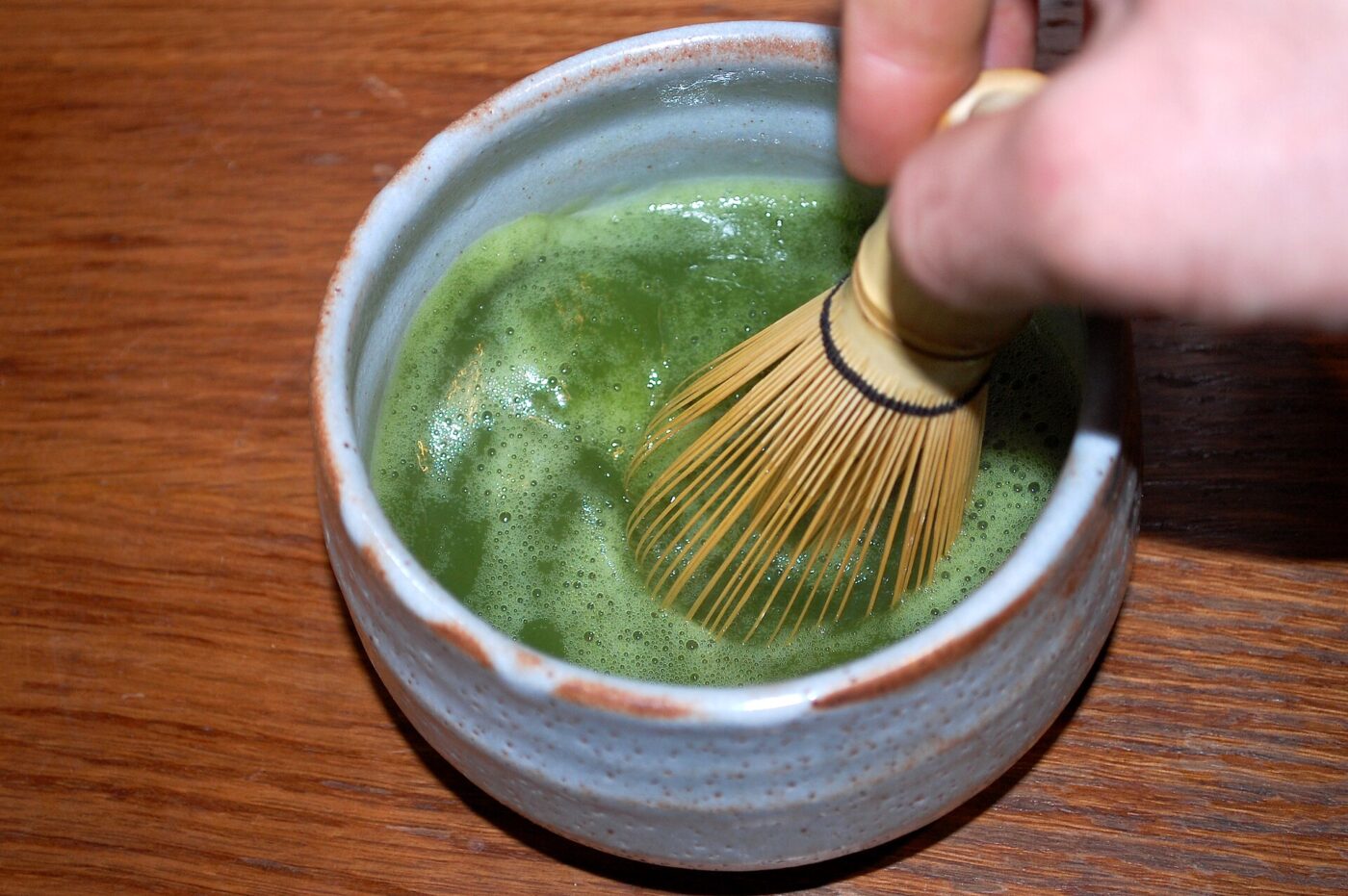
Match the powder to the use. For lattes, smoothies and baking, where milk and sugar mask subtle differences, a lower-priced culinary powder does the job. If you drink matcha whisked with water, paying more per gram makes more sense, and a bamboo whisk is the traditional tool for a smooth cup.
There are counter-signals. Tencha production has more than tripled since 2014, and export growth slowed from 98% in 2025 to 81% in the first seven months of 2026, still fast but no longer accelerating. If planting keeps expanding, leaf prices could cool, but nothing in MAFF’s July 2026 data shows that happening yet.
What to watch next
- MAFF’s August 2026 export figures, which the ministry lists for release on October 2, 2026
- Next spring’s first-flush prices in Kagoshima and Shizuoka, summarized in MAFF’s tea situation updates
- Any change to the U.S. tariff treatment of green tea from Japan
Where to start
Paid links: we earn a commission if you buy through the buttons below, at no extra cost to you. As an Amazon Associate I earn from qualifying purchases.
Matcha buys compared by use
| Product type | Good fit for | Where to look |
|---|---|---|
| Culinary-grade matcha powder | Fits lattes and baking | See listings on AmazonOpens Amazon search results, not one listing: check the model on the product page. |
| Organic Japanese matcha powder | Fits buyers who want organic | See listings on AmazonOpens Amazon search results, not one listing: check the model on the product page. |
| Bamboo matcha whisk set | Fits whisking at home | See listings on AmazonOpens Amazon search results, not one listing: check the model on the product page. |
Product types that fit the trend described above, not tested models. Check the exact listing before you buy. How we pick them.
Culinary-grade matcha powder
Where to look: Amazon
For daily lattes and baking. Compare the price per gram and look for the origin and a production date on the listing.
- Lower price per gram
- Holds up in milk and sugar
- Grade names are not standardized
- Color and taste vary by lot
Organic Japanese matcha powder
Where to look: Amazon
For buyers who want certified organic tea. MAFF data show 62.8% of 2025 green tea volume to the U.S. shipped under organic equivalence.
- Certification is stated on the label
- Most U.S.-bound Japanese tea ships as organic
- Usually costs more per gram
- Certification says nothing about grade
Bamboo matcha whisk set
Where to look: Amazon
For people who drink matcha whisked with water rather than in lattes. Check the tine count and whether a holder is included.
- Traditional tool for a smooth cup
- Sets often include a scoop and holder
- Bamboo tines wear with use
- Needs to dry fully between uses
More: Food and Drink trends and how the Trend Signal is scored.
Sources
- Agricultural, forestry and fishery product and food exports, 2025 (in Japanese) — Japan Ministry of Agriculture, Forestry and Fisheries
- Agricultural, forestry and fishery product and food exports, July 2026 (in Japanese) — Japan Ministry of Agriculture, Forestry and Fisheries
- The tea situation, as of July 2026 (in Japanese) — Japan Ministry of Agriculture, Forestry and Fisheries
- Export results and release schedule (in Japanese) — Japan Ministry of Agriculture, Forestry and Fisheries
- Modifying the Scope of the Reciprocal Tariff with Respect to Certain Agricultural Products — The White House
- Alfred Launches Espresso-Free Cafe Matcha Flagship in LA — Daily Coffee News
- Time for tea: tea trends and beverage alcohol, July 2026 insight — IWSR
Questions readers ask
Why is matcha so expensive in 2026?
Demand has outrun supply. Japan’s green tea exports hit a record ¥72.1 billion in 2025, up 98.2%, and rose another 80.9% in January through July 2026. MAFF reports tencha averaged ¥8,562 a kilogram in 2025, about 4.9 times sencha, and 2026 first-flush tea traded at about double the prior year in Kagoshima.
Is there a matcha shortage?
The data show tight supply rather than none. Japan’s tencha production has grown about 3.2 times since 2014, but powdered tea exports keep rising faster, and Daily Coffee News reported in January 2026 that matcha costs had escalated on production constraints and demand.
Are there U.S. tariffs on matcha from Japan?
The most recent U.S. action on green tea in the official sources we checked is a November 14, 2025 executive order that, effective November 13, 2025, added the U.S. tariff headings for green tea to the list of products exempt from the reciprocal tariff. Matcha is classified under those green tea headings.
What is the difference between ceremonial and culinary matcha?
Grade names are seller labels; Japan’s trade statistics count matcha within powdered green tea and do not use those terms. Compare what the label discloses instead: whether it is made from tencha, the origin, a production date, organic certification and the price per gram.