Amazon’s search box shows how people shop this category. Typing high chair on October 12, 2026 returned high chairs for babies and toddlers in second place and portable high chair in sixth. Those are two different products under federal law, and the gap between them is where the confusion in this aisle lives.
We do not test products and have not tested any high chair. This compares what the federal rules require with what the U.S. Consumer Product Safety Commission published in its own notices. Our selection rule was mechanical: a title search of the CPSC recall service on October 12, 2026 for notices published between January 1, 2024 and that date whose titles name high chairs, with units and hazard wording taken from the notices. The counts and the unit totals below are our arithmetic over those notices, not published agency figures.
Trend Signal
72/100 Strong momentum
- Emerging
- Rising
- Mainstream
- Peaking
- Cooling
Eleven of the thirteen high chair recalls since January 2024 cite a federal standard
Our own count of the CPSC recall service, searched by title on October 12, 2026, found thirteen notices published since January 1, 2024 whose titles name high chairs; eleven state that the product violated a federal safety regulation, most often the high chair rule at 16 CFR part 1231.
Our editorial reading of the cited data, not a forecast. How it is scored
By the numbers
- ASTM F404-21Edition of the high chair standard required for chairs made after July 23, 2022CPSC
- 10 degreesSleep-surface angle above which a product is a banned inclined sleeper under the 2022 lawU.S. Government Publishing Office
- 2,750High chairs recalled on April 3, 2025 over the federal inclined sleeper banCPSC
- About 150Units in the February 26, 2026 recall for a missing attached crotch restraintCPSC
What the federal high chair rule actually says
High chairs are one of the durable infant and toddler products Congress told CPSC to regulate under section 104 of the Consumer Product Safety Improvement Act of 2008. The agency did that in 2018, and the rule sits at 16 CFR part 1231. The part is short: every high chair must comply with all applicable provisions of ASTM F404-21, approved on November 15, 2021.
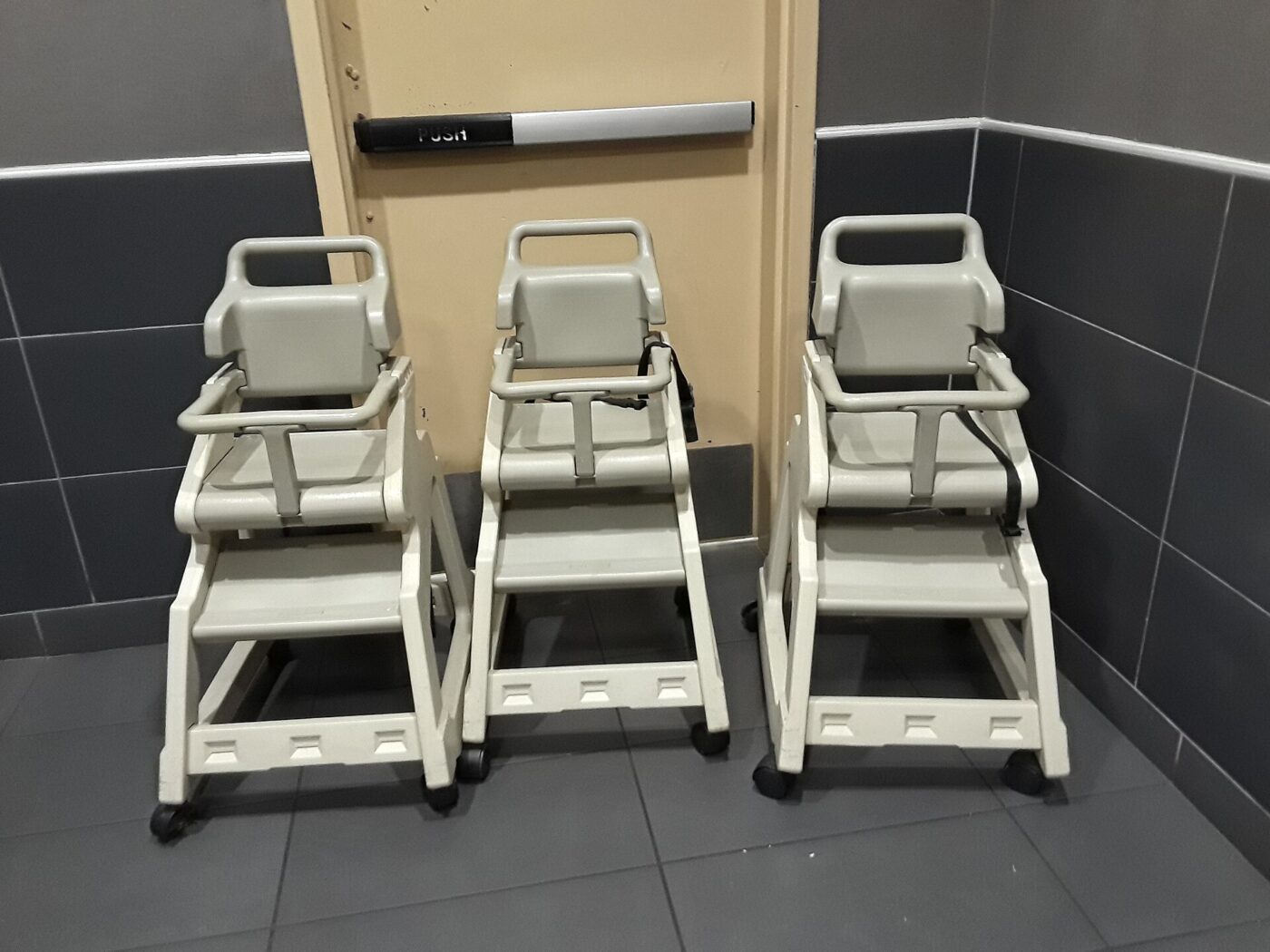
CPSC’s business guidance page for high chairs ties the required edition to the date of manufacture. Chairs made after June 19, 2019 had to meet ASTM F404-18, chairs made after July 3, 2021 had to meet F404-20, and chairs made after July 23, 2022 have to meet F404-21. The same page defines the product that falls inside the rule: a freestanding chair for a child up to 3 years of age with a seating surface more than 15 inches above the floor that raises the child for feeding or eating.
One part number, one ASTM edition, and a scope that turns on seat height and the age the chair is sold for.
Portable high chair is not one product in federal law
The sixth autocomplete suggestion, portable high chair, covers at least three regulated shapes. A folding freestanding chair is still a high chair under part 1231. A seat that clamps onto the edge of a table is a portable hook-on chair, regulated separately at 16 CFR part 1233, which as amended on March 30, 2026 now incorporates ASTM F1235-25, approved November 15, 2025. A seat that straps onto an adult dining chair is a booster seat under 16 CFR part 1237, which incorporates ASTM F2640-18, approved April 1, 2018.
That matters because the certificate, the test report and the warning set all follow the part number, not the marketing word. CPSC made the point itself in a March 7, 2024 recall of a 3-in-1 product sold as both a high chair and a booster seat: notice 24-153 says the product violated the safety regulations for both categories, and lists failures across restraint, stability, static load, latching, leg openings and warnings.
The failures the 2024 to 2026 notices kept naming
Reading the notices in sequence, the wording barely changes. The restraint is missing or not attached, so a child can fall. The opening between the seat and the tray, or between the seat and the side, is large enough for a child’s head, so the notice calls it an entrapment hazard. In notice 26-290 of February 26, 2026, CPSC said the chairs were sold without the required attached crotch restraint.
The volumes are small, and all eleven standard-violation notices name an online listing. Adding up the units CPSC states in them gives about 24,800 chairs, which is our arithmetic and not an agency total. Two of the thirteen notices cite no standard at all, and they are the two with injuries attached. Notice 24-311 of July 25, 2024 covered about 27,140 plastic restaurant high chairs after nine reports of a front T-bar loosening or breaking, with two injuries. Notice 25-336 of June 12, 2025 covered about 18,280 Bugaboo Giraffe highchairs whose legs could detach if the screws were not properly tightened during assembly, after 22 reports of legs detaching, including 13 reports of minor injuries. Between them those two notices cover more chairs than every standard-violation recall in the period combined.
| Date | Notice | Units | What CPSC said failed |
|---|---|---|---|
| Feb 26, 2026 | 26-290 | About 150 | No attached crotch restraint; head entrapment between seat and side |
| Nov 26, 2025 | 26-121 | About 130 | No attached restraint system; head entrapment between seat and tray |
| Oct 30, 2025 | 26-061 | About 4,300 | No attached restraint system; seat-to-tray entrapment |
| Jun 26, 2025 | 25-706 | About 950 | Infant sleep marketing above ten degrees; high chair warning requirements |
| Jun 5, 2025 | 25-318 | About 380 | Restraint system can fail; seat-to-tray entrapment |
| May 15, 2025 | 25-278 | About 5,400 | Unattached restraint; locks or latches can fail; entrapment |
| Apr 10, 2025 | 25-222 | About 1,400 | Activity center leg openings too wide; tray can disengage |
| Apr 3, 2025 | 25-206 | About 2,750 | Marketed for infant sleep above ten degrees |
| Feb 27, 2025 | 25-166 | About 4,400 | Inclined sleeper ban plus seat-to-tray entrapment |
| Sep 12, 2024 | 24-362 | About 4,760 | Leg openings too wide; tray can disengage |
| Mar 7, 2024 | 24-153 | About 175 | Restraint, stability, static load, latching, leg openings, warnings |
When a feeding chair becomes a banned sleep product
Three of the notices are not really about feeding. The Safe Sleep for Babies Act of 2021, enacted as Public Law 117-126 on May 16, 2022, made inclined sleepers for infants a banned hazardous product under section 8 of the Consumer Product Safety Act regardless of the date of manufacture. The statute defines one as a product with an inclined sleep surface greater than ten degrees that is intended, marketed, or designed to provide sleeping accommodations for an infant up to 1 year old, and CPSC’s own rule at 16 CFR part 1236 carries the matching ten-degree limit. So a recliner mode marketed as a place a baby can nap turns the product into something the statute bans outright.
That is exactly what the April 3, 2025 notice says. About 2,750 convertible and foldable high chairs sold online from April 2023 through August 2024 were recalled because they were marketed for infant sleep and had an incline greater than ten degrees, in violation of both the Infant Sleep Products Rule and the Safe Sleep for Babies Act. The February 27, 2025 and June 26, 2025 notices make the same citation. If a product page sells a reclining mode as a sleep mode, that is the claim CPSC has been acting on.
Four things are checkable before you buy: the recall database searched by brand and by storefront, the part number that matches the shape of the seat, the tracking label that children’s products must carry, and whether a sleep mode is advertised at all. A notice tells you which units CPSC found failing a requirement; it does not tell you that an unrecalled model passes. Our write-ups on the car seat side impact standard and the gate and enclosure rule cover the neighboring parts of 16 CFR.
A nap claim on a feeding chair is a regulatory problem, not a feature.
What to watch next
- Whether CPSC moves part 1231 to a newer ASTM F404 edition, as it did for portable hook-on chairs in March 2026; the edition in force is printed in the part text on eCFR
- Whether monthly CPSC notices keep naming marketplace sellers of convertible high chairs rather than established brands
Where to start
Paid links: we earn a commission if you buy through the buttons below, at no extra cost to you. As an Amazon Associate I earn from qualifying purchases.
Feeding seat shapes and the federal rule that applies to each
| Product type | Good fit for | Where to look |
|---|---|---|
| Full-size convertible high chair | Fits a dedicated feeding spot | See listings on AmazonOpens Amazon search results, not one listing: check the model on the product page. |
| Portable hook-on chair | Fits restaurants and small kitchens | See listings on AmazonOpens Amazon search results, not one listing: check the model on the product page. |
| Booster seat for a dining chair | Fits a child who has outgrown a tray | See listings on AmazonOpens Amazon search results, not one listing: check the model on the product page. |
Product types that fit the trend described above, not tested models. Check the exact listing before you buy. How we pick them.
Full-size convertible high chair
Where to look: Amazon
The shape the high chair rule was written for. The listing detail worth reading is the mode list: every extra mode adds a regulation the same frame has to clear.
- Tray and footrest are standard
- Covered squarely by 16 CFR part 1231
- Convertible modes pull in extra rules
- Takes permanent floor space
Portable hook-on chair
Where to look: Amazon
Regulated as a portable hook-on chair under 16 CFR part 1233, which moved to ASTM F1235-25 in March 2026, not as a high chair. Check the published table thickness range before anything else.
- No floor footprint
- Folds for a bag
- Sits under a different rule, 16 CFR part 1233
- Depends entirely on the host table
More: Baby and Parenting trends and how the Trend Signal is scored.
Sources
- 16 CFR part 1231, Safety Standard for High Chairs — eCFR
- Business Guidance: High Chairs — U.S. Consumer Product Safety Commission
- Bicystar High Chairs recall, notice 26-290 — CPSC
- HONEYJOY high chairs recall, notice 25-206 — CPSC
- Safe Sleep for Babies Act of 2021, Public Law 117-126 — GPO
- 16 CFR part 1233, Safety Standard for Portable Hook-on Chairs — eCFR
- Bugaboo Giraffe High Chairs recall, notice 25-336 — CPSC
- Lancaster Table & Seating Plastic Restaurant High Chairs recall, notice 24-311 — CPSC
- 16 CFR part 1237, Safety Standard for Booster Seats — eCFR
Questions readers ask
Does a high chair sold in the United States have to meet a federal standard?
Yes. 16 CFR part 1231 requires every high chair to comply with ASTM F404-21 if it was made after July 23, 2022, and CPSC also requires a Children’s Product Certificate citing that part under section 14(a) of the Consumer Product Safety Act.
Is a portable high chair covered by the same rule?
Not necessarily. A folding freestanding chair stays under part 1231, a seat that clamps to a table is a portable hook-on chair under part 1233, which moved to ASTM F1235-25 in March 2026, and a seat that straps to a dining chair is a booster seat under part 1237 and ASTM F2640-18.
What did CPSC cite most often in high chair recalls between 2024 and 2026?
A restraint that was missing, unattached or able to fail, and an opening between the seat and the tray large enough to trap a child’s head. Both appear in the notices as violations of the federal high chair regulation. The Children’s Product Certificate that proves testing is not published to shoppers; the tracking label and the recall database are.
Why were some high chairs recalled over sleep rather than feeding?
The Safe Sleep for Babies Act of 2021, Public Law 117-126 of May 16, 2022, bans inclined sleepers for infants with a sleep surface angle greater than ten degrees. CPSC cited that ban, and its own 16 CFR part 1236, in the April 3, 2025 and February 27, 2025 high chair recalls.