Amazon returned ten completions for jump rope weighted on October 12, 2026, and they are not ten versions of the same product. Some add weight to the cord, some add it to the handles, and some remove the cord entirely and leave a weighted stub spinning in each hand. The number on the listing, 0.5 or 1 pound, can refer to any of the three, and the three behave nothing alike.
We have not tested any of these ropes. This explainer reads what makers publish about cord weights, cable construction and handle grades, and checks the category against the Consumer Product Safety Commission recall database on October 12, 2026. We worked only from products whose own pages state a weight or a cable specification.
Trend Signal
58/100 Steady momentum
- Emerging
- Rising
- Mainstream
- Peaking
- Cooling
Three different products share one label on the listing page
The ten Amazon US completions for jump rope weighted on October 12, 2026 describe three distinct products: a weighted cord, weighted handles and a cordless weighted stub. One maker publishes cords from 1 ounce to 5 pounds and cordless attachments from 1/4 to 3 pounds, with handle grades matched to the cord weight.
Our editorial reading of the cited data, not a forecast. How it is scored
By the numbers
- 1 oz to 5 lbPublished span of one maker rope line, a 1 oz sprint rope to a 5 lb heavy ropeCrossrope
- 0.1 inPublished cable diameter of a competition speed rope, rubber-coated galvanized steelREP Fitness
- 66,000Children’s activity books whose Chinese jump ropes were recalled in June 1997CPSC
- +3.5%BLS consumer price index for sports equipment, August 2025 to August 2026BLS
Three places the weight can sit
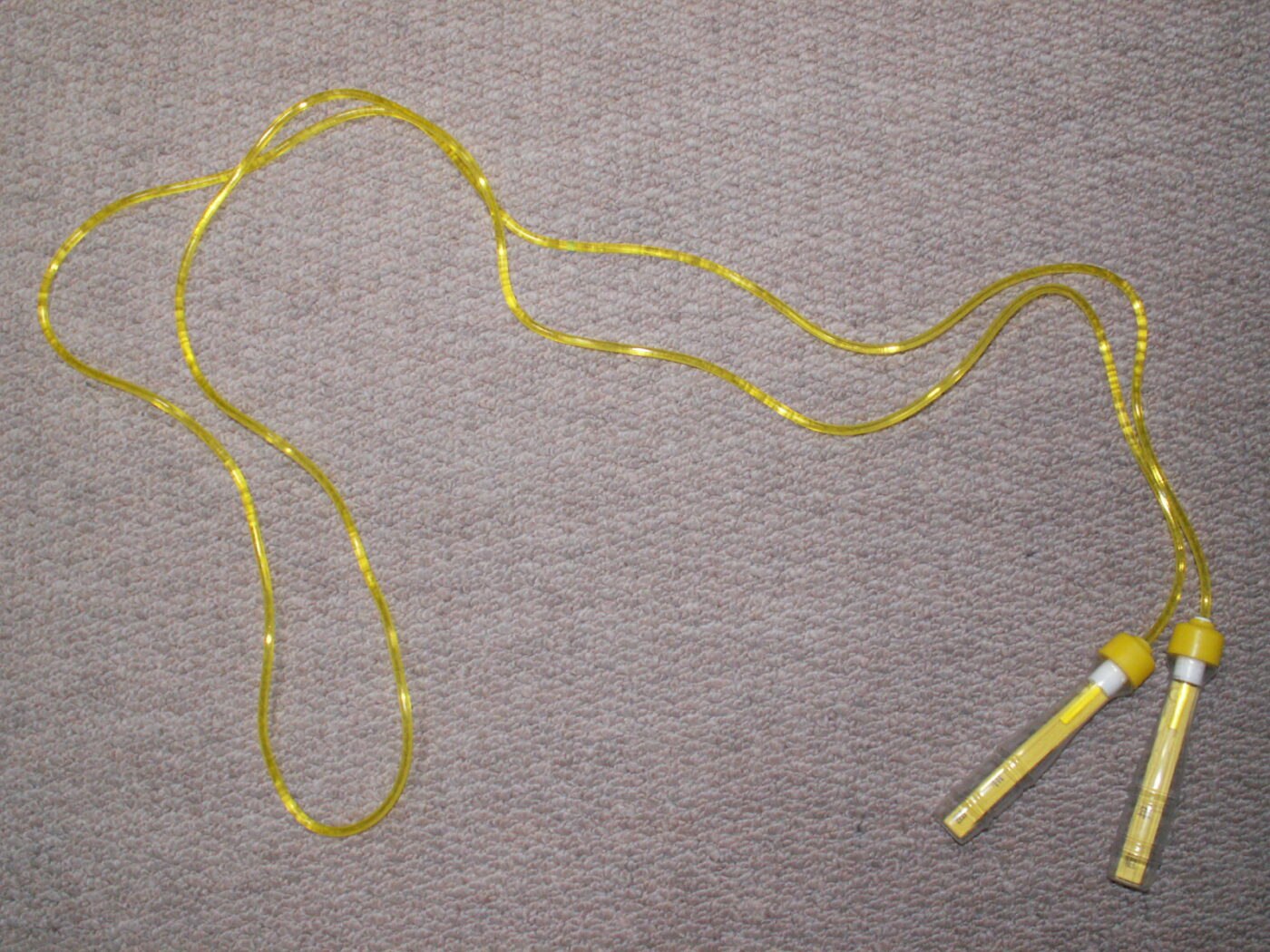
The clearest published range in the category belongs to Crossrope, which sells the weight separately from the handles and therefore has to state it. Its classic sets pair handles with cords of 1/4 and 1/2 pound or 1 and 2 pounds, its heavy line publishes cords at 3/4, 1.5, 3, 4 and 5 pounds, and and its speed line publishes cords at 3, 6 and 9 ounces, with a 2-ounce speed rope and a 1-ounce sprint rope in a separate line. That is a ladder from an ounce to 5 pounds, all in the cord.
The same maker publishes cordless attachments at 1/4, 1/2, 3/4, 1, 1.5, 2 and 3 pounds. A cordless rope puts that mass in a short stub spinning from each handle, so the hands feel a load and nothing passes under the feet. The published weights make the comparison explicit: the same 1-pound figure can describe a cord you jump over or a stub you do not.
The third case is the weighted handle, which the Amazon completions name directly. Here the cord is light and the mass sits in your palms, so the load is static rather than swinging. Neither of the two makers whose pages we read, Crossrope and REP Fitness, publishes a handle weight on its own the way cord weights are published, but Crossrope does grade handles to the cord: slim handles for the lighter ropes, power handles for the heavier ones, and a separate grade published for the 4 and 5 pound cords. That grading is the clue a buyer can use, because a handle sold for 5-pound cords is built for a different load than one sold for a quarter pound.
Read where the weight is before you read how much. A pound in the cord, in the handles or in a stub are three products.
What a speed rope is instead
A speed rope is specified by cable, not by mass. REP Fitness publishes a competition rope with a 0.1-inch rubber-coated galvanized steel cable, 118.1 inches long, adjustable by hand, on 5.9-inch knurled handles with ball bearings, and the whole rope is published at 0.4 pounds. The stated use is double-unders and faster work.
Set that against the weighted ladder and the arithmetic is informative: a complete competition rope, handles included, weighs less than half of a 1-pound weighted cord. The two categories are not competing on a spectrum. One is built so that the rope disappears, the other so that you feel it.
The cable spec also tells you where speed ropes fail. A thin coated steel cable kinks, and once kinked it will not travel straight. That is why adjustability and replaceability matter more than weight on this side of the category.
Why cordless exists, and what it gives up
A turning rope needs more room than people expect: clearance above the head for the arc, clearance in front and behind for the cord to pass, and a floor surface that will not chew the cord. Low ceilings, pendant lights and carpet all defeat it, and in a shared building the repeated contact of a cord on a hard floor is a noise question for the room below, the same constraint we set out for under-desk treadmills in apartments.
The cordless format answers all of that by deleting the cord. The published attachment weights run from 1/4 to 3 pounds, so most of the corded ladder can be matched in the hand; what disappears is the arc, the trip and the contact noise. What also disappears is the thing that enforces the timing, because nothing passes under your feet, so the rhythm is yours to keep rather than the rope’s.
Our read is that the cordless version is a room-constrained purchase rather than an upgrade, much like the gear in the weighted vest trend. If you have the ceiling and the floor, the corded version does something the cordless one cannot.
Cordless matches the weight and removes the arc. The rhythm goes with the cord.
What the safety record does and does not say
A product-name search of the CPSC recall database on October 12, 2026 for jump ropes returned a single entry, from June 19, 1997. Klutz offered to replace the Chinese jump ropes sold with about 66,000 children’s activity books, because the ends of the elasticized ropes were joined by metal crimps that could fail in use. The company had received 17 reports of ropes breaking apart, and one child was struck and scratched near the eye without needing medical attention. The remedy was to replace every metal-crimped rope with a knotted one.
That is the whole federal record for this product type. No weighted rope, no cordless rope and no weighted-handle rope appears in that search, which means a buyer has no recall history to screen against, unlike adjustable dumbbells or resistance bands, where a run of notices lets you compare a product against a documented failure mode.
What the 1997 notice still teaches is where a rope comes apart: at the junction between cord and handle or crimp. That is the joint to look at in any published photograph, and the reason the handle grade matched to cord weight is worth more attention than the weight number itself.
Matching the rope to the use and the room
If the room has the ceiling height and a floor you do not mind, a corded rope is the full product, and the published ladder sorts cleanly, since the maker sells its ounce ropes as speed ropes and its pound-and-up cords as heavy ropes. Buy the handle grade the maker pairs with that cord rather than mixing.
If the room does not, the cordless attachment in the same published weight is the honest substitute, and the weighted-handle version is the hardest to check, because the mass is static in your hands and neither of the two makers we read publishes a handle weight on its own. Prices are drifting up either way: the BLS consumer price index for sports equipment rose 3.5% between August 2025 and August 2026 after falling 0.3% over calendar 2025, and the producer price index for sporting and athletic goods manufacturing rose 4.1% from December 2024 to August 2026. For the rest of a home setup, see our equipment price trail and at-home HYROX gear.
What to watch next
- Any first CPSC entry for a weighted or cordless jump rope, since the category has no modern notice at all
- Whether makers start publishing handle weights the way they publish cord weights
- The monthly BLS sports equipment CPI, for whether the 2026 increase holds through the discount window
Where to start
Paid links: we earn a commission if you buy through the buttons below, at no extra cost to you. As an Amazon Associate I earn from qualifying purchases.
Jump rope formats compared on the things that differ
| Product type | Good fit for | Where to look |
|---|---|---|
| Weighted-cord jump rope set | Fits a room with ceiling height | See listings on AmazonOpens Amazon search results, not one listing: check the model on the product page. |
| Cordless weighted jump rope | Fits low ceilings | See listings on AmazonOpens Amazon search results, not one listing: check the model on the product page. |
| Bearing speed rope with steel cable | Fits timed speed work | See listings on AmazonOpens Amazon search results, not one listing: check the model on the product page. |
Product types that fit the trend described above, not tested models. Check the exact listing before you buy. How we pick them.
Weighted-cord jump rope set
Where to look: Amazon
The format with the clearest published specs, because the weight sits in a cord sold separately from the handles. Match the handle grade the maker pairs with the cord weight.
- Published cord weights from ounces to 5 pounds
- Rope enforces the timing
- Needs overhead and floor clearance
- Cord wears where it meets the handle
Cordless weighted jump rope
Where to look: Amazon
One maker publishes cordless attachments at 1/4, 1/2, 3/4, 1, 1.5, 2 and 3 pounds, mirroring the lighter half of its corded ladder. A room-constrained substitute rather than a different kind of training.
- Same published weights as corded
- No arc and no cord contact noise
- Nothing enforces the rhythm
- Handles are often sold separately
Bearing speed rope with steel cable
Where to look: Amazon
A published competition rope weighs 0.4 pounds complete, with a 118.1-inch cable on 5.9-inch handles. Specified by cable and bearing rather than by weight.
- Published 0.1-inch coated steel cable
- Ball bearings and hand adjustment
- Cable kinks once and stays kinked
- No useful load on the shoulders
More: Fitness and Training trends and how the Trend Signal is scored.
Sources
- Jump rope and cordless attachment weights — Crossrope
- Competition speed rope specifications — REP Fitness
- Klutz Chinese jump rope recall, June 1997 — CPSC
- Recalls and product safety warnings database — CPSC
- CPI, sports equipment, CUUR0000SERC02 — BLS
- PPI, sporting and athletic goods manufacturing — BLS via FRED
Questions readers ask
What does weighted mean on a jump rope listing?
It can mean three different things: mass in the cord, mass in the handles, or a cordless weighted attachment. One maker publishes cords from 1 ounce to 5 pounds and cordless attachments at 1/4, 1/2, 3/4, 1, 1.5, 2 and 3 pounds, so the same number can describe very different products.
How heavy is a speed rope by comparison?
A published competition speed rope weighs 0.4 pounds in total, with a 0.1-inch rubber-coated galvanized steel cable 118.1 inches long on 5.9-inch handles with ball bearings. That is less than half the weight of a 1-pound weighted cord.
Are cordless jump ropes a real substitute?
Their published attachment weights run from 1/4 to 3 pounds, which covers most of the corded ladder, and they remove the arc, the trip risk and the cord noise. What they do not do is enforce the timing, because nothing passes under your feet.
Have weighted jump ropes been recalled?
We searched the CPSC recall database on October 12, 2026 and found no entries for weighted, cordless or weighted-handle ropes. The only jump rope recall in it is from June 19, 1997, covering the ropes sold with about 66,000 children’s activity books, whose metal crimps could fail.
Are jump rope prices rising?
There is no published index for jump ropes. The BLS consumer price index for sports equipment rose 3.5% from August 2025 to August 2026 after falling 0.3% over calendar 2025, and the producer price index for sporting and athletic goods manufacturing rose 4.1% from December 2024 to August 2026.