The economics of home printing are laid out plainly in HP’s own accounts. In its Form 10-Q for the three months to July 31, 2026, signed on August 26, 2026, its printing segment took $3,912 million of revenue, and $2,536 million of that came from supplies: ink, toner and media. Hardware for consumers accounted for $275 million. The machine has never been the product.
What has changed is the machine buyers now pick. HP told the SEC that consumer printer unit volume fell 9.1 percent in that quarter while average selling prices rose 16.5 percent, and it attributed the price increase primarily to favorable mix shifts towards Big Tank, the name for its refillable, bottle-fed line, and to currency impacts. Epson, which has sold that idea since 2011, announced a $159.99 list price for its cheapest model on July 1, 2026.
Trend Signal
62/100 Steady momentum
- Emerging
- Rising
- Mainstream
- Peaking
- Cooling
Fewer consumer printers sold, at higher prices, on a tank mix
HP told the SEC, in a Form 10-Q signed August 26, 2026, that consumer printer unit volume fell 9.1 percent in the three months to July 31, 2026 while average selling prices rose 16.5 percent, which it attributed primarily to favorable mix shifts towards Big Tank, its refillable line, and to currency.
Our editorial reading of the cited data, not a forecast. How it is scored
By the numbers
- 65%Supplies share of HP printing revenue, three months to July 31, 2026 (our calculation)HP via SEC
- +16.5%HP consumer printer average selling prices, three months to July 31, 2026HP via SEC
- $159.99Manufacturer list price of the cheapest Epson EcoTank, announced July 1, 2026Epson
- 100MEcoTank units Epson said in July 2025 it had sold worldwide, 2011 to October 2024Epson
What HP’s own quarter shows
HP breaks printing into three lines, and all three shrank in the three months to July 31, 2026: supplies fell 2.8 percent to $2,536 million, commercial printing fell 1.1 percent to $1,101 million and consumer printing fell 1.8 percent to $275 million.
The interesting detail is underneath. HP said supplies declined primarily because of a falling installed base and lower usage, partly offset by pricing actions. In other words, fewer HP printers are in service and the ones that are print less, and the company is holding revenue up on price. Across all printing, units fell 6.8 percent while average selling prices rose 5.8 percent.
For consumers specifically, HP reported a 9.1 percent drop in printer unit volume and a 16.5 percent rise in average selling prices, which it said were driven primarily by favorable mix shifts towards Big Tank and by currency impacts. That is a vendor with the largest supplies business in the industry telling investors that its own buyers are moving to the printers that buy fewer cartridges.
HP is selling fewer consumer printers at higher prices, and it names the tank line as the reason.
How cheap the entry point got

Epson set the low end on July 1, 2026 with three additions to its seventh-generation EcoTank line: the ET-1910 at $159.99, the ET-2900 at $239.99 and the ET-4903 at $299.99. Epson says the ET-1910 ships with enough ink for up to 3,600 black and 6,500 color pages and that the ink in the box lasts up to three years at about 100 pages a month.
Higher up the same line, announced on July 7, 2025, the ET-3950 listed at $419.99 and the ET-4950 at $499.99, with a replacement ink set Epson rates at 8,500 black and 6,500 color pages and describes as equivalent to about 80 individual cartridges. In that release Epson said the EcoTank line had sold over 100 million units, which a footnote scopes to worldwide sales from 2011 to October 2024, and cited Circana retail tracking data for the 12 months ending January 2025 for its claim to be the best-selling supertank line.
The up-front gap is the whole trade. A tank printer asks for more money on day one and less afterwards, and the payback depends entirely on how many pages come out of it before it fails or is replaced.
| Model | List price at announcement | Ink in the box, as stated by Epson |
|---|---|---|
| EcoTank ET-1910 (July 2026) | $159.99 | Up to 3,600 black / 6,500 color pages |
| EcoTank ET-2900 (July 2026) | $239.99 | Up to three years at about 100 pages a month |
| EcoTank ET-4903 (July 2026) | $299.99 | Up to three years at about 100 pages a month |
| EcoTank ET-3950 (July 2025) | $419.99 | Replacement set rated 8,500 black / 6,500 color |
| EcoTank ET-4950 (July 2025) | $499.99 | Replacement set rated 8,500 black / 6,500 color |
Where the savings claims need reading twice
In its July 1, 2026 release Epson said buyers can save up to 90 percent with replacement ink bottles against ink cartridges, with the footnote putting the comparison against Epson standard-capacity cartridges for similarly featured Epson consumer inkjet printers using prices and yields as of May 2026. On its EcoTank Pro page, as published in September 2026, it claims up to 80 percent against standard-capacity color laser toner cartridges, with a footnote basing that on best-selling color laser printers priced at $999 or less and speeds of 40 ppm or less, using industry data it dates to August 2020.
Both are the manufacturer’s own comparisons, measured on its own test suites, and both are ceilings rather than typical outcomes. Epson’s own footnotes say actual savings vary considerably with print tasks, volumes and usage, and one of the underlying comparisons rests on pricing data more than five years old. A household printing a few hundred pages a year will not reach the page counts these figures assume.
Epson’s offer of unlimited ink for two years on EcoTank Pro models also carries conditions: registration within 30 days of purchase, four ink bottles per claim with no repeated colors, and empty bottles retained for submission with the rebate form.
Treat the percentage savings as the vendor’s ceiling, then redo the math at your own page count.
Who the switch actually pays off for
The break-even is a page count, not an opinion. A tank printer costs more up front and refills in bottles; a cartridge printer costs less up front and refills in cartridges. If a household prints enough to buy cartridges more than once or twice a year, the front-loaded machine wins on the arithmetic the vendors themselves publish. If it prints a ream a year, the cheaper machine probably outlives its own math.
There is a second reason the tank market is growing that has nothing to do with savings: the installed base is shrinking. HP attributes its supplies decline to fewer printers in service and less printing per printer, and a household that prints rarely is exactly the household that resents an ink purchase. A machine that comes with years of ink removes the transaction rather than the cost.
For anyone printing mostly text, a monochrome laser is the other honest answer, with toner instead of ink. Epson’s footnote measures its Pro savings claim against color laser printers priced at $999 or less, not against a basic mono unit.
- Count your pages a year before comparing any savings claim
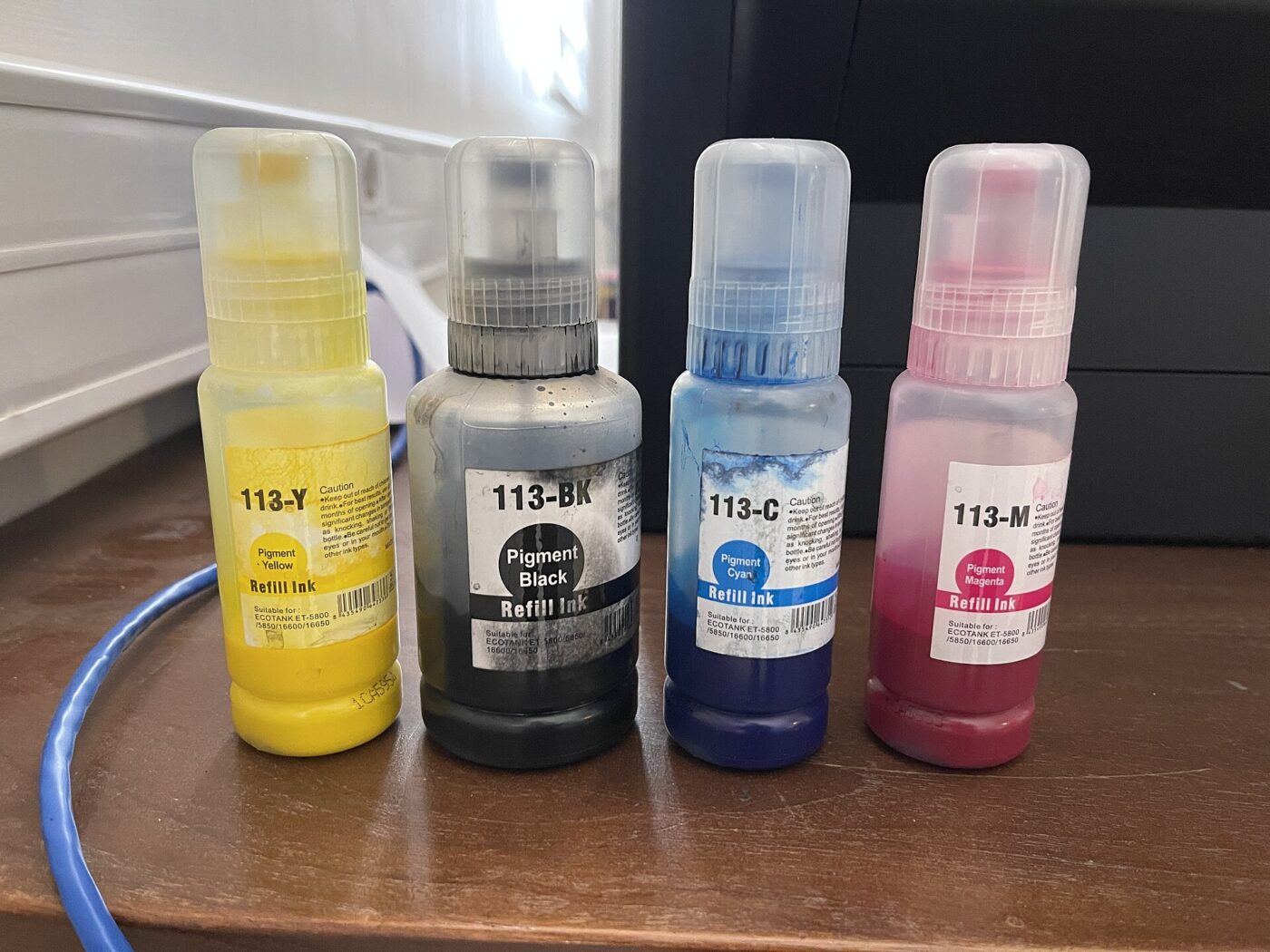
- Check the ink bottle model numbers the printer takes, and that they are sold as a set
- Check for automatic duplex if the printing is double-sided documents
The counter-signal in the same filing
The whole category is shrinking. HP’s printing revenue fell in every line in the quarter to July 31, 2026, and the supplies decline was blamed on installed base and usage rather than competition. A tank printer bought in 2026 is a purchase inside a market that is getting smaller each year.
We read HP’s disclosure as the most useful public marker in this category: when the supplies giant reports rising consumer prices driven by its own tank line, the shift is no longer a niche preference.
What to watch next
- HP quarterly reports, for whether consumer printer average selling prices keep rising on a tank mix shift
- Epson entry-level list pricing, after the $159.99 announced on July 1, 2026
- HP supplies revenue, which fell 2.8 percent in the quarter to July 31, 2026 on a shrinking installed base
Where to start
Paid links: we earn a commission if you buy through the buttons below, at no extra cost to you. As an Amazon Associate I earn from qualifying purchases.
Home printer types compared on where the money goes
| Product type | Good fit for | Where to look |
|---|---|---|
| Cartridge-free ink tank all-in-one | Fits steady color and photo printing | See listings on AmazonOpens Amazon search results, not one listing: check the model on the product page. |
| Monochrome laser printer | Fits text-heavy printing | See listings on AmazonOpens Amazon search results, not one listing: check the model on the product page. |
| Replacement ink bottle set | Fits an ink tank printer already owned | See listings on AmazonOpens Amazon search results, not one listing: check the model on the product page. |
Product types that fit the trend described above, not tested models. Check the exact listing before you buy. How we pick them.
Cartridge-free ink tank all-in-one
Where to look: Amazon
The type HP says is pulling its own consumer prices up. Worth it when the household prints enough to buy ink more than once or twice a year.
- Ink in the box is measured in thousands of pages
- Refills are bottles, not chipped cartridges
- Costs more on day one
- Bottle sets are model-specific
Monochrome laser printer
Where to look: Amazon
The other answer for documents rather than photos. Check whether the included toner is a full or starter cartridge, because that changes the real entry price.
- Toner does not dry out between jobs
- Simple consumable to buy
- No color
- Starter toner is often smaller than a full cartridge
Replacement ink bottle set
Where to look: Amazon
Buy against the model code printed on the old bottle. Epson rates a replacement set for its ET-3950 class at 8,500 black and 6,500 color pages.
- Sold as multi-color sets
- Yields are published per set
- Wrong model code means wrong bottle
- Sets can omit the color you actually ran out of
More: Work and Office trends and how the Trend Signal is scored.
Sources
- HP Inc. quarterly report on Form 10-Q for the period ended July 31, 2026 — US Securities and Exchange Commission
- Epson introduces its most affordable Supertank to date in seventh generation EcoTank line — Epson via PR Newswire
- Epson unveils full line of seventh generation EcoTank cartridge-free Supertank printing solutions — Epson
- EcoTank Pro cartridge-free printers — Epson America
Questions readers ask
Is an ink tank printer worth it?
It depends on page count. Epson claims savings of up to 90 percent on replacement bottles against cartridges, but that is the company’s own ceiling, measured on its own test suite. The up-front price is higher: its cheapest EcoTank carried a $159.99 list price on July 1, 2026, while the ET-4950 listed at $499.99 in July 2025.
Are tank printers actually taking over?
They are taking a growing share of the money. HP told the SEC that its consumer printer average selling prices rose 16.5 percent in the three months to July 31, 2026 while unit volume fell 9.1 percent, and said the price rise came primarily from mix shifts towards its Big Tank line and from currency.
Why is printer ink still such a big business?
Because it is most of the business. In the three months to July 31, 2026, supplies brought HP $2,536 million of $3,912 million in printing revenue, about 65 percent by our calculation, against $275 million from consumer printer hardware.
How much ink comes in the box?
Epson states its own figures per model. It says the ET-1910 includes up to 3,600 black and 6,500 color pages, and that models in the line ship with enough ink to last up to three years at about 100 pages a month.