We have not tested any of these. This compares what the makers publish about their own products against the federal definitions, the energy labels those definitions produce, and the recall record. We chose the models below because each is sold by the company that makes it and has a specification page or an EnergyGuide label we opened and read on September 25, 2026.
This product needs that treatment because the words are doing unregulated work. Freezer section, freezer compartment, chiller, dual zone and ice box all appear on compact fridges, and only some describe a compartment that can hold frozen food. There is a federal line that settles it, and once you know where it is you can check any listing in a minute.
Trend Signal
55/100 Steady momentum
- Emerging
- Rising
- Mainstream
- Peaking
- Cooling
The federal definition, not the product title, decides whether it can freeze
Under 10 CFR 430.2 a refrigerator-freezer must have a compartment capable of 8 degrees Fahrenheit that the user can set to 0 degrees or below; a product classed as a refrigerator needs no such compartment.
Our editorial reading of the cited data, not a forecast. How it is scored
By the numbers
- 8°FTemperature a refrigerator-freezer compartment must reach under 10 CFR 430.2eCFR
- 321 kWhYearly electricity use on the label for GE’s 3.1 cu ft compact refrigerator-freezerGE Appliances
- 10%Energy saving ENERGY STAR requires of compact products against the federal minimumENERGY STAR
- 121,680Galanz retro refrigerators recalled July 30, 2026 after 34 fire reports and one deathCPSC
The definition that decides it
The Department of Energy defines these products in 10 CFR 430.2, and the Federal Trade Commission uses near-identical wording in its labeling rule at 16 CFR 305.3. A refrigerator-freezer is a cabinet with two or more compartments, at least one able to hold above 32 and below 39 degrees Fahrenheit, and at least one other capable of maintaining 8 degrees Fahrenheit and adjustable by the user to 0 degrees or below.
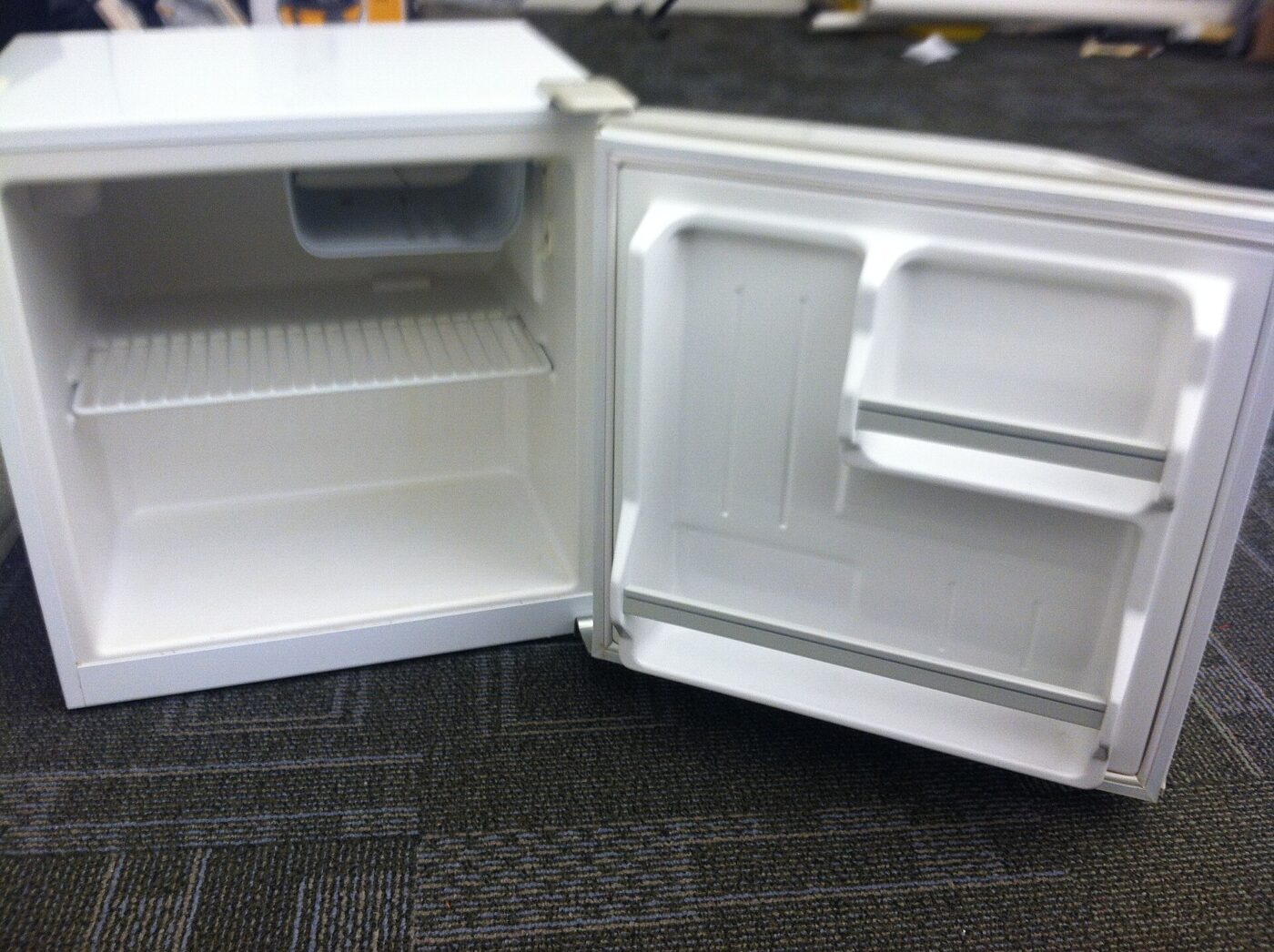
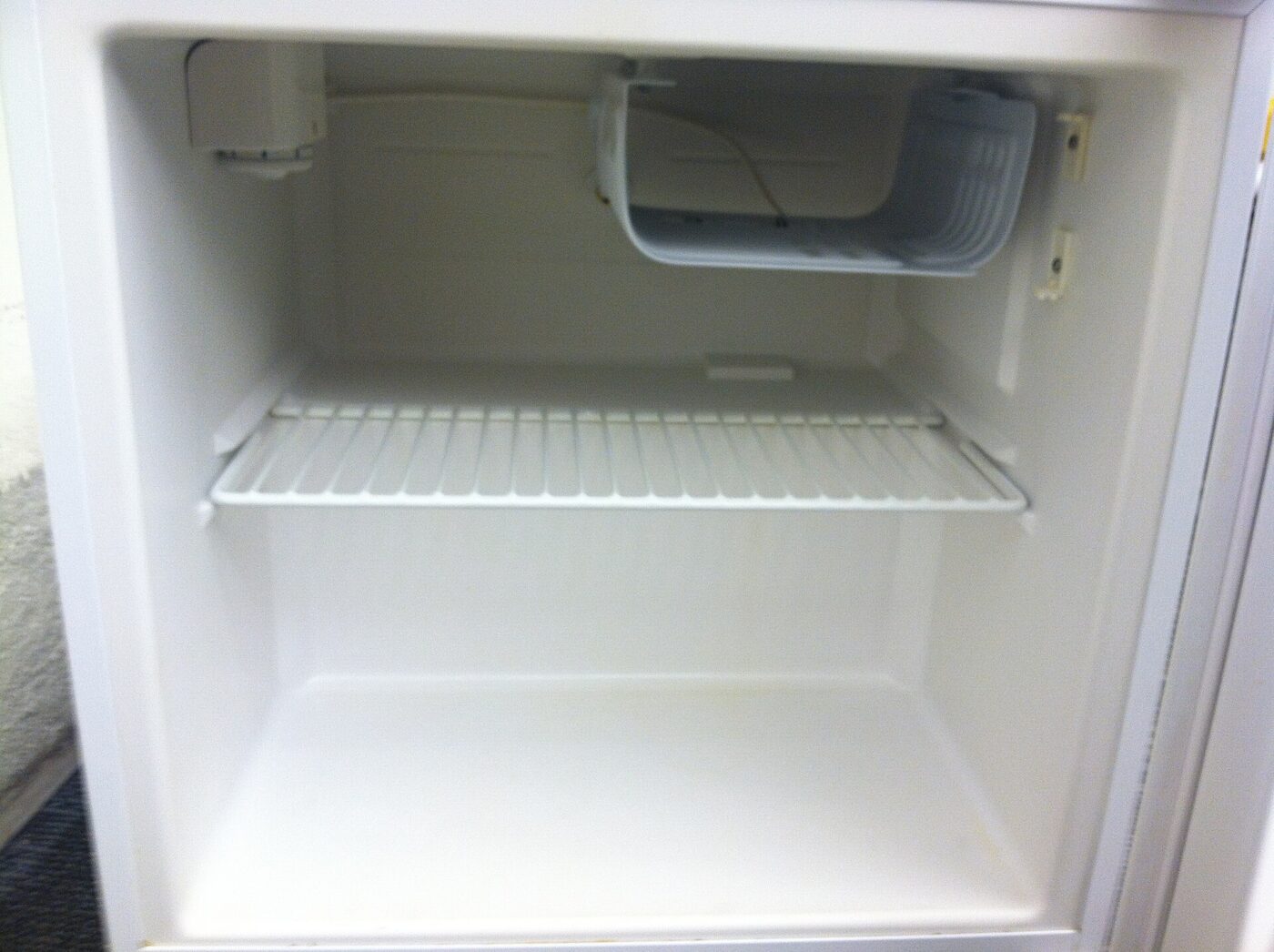
A refrigerator, by the same rules, may include a compartment that goes below 32 degrees but does not provide a separate low-temperature compartment capable of maintaining below 8 degrees. That is the whole distinction, and it is why a single-door compact with an ice box inside the fresh food section is a refrigerator under federal rules no matter what the box says.
A third category is worth knowing: an all-refrigerator has no compartment below 32 degrees at all, though it may include one of half a cubic foot or less for making ice. A compact product of any of these types is one with a total refrigerated volume below 7.75 cubic feet.
Two or more compartments, one of them user-settable to 0 degrees or below. That is a freezer.
Read the published temperature range, not the product title
The quickest test on any listing is the temperature range in the specification table. Newair’s 3.1 cubic foot dual-door compact, model NRF031BK00, publishes a fridge range of 32 to 50 degrees Fahrenheit and a separate freezer range of minus 11.2 to 10.4 degrees. That second line describes a compartment that can hold frozen food. On the company’s 3.3 cubic foot model, the specification table read on September 25, 2026 describes a single zone with a chiller compartment and gives one range, 32 to 50 degrees, with no freezer range at all. That block also repeats the 3.1’s model numbers, so the difference may lie in the page rather than the product.
Makers of single-door compacts are often candid if you read past the bullet points. Danby’s 4.4 cubic foot Designer compact, DCR044A2BDD, is described on Danby’s own page as suitable if you need to freeze certain types of foods or are simply looking for a place to make and store ice cubes, with a full-width independent freezer section and semi-automatic defrost. That is an accurate description of an ice-box compartment, not of a freezer drawer.
If the listing gives no temperature range, the EnergyGuide label settles it, because the label prints the federal category. GE’s label for its 3.1 cubic foot double-door compact reads Refrigerator-Freezer, Partial Automatic Defrost; its label for the 4.4 cubic foot single-door model reads Refrigerator, Manual Defrost.
A real freezer costs you energy, and the label shows how much
This is the trade nobody mentions. The EnergyGuide label on GE’s 3.1 cubic foot compact refrigerator-freezer gives estimated yearly electricity use of 321 kWh. The label on its 4.4 cubic foot compact refrigerator with manual defrost gives 227 kWh. The bigger cabinet uses 94 kWh a year less, about 29 percent less, because it does not run a low-temperature compartment and does not defrost itself.
Both figures are produced the same way, which is what makes the comparison fair. Since April 11, 2022, any representation of volume and energy use for these products must be based on the test procedure in Appendix A to subpart B of 10 CFR part 430. The label says so itself: compare only to other labels with yellow numbers.
ENERGY STAR sits on top of that. Under criteria in force since August 5, 2021, compact products under 7.75 cubic feet must use 10 percent less measured energy than the federal minimum to be certified, and wine refrigerators are not eligible at all — which matters if you are cross-shopping a beverage cooler.
| Published label category | Capacity | Estimated yearly use |
|---|---|---|
| Refrigerator-freezer, partial automatic defrost | 3.1 cu ft | 321 kWh |
| Refrigerator, manual defrost | 4.4 cu ft | 227 kWh |
What the recall record holds for compact refrigeration
We searched the CPSC recall database by product name on September 25, 2026. The most consequential entry in this size class is serious and current: on July 30, 2026 Galanz Americas recalled about 121,680 retro refrigerators, models BCD-215V-62H, GLR76TRDER, GLR76TBKER, GLR76TBEER and GLR76TWEER with date codes from December 2018 through December 2020, because internal electrical components can short circuit and ignite. CPSC states it is aware of 34 reports of fire, one of which resulted in a fatality according to the local fire department report. The remedy is a free in-home repair.
Those units are 7.6 cubic feet, just inside the federal compact line of 7.75, and the model number and date code are printed on a white label at the upper left of the back panel. Smaller entries matter too. In May 2023 Kell Electronic recalled about 25,000 Personal Chiller mini gamer refrigerators, model K1000BK, because the power cord can overheat; the firm had six reports and no injuries. A search on mini fridge returns that one record, while compact refrigerator, dorm refrigerator and beverage cooler each return none — which tells you as much about how recalls are indexed as about the products.
Check your model number against the CPSC database before you buy a used or discounted unit.
Where you can actually put it
Mini fridge cabinet and mini fridge stand are among the most searched follow-ups here, and the manufacturers answer them directly. GE’s owner’s manual for its 3 and 4 cubic foot models says not to install the unit in a recessed area and not to build it in, and specifies half an inch of clearance at the sides and 2 inches at the top and back. Danby says its refrigerators are meant to be free-standing, with the front left open so air can circulate.
Ambient temperature is the other limit. GE says not to install the refrigerator where the temperature will go below 50 degrees Fahrenheit, because it will not run often enough to maintain proper temperatures. Danby says its refrigerators are not designed for outside installation, extends that to garages, porches and carports, and warns that it affects the warranty. One last detail: Danby asks that a unit carried on its side be left upright for six hours before it is plugged in.
What to watch next
- The DOE standards for compact refrigerator-freezer classes with compliance starting January 31, 2029, which will change what the label numbers look like on new models
- Whether more makers publish a separate freezer temperature range in the spec table, since that is the single line that answers the question
- New entries under refrigerator and mini fridge in the CPSC recall database, free to search by product name
Where to start
Paid links: we earn a commission if you buy through the buttons below, at no extra cost to you. As an Amazon Associate I earn from qualifying purchases.
Compact fridge types compared on what the freezer can actually do
| Product type | Good fit for | Where to look |
|---|---|---|
| Two-door compact refrigerator-freezer | Fits frozen food storage | See listings on AmazonOpens Amazon search results, not one listing: check the model on the product page. |
| Single-door compact with chiller section | Fits drinks and ice | See listings on AmazonOpens Amazon search results, not one listing: check the model on the product page. |
| Appliance thermometer | Fits checking what you own | See listings on AmazonOpens Amazon search results, not one listing: check the model on the product page. |
Product types that fit the trend described above, not tested models. Check the exact listing before you buy. How we pick them.
Two-door compact refrigerator-freezer
Where to look: Amazon
The type that matches the federal definition. Expect the EnergyGuide label to read refrigerator-freezer, and a higher kWh figure than a single-door model of the same size.
- Separate freezer door
- Usually a published freezer range
- Higher yearly energy use
- Less fresh food space per cubic foot
Single-door compact with chiller section
Where to look: Amazon
What most people are shown when they search for a freezer. Danby describes its full-width freezer section as suited to making and storing ice, which is a fair description of the category.
- Lower yearly energy use
- More usable fresh food room
- Ice box is not a freezer
- Manual defrost takes time
Appliance thermometer
Where to look: Amazon
The cheapest way to find out what your compartment really holds. The federal line is a compartment the user can set to 0 degrees Fahrenheit or below.
- Settles the question directly
- Works in any cabinet
- Adds a step
- Needs a few hours to settle
More: Home and Kitchen trends and how the Trend Signal is scored.
Sources
- 10 CFR 430.2, definitions of refrigerator and refrigerator-freezer — eCFR
- 16 CFR 305.3, description of appliances — eCFR
- Refrigerators and Freezers Key Product Criteria — ENERGY STAR
- EnergyGuide label, GDE03 compact refrigerator-freezer — GE Appliances
- EnergyGuide label, GME04 compact refrigerator — GE Appliances
- GDE03GGKWW documents — GE Appliances
- Owner’s Manual, 3 and 4 cubic foot compact refrigerators — GE Appliances
- Danby Designer 4.4 cu. ft. Compact Refrigerator DCR044A2BDD — Danby
- Newair 3.1 Cu. Ft. Compact Mini Fridge with Freezer — Newair
- Newair 3.3 Cu. Ft. Compact Mini Fridge with Freezer — Newair
- Galanz Americas Recalls Retro Refrigerators, One Death Reported — CPSC
- Kell Electronic Recalls Personal Chiller Mini Gamer Refrigerators — CPSC
Questions readers ask
Does a mini fridge freezer compartment actually freeze food?
Not necessarily. Under 10 CFR 430.2 a refrigerator-freezer must have a compartment capable of maintaining 8 degrees Fahrenheit that the user can set to 0 degrees or below. A product classed as a refrigerator may have a compartment below 32 degrees but is not required to reach 8 degrees, which is what an ice box inside a single-door compact usually is.
Does a mini fridge with a freezer use more electricity?
On the published labels, yes. GE’s EnergyGuide label for its 3.1 cubic foot compact refrigerator-freezer with partial automatic defrost gives 321 kWh a year. The label for its 4.4 cubic foot compact refrigerator with manual defrost gives 227 kWh a year, despite the larger cabinet.
Can I put a mini fridge inside a cabinet or a stand?
The makers say not to enclose it. GE’s owner’s manual for its 3 and 4 cubic foot models says not to install the unit in a recessed area and not to build it in, and calls for half an inch at the sides and 2 inches at the top and back.
Have any mini fridges been recalled?
Yes. On July 30, 2026 CPSC announced a recall of about 121,680 Galanz retro refrigerators of 7.6 cubic feet after 34 fire reports and one death. In May 2023 Kell Electronic recalled about 25,000 Personal Chiller mini gamer refrigerators, model K1000BK, for a power cord that can overheat.