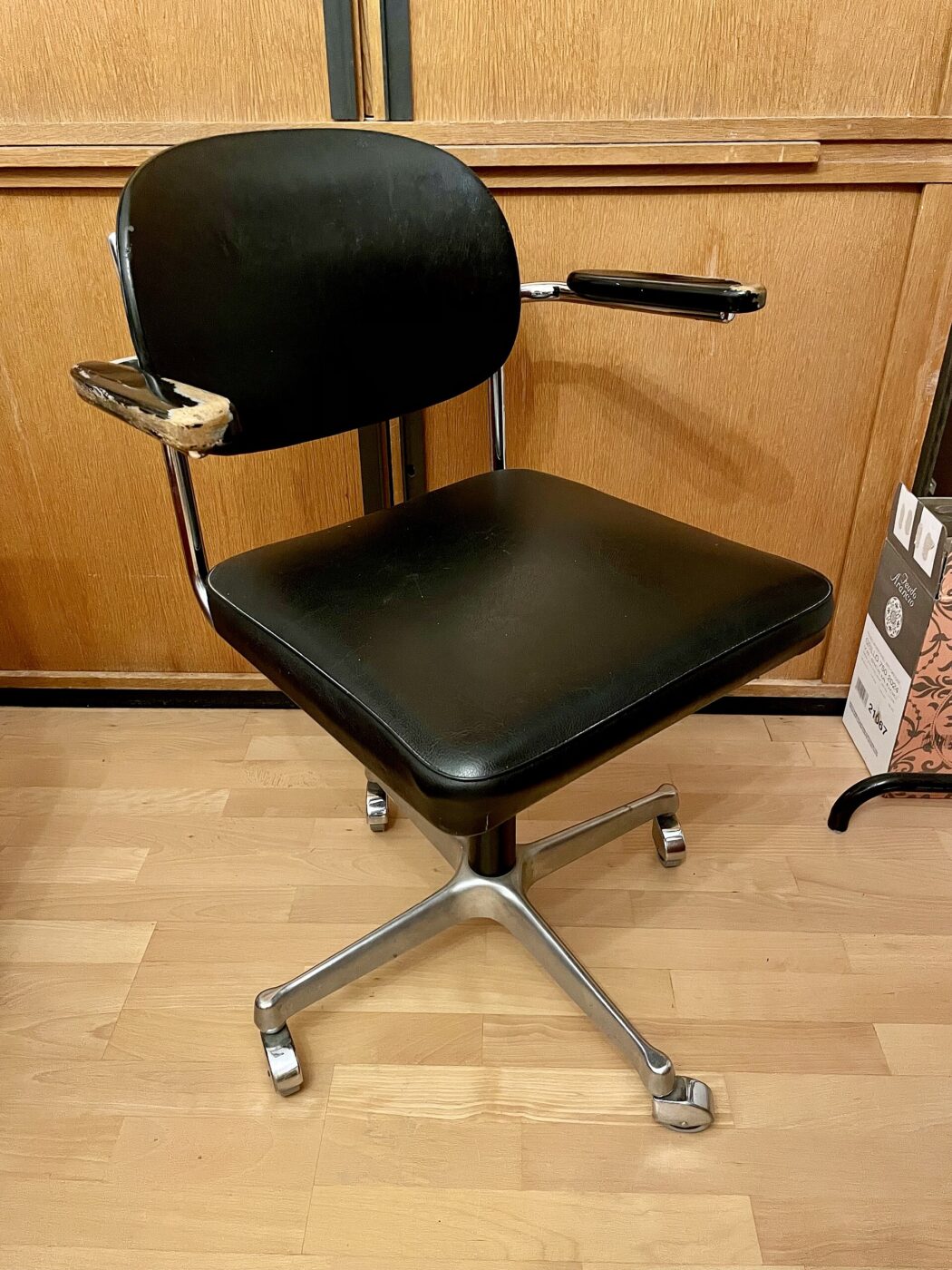
A desk chair is a simple object with one demanding job: hold an adult still for eight hours and let them lean back without thinking about it. The public record of what goes wrong is unusually clear, because every US recall is published with a unit count, an incident count and a description of the failure.
Read the four desk and office chair recalls the Consumer Product Safety Commission posted between January 2024 and September 2026 together and the pattern is hard to miss. None of them involved padding, fabric, casters or gas cylinders. All four were about a connection: the bolt, the anchor or the base that holds the chair together when someone leans on it.
Trend Signal
44/100 Steady momentum
- Emerging
- Rising
- Mainstream
- Peaking
- Cooling
Recalls keep landing on the backrest and base connections
We added up the US unit counts in four CPSC recall notices for desk and office chairs issued between January 2024 and September 2026, which we pulled on September 24, 2026: about 86,700 chairs, and in each notice the reported failure was a connection between the seat, the base or the backrest.
Our editorial reading of the cited data, not a forecast. How it is scored
By the numbers
- 16,000Branch ergonomic chairs recalled in the US on September 3, 2026 over detaching backrestsCPSC
- 64,000WorkPro Momentum office chairs recalled on January 16, 2025 over failing boltsCPSC
- 190Reports of the base breaking before the Article Spin swivel chair recall of May 9, 2024CPSC
- 11Reports of backrests detaching before the Branch recall of September 3, 2026CPSC
The same kind of joint keeps failing
The newest notice is the clearest. On September 3, 2026, CPSC published recall 26-735 covering about 16,000 Branch ergonomic chairs in the US, plus about 180 in Canada, because the backrests can detach. Branch had 11 reports and no injuries. The chairs were made in Thailand and sold online from about December 2025 through July 2026 for between $320 and $350 at BranchFurniture.com, Amazon.com, WestElm.com, ContainerStore.com, OfficeDepot.com and other websites.
The largest was recall 25-097 on January 16, 2025, covering about 64,000 WorkPro Momentum chairs sold by Veyer, the supply chain division of ODP. There the bolts connecting the back of the chair to its base could fail. Seven consumers reported falling, and two of those reported minor injuries. The chairs sold from October 2021 through September 2024 for about $430, in Office Depot and OfficeMax stores and online at Amazon, Walmart, eBay and elsewhere.
The two smaller notices complete the pattern. Recall 24-231, on May 9, 2024, covered about 4,500 Article Spin swivel chairs in the US whose base could break, with 190 reports and no injuries, sold exclusively at article.com from July 2021 through June 2023 for about $700. Recall 26-329, on March 19, 2026, covered about 2,200 Tainoki swivel office chairs sold at HomeGoods from August through December 2025 for $180 to $200, whose base can bend, with no incidents reported. Adding the four US unit counts in those notices, which we read on September 24, 2026, gives about 86,700 chairs; that total is ours, not a figure CPSC publishes.
| Recall date | Brand | US units | What failed |
|---|---|---|---|
| May 9, 2024 | Article Spin swivel chairs | About 4,500 | Base can break |
| January 16, 2025 | WorkPro Momentum, sold by Veyer | About 64,000 | Bolts joining back to base can fail |
| March 19, 2026 | Tainoki Noah, Owen and Warren | About 2,200 | Base can bend |
| September 3, 2026 | Branch ergonomic chairs | About 16,000 | Backrest can detach |
Four notices, four connection failures, and not one about the parts buyers usually compare.
Why the window of manufacture matters
The Branch notice is narrower than its headline. CPSC said in the notice itself that the recall applies only to chairs with backrest anchors that were incorrectly installed at the time of manufacture, and that the recalled chairs were manufactured between September 10, 2025 and April 22, 2026; trade outlet Home News Now reported the same window on September 8, 2026. That is an assembly-line error in a defined period, not a design that was wrong from the start.
Assembly windows are why two chairs of the same model can have different status, and why the remedy paperwork asks for photographs of the label on the underside of the seat. Branch’s repair kit is issued after a consumer submits photos of the manufacture label and the removed backrest; Tainoki’s refund requires photos of the chair, the model number and proof of destruction.
Where these chairs were sold says something too
The four notices cover four very different channels: a direct-to-consumer brand selling through its own site and several large retailers, a house brand sold through office superstores and marketplaces, an online furniture brand selling exclusively through its own site, and an off-price chain. Price was not the variable either, with recalled chairs at $180 to $200, $320 to $350, about $430 and about $700.
All four were manufactured outside the United States, in China, Thailand and Vietnam, which is ordinary for the category and is stated in each notice. None of the four notices cites a safety standard, which is worth noting only because CPSC does name one when a product has one, as in the recalls it headlines as violating the mandatory standard for clothing storage units. In the Branch case the fault is described as backrest anchors installed incorrectly at the factory, which is an assembly error rather than a design that tested badly.
Price, channel and brand did not separate the recalled chairs from the rest.
What a buyer can actually check

Before buying, search the CPSC recall database for the brand and model. The recalls are posted with model names, model numbers and where the label sits on the chair, and Tainoki’s notice specifies that model numbers are on a label under the seat. A brand with an open recall is not automatically a bad buy, but it is worth knowing what the remedy is and whether the company answers.
After buying, do the boring first-week check. Every one of these four failures was at a fastener or a structural part: the bolts between the backrest and the base, the anchors holding the backrest, and the five-star base itself. Those are the parts to look at when the chair is new, and again when it has been moved between rooms or reassembled.
If a chair is covered by a recall, stop using it. That is the language CPSC uses in all four notices, and the remedy is free: repair kits from Branch and Veyer, a replacement base from Article, a refund from Tainoki.
- Look for a label under the seat with the model number before assuming a recall does not apply
- Check the backrest-to-base bolts after assembly and again after any move
- Register the chair with the maker if a card or form is offered, so a recall notice can reach you
What the record does not tell you
A recall count is not an injury rate. Across these four notices, CPSC recorded seven falls and two minor injuries, all in the WorkPro recall, against the roughly 86,700 chairs we counted. The other three notices reported no injuries at all, and one of them, the Article recall, had 190 reports of the base breaking with nobody hurt.
Nor is the absence of a recall evidence of a well-built chair, since recalls begin with reports reaching a company or the commission, and a marketplace seller that has disappeared has nobody to report to.
We read this record as a reason to buy on serviceability: a chair whose maker publishes parts, answers a recall with a kit and can be reached at a phone number is worth more than a specification sheet claiming the same numbers.
What to watch next
- The CPSC recall feed for desk and office chairs, where four notices have landed since January 2024
- Whether Branch extends its recall beyond chairs made between September 10, 2025 and April 22, 2026
- Whether any of these brands moves from repair kits to refunds, which usually signals a broader problem
Where to start
Paid links: we earn a commission if you buy through the buttons below, at no extra cost to you. As an Amazon Associate I earn from qualifying purchases.
Desk chair types compared on the parts that fail
| Product type | Good fit for | Where to look |
|---|---|---|
| Mesh task chair with adjustable arms | Fits full-day seated work | See listings on AmazonOpens Amazon search results, not one listing: check the model on the product page. |
| Heavy-duty office chair | Fits heavier users and longer warranties | See listings on AmazonOpens Amazon search results, not one listing: check the model on the product page. |
| Replacement chair base and casters | Fits repairing a chair worth keeping | See listings on AmazonOpens Amazon search results, not one listing: check the model on the product page. |
Product types that fit the trend described above, not tested models. Check the exact listing before you buy. How we pick them.
Mesh task chair with adjustable arms
Where to look: Amazon
The mainstream type in all four recalls. After assembly, check the bolts joining the backrest to the base, which is where three of the four failures happened.
- Common parts and widely stocked spares
- Backrest hardware is usually reachable
- Mesh backs vary widely in frame quality
- Assembly quality is the real variable
Heavy-duty office chair
Where to look: Amazon
Worth reading the rating closely, since a number on the listing can describe the seat rather than the whole chair. Ask what the warranty covers on the base and cylinder.
- Heavier gauge bases are common
- Longer warranties are more often offered
- Bulkier footprint
- Rating language differs between brands
Replacement chair base and casters
Where to look: Amazon
If a chair is under recall, take the free remedy first. If it is simply old, a base is the part most likely to be worn and the easiest to replace.
- Cheaper than replacing a good chair
- Fixes the exact part that failed twice in four recalls
- Stem and cylinder sizes vary
- Not a substitute for a recall remedy
More: Work and Office trends and how the Trend Signal is scored.
Sources
- Branch recalls ergonomic chairs due to fall hazard, recall 26-735 — US Consumer Product Safety Commission
- Veyer recalls WorkPro office chairs due to fall hazard, recall 25-097 — US Consumer Product Safety Commission
- Tainoki Fine Furniture recalls office chairs, recall 26-329 — US Consumer Product Safety Commission
- Spin swivel chairs recalled due to fall hazard, recall 24-231 — US Consumer Product Safety Commission
- CPSC announces recall of more than 16,000 ergonomic office chairs — Home News Now
- Recall database and incident reporting — SaferProducts.gov, US Consumer Product Safety Commission
Questions readers ask
How do I know if my office chair is recalled?
Look for the model number on the label under the seat, then search the CPSC recall database on SaferProducts.gov for the brand. The four desk and office chair recalls since January 2024 list model names, numbers and colors; the Tainoki notice specifies the label is on the underside of the seat.
What part of an office chair fails most in recalls?
The connections. In the four CPSC notices since January 2024, the failures were a detaching backrest, bolts between the back and the base failing, a base that can break and a base that can bend.
Are recalled chairs replaced or repaired?
It varies by notice. Branch and Veyer offered free repair kits containing replacement hardware, Article offered a free replacement base, and Tainoki offered a full refund after photos and proof of destruction.
Have people been hurt by these chairs?
CPSC recorded seven reports of consumers falling in the WorkPro recall, two of them with minor injuries. The Branch, Article and Tainoki notices each reported no injuries, despite 11 and 190 incident reports in the first two.