We have not tested these fans. This compares the figures each maker publishes on its own product page against the federal recall record and the governing safety standard. We limited the field to battery fans sold in the US that publish a spec table on the maker’s own site, and searched each brand against the CPSC recall database on September 25, 2026.
A camping fan is one of the few pieces of gear where the marketing number and the useful number are almost never the same. The headline is a best-case runtime at the lowest speed, or a battery figure in units that cannot be compared across brands. Three published rows settle most of the decision: battery size in watt-hours, runtime at the speed you would use, and airflow in a unit you can compare.
Trend Signal
71/100 Strong momentum
- Emerging
- Rising
- Mainstream
- Peaking
- Cooling
Big batteries arrived in camping fans, and so did the charging recalls
Our search of the CPSC recall database on September 25, 2026 found three rechargeable fan recalls for battery fires, covering about 80,380 units, and every one of them describes the battery overheating while charging rather than while running.
Our editorial reading of the cited data, not a forecast. How it is scored
By the numbers
- 144 WhBattery size BougeRV publishes for the F02 outdoor fan, as 8 Ah at 18 voltsBougeRV
- 5.5-33.5 hOperating time BougeRV publishes for the F01 camping fan across its four speedsBougeRV
- 48,000Living Glow portable waist fans recalled for battery fire hazard, October 9, 2025U.S. CPSC
- 100 WhLithium-ion limit for air travel without operator approval under 49 CFR 175.10eCFR, U.S. Government
Runtime is a range, and the low number is the one to read
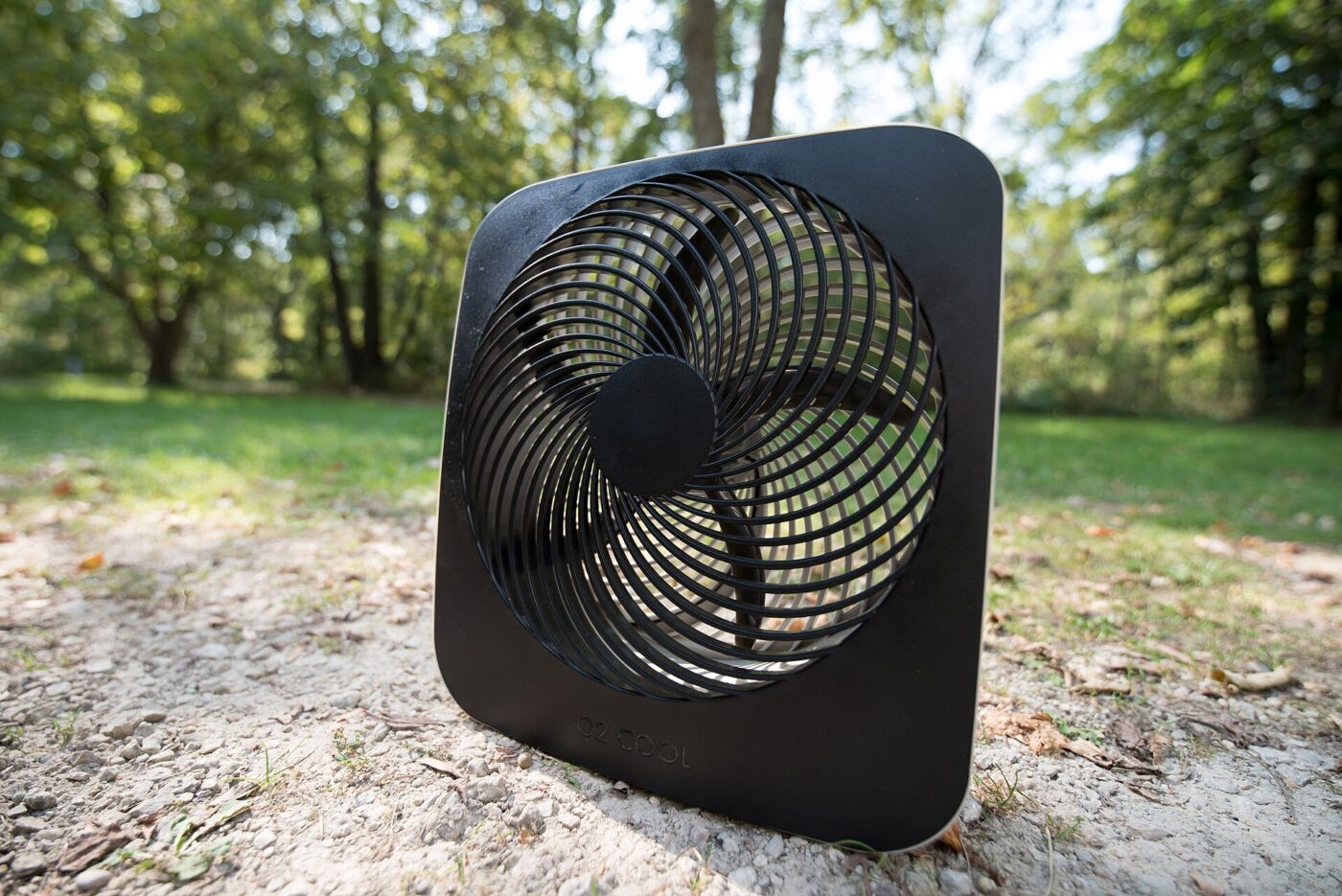
BougeRV publishes “5.5H-33.5H” as the operating time of its F01 camping fan across four speeds, while the copy on the same page leads with “up to 33.5 hours of runtime.” Both are true; only one describes a warm night when you want air moving.
The larger F02 shows the same pattern. Its spec table gives operating time as “8 hours(Max Speed)” while the page copy claims “8–72 hours on a single charge.” The spec table number is tied to a defined condition, so compare with that one.
The useful habit is to divide. Battery size in watt-hours over runtime at maximum speed gives an average draw you can check: 144 Wh across 8 hours is about 18 watts, by our calculation. A fan claiming a far longer high-speed runtime from a smaller battery is being generous about its conditions.
| Fan | Battery published | Runtime published | Airflow published | Noise published |
|---|---|---|---|---|
| BougeRV F01 | 20,000 mAh, no voltage given | 5.5 to 33.5 hours | 5.4 meters per second wind speed | 37 dB |
| BougeRV F02 | 8 Ah at 18 V, stated as 144 Wh | 8 hours at maximum speed | 755 CFM | Spec row reads Brushless motor |
| Ryobi 18V ONE+ 14 in. Air Cannon | Any 18V ONE+ battery or a barrel plug adapter | Only in a runtime chart image, not as a figure | 2,300 CFM on high | Over 55% quieter, no decibel figure |
Compare the runtime that carries a stated condition, not the one in the headline.
Milliamp-hours are not a battery size
BougeRV lists the F01 battery as “20,000mAh” and gives no voltage anywhere in the spec table. Without a voltage that figure cannot be converted to watt-hours, so it cannot be compared with any fan that publishes them, or checked against the one legal limit that applies here.
The F02 does it properly: “8Ah (144Wh)” with an operating voltage row reading 18 V. Eight amp-hours at 18 volts is 144 watt-hours, and the arithmetic is visible. That is the format to look for, and its absence is itself information.
The limit is federal. Under 49 CFR 175.10 a lithium-ion battery in a portable electronic device may not exceed 100 Wh; between 100 Wh and 160 Wh it needs the operator’s approval, with no more than two spares, in carry-on baggage. The F02’s 144 Wh pack sits in that approval band, and an individual carrier can set a stricter limit than the regulation does. A fan sold as 20,000 mAh could be either side of the line and the buyer cannot tell. Our piece on airline power bank rules in 2026 covers how carriers apply this.
Airflow and noise are published in whatever unit flatters the fan

Airflow appears in two incompatible units. BougeRV rates the F02 at 755 CFM and the F01 at a wind speed of 5.4 meters per second. Cubic feet per minute is volume; meters per second is velocity at one point. A narrow nozzle gives high velocity with modest volume, which is why a fan that feels strong at arm’s length can do nothing to a tent.
Scale matters too. Ryobi advertises “2,300 CFM on high” for its 18V ONE+ 14-inch Air Cannon, roughly three times the F02 figure. For moving air through a tent or an awning, volume does the work.
Noise is the least disciplined row on these pages. BougeRV publishes 37 dB for the F01 with no measuring distance attached. On the F02 the noise level row contains no number at all; it reads “Brushless motor.” Ryobi claims “Over 55% Quieter” with no decibel figure and no stated comparison. None of the three can be ranked against another as published.
- CFM for how much air moves, which is what fills a tent
- Meters per second for how fast it moves at one point, which is what you feel up close
- A decibel figure with a distance attached, or treat the noise claim as marketing
- Blade diameter: BougeRV gives 9 inches on the F01 and 190 mm on the F02
The recall pattern is charging, not running
Our search of the CPSC recall database on September 25, 2026 returned four recalls of rechargeable fans, three of them for battery fires with nearly identical hazard descriptions. On October 9, 2025, about 48,000 Living Glow portable waist fans sold on HSN were recalled because “the lithium-ion batteries can overheat while charging, posing a fire hazard,” after four reports of melting or fire. On September 18, 2025, about 22,600 IcyBreeze Buddy misting fans were recalled because the fan “can overheat while charging and ignite,” after seven reports, two ending in fire. On July 21, 2021, Rite Aid recalled about 9,780 handheld fans for the same reason.
That is about 80,380 units by our count, and not one of the three describes a battery failure during use. The fourth notice, for Nuby stroller fans, is a blade-access hazard rather than a battery one. The failure mode is a charge cycle. For a camper that means one habit: charge the fan outside the tent, on a hard surface, while someone is awake.
The standard for the fan itself is UL 507, Electric Fans, in its Tenth Edition, with revisions ANSI-approved on August 14, 2026. Its scope covers fans that circulate air, rated 600 volts or less. The battery falls under separate cell and pack standards, which is why a fan can carry a listing mark and still have a charging fault recalled later.
Register the fan with the maker, and search the model on the CPSC recall list before the trip, not after.
What to check on a listing before you buy
A camping fan is a small purchase with a sharp failure mode, so the checks are short. Look for watt-hours rather than milliamp-hours, a runtime tied to a named speed, CFM if the job is a tent, and a decibel figure with a distance attached.
Then check the charging path, because that is where the recalls are. A removable battery like the F02’s lets a failing pack be replaced rather than binned, and that detail sits in the spec table rather than the headline.
Finally, match the fan to the power you are bringing. A USB fan drawing single-digit watts is nothing against a 1 kWh camping battery. The 11.9 lb weight BougeRV publishes for the F02 is a reminder that the biggest airflow number comes attached to real mass.
What to watch next
- Whether listings move from milliamp-hours to watt-hours, the only format checkable against the 100 Wh air travel limit
- Further CPSC notices for rechargeable fans, where every battery-fire recall since 2021 describes a charging fault
- UL 507 revisions, last ANSI-approved on August 14, 2026, as battery fans grow as a share of the category
Where to start
Paid links: we earn a commission if you buy through the buttons below, at no extra cost to you. As an Amazon Associate I earn from qualifying purchases.
Camping fan types compared on the specs that differ
| Product type | Good fit for | Where to look |
|---|---|---|
| Rechargeable camping fan with stand | Fits a tent overnight | See listings on AmazonOpens Amazon search results, not one listing: check the model on the product page. |
| Clip-on tent fan | Fits clipping to a pole or tailgate | See listings on AmazonOpens Amazon search results, not one listing: check the model on the product page. |
| High-airflow battery fan | Fits moving air through a big space | See listings on AmazonOpens Amazon search results, not one listing: check the model on the product page. |
Product types that fit the trend described above, not tested models. Check the exact listing before you buy. How we pick them.
Rechargeable camping fan with stand
Where to look: Amazon
The stand-and-hook format is the common camping shape. BougeRV publishes 5.5 to 33.5 hours across four speeds on its F01 and a 37 dB figure with no distance stated, which is typical.
- Low-speed runtime spans a full night
- Often includes a light and a hook
- Headline runtime is the lowest speed
- Charging faults drive every battery recall we found
Clip-on tent fan
Where to look: Amazon
A clip fan trades battery size for placement. Check the guard if children are in the tent: CPSC recalled about 33,600 Nuby stroller fans in March 2025 after fingers reached the blade.
- Clips out of the sleeping area
- Usually charges over USB-C
- Small battery means short high-speed runtime
- Blade guards vary a lot
High-airflow battery fan
Where to look: Amazon
When the job is moving air through a shelter rather than across a face, volume wins. Ryobi publishes 2,300 CFM on high for its 14-inch Air Cannon and no decibel figure.
- CFM figures an order above pocket fans
- Some run from a tool battery or an adapter
- Heavy: BougeRV publishes 11.9 lb for the F02
- Noise often published as a percentage claim
More: Travel and Adventure trends and how the Trend Signal is scored.
Sources
- BougeRV F02 outdoor fan specifications — BougeRV
- BougeRV F01 outdoor fan specifications — BougeRV
- 18V ONE+ 14 in. Air Cannon Fan — RYOBI Tools
- Living Glow Portable Waist Fans Recalled — U.S. CPSC
- IcyBreeze Cooling Recalls Portable Misting Fans — U.S. CPSC
- Rite Aid Recalls Rechargeable Handheld Fans — U.S. CPSC
- UL 507 Electric Fans, Tenth Edition — UL Standards and Engagement
- 49 CFR 175.10, exceptions for passengers and crewmembers — eCFR
Questions readers ask
How long does a camping fan actually run?
Read the range, not the headline. BougeRV publishes 5.5 to 33.5 hours across four speeds for the F01; for the F02 its spec table gives 8 hours at maximum speed while the copy claims 8 to 72 hours.
Is 20,000 mAh a big fan battery?
There is no way to tell without a voltage. BougeRV publishes 20,000 mAh for the F01 with no voltage row, while the F02 publishes 8 Ah at 18 volts and states the result as 144 Wh, the format that can be compared and checked.
Can I take a rechargeable camping fan on a plane?
It depends on the watt-hour rating. 49 CFR 175.10 limits a lithium-ion battery to 100 Wh and allows 100 Wh to 160 Wh only with the operator’s approval and at most two spares in carry-on baggage. A 144 Wh fan pack sits in that band, and a carrier may set a stricter limit than the regulation.
Have rechargeable fans been recalled?
Yes. Our CPSC search on September 25, 2026 found about 48,000 Living Glow waist fans recalled on October 9, 2025, about 22,600 IcyBreeze Buddy misting fans on September 18, 2025, and about 9,780 Rite Aid handheld fans on July 21, 2021, all for batteries overheating while charging.