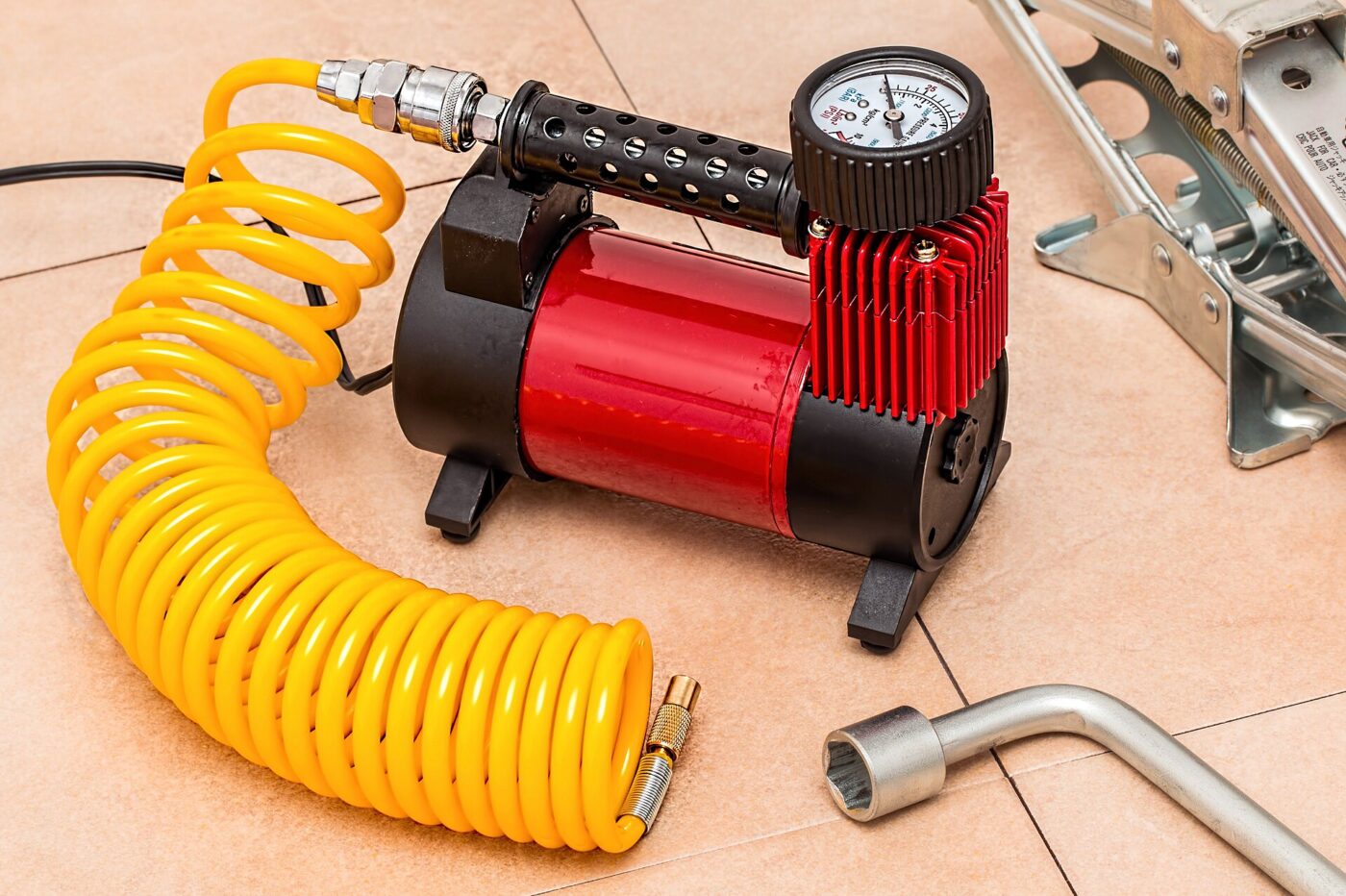
A portable tire inflator is not an exciting purchase. It is a plastic box that hums for four minutes and adds five pounds of air. It keeps selling because of a quiet mismatch between what the dashboard seems to promise and what federal rules actually require it to do.
The tire pressure monitoring light is not a gauge. It is a legally defined alarm with a threshold, and that threshold sits far below where a tire stops being efficient or comfortable. Add gasoline near $4.48 a gallon and a fleet in which many cars carry no spare, and a pump in the trunk stops being about emergencies and starts being about arithmetic.
Trend Signal
52/100 Steady momentum
- Emerging
- Rising
- Mainstream
- Peaking
- Cooling
A legal warning threshold plus fewer spare tires keeps demand steady
Federal rules require the dashboard telltale to light only once a tire is 25% or more below the placard pressure, and gasoline averaged $4.478 a gallon on September 21, 2026, which raises what quiet underinflation costs.
Our editorial reading of the cited data, not a forecast. How it is scored
By the numbers
- 25%Underinflation below placard pressure that must trigger the required TPMS telltale49 CFR 571.138
- 0.2%Fuel economy lost for each 1 psi drop in the average pressure of all four tiresU.S. Department of Energy
- $4.478U.S. average retail price of regular gasoline on September 21, 2026U.S. Energy Information Administration
- 28%Model year 2017 vehicles that do not come with a spare tire, AAA research, October 2017AAA
What the warning light is legally required to do

Federal Motor Vehicle Safety Standard No. 138 governs tire pressure monitoring systems on passenger cars, multipurpose passenger vehicles, trucks and buses rated at 10,000 pounds or less. Its stated purpose is to warn drivers of significant under-inflation, and the word doing the work in that sentence is significant.
The requirement is specific. The system must illuminate a low tire pressure warning telltale not more than 20 minutes after the pressure in one or more tires, up to four, falls to or below either 25% under the manufacturer recommended cold inflation pressure or a floor value in the standard, whichever is higher. The telltale must stay lit while the pressure remains there.
On a car placarded at 35 psi, that threshold is about 26 psi. A tire at 30 psi is meaningfully soft, wears its shoulders faster and costs fuel, and it is entirely correct for the dashboard to say nothing about it. The system is doing its job; its job is just narrower than drivers assume.
The telltale is a blowout-prevention alarm, not a maintenance reminder. A gauge is the maintenance reminder.
The fuel math changed when gasoline passed $4
The Department of Energy puts numbers on the penalty on its fuel economy site: keeping tires inflated to the proper pressure improves gas mileage by 0.6% on average and up to 3% in some cases, and under-inflated tires lower gas mileage by about 0.2% for every 1 psi drop in the average pressure of all tires.
Those are small percentages against a large and growing number. The Energy Information Administration recorded a U.S. average regular gasoline price of $4.478 a gallon on September 21, 2026, $1.305 higher than a year earlier, and BLS measured motor fuel up 27.9% over the 12 months to August 2026.
There is a second-order cost too. AAA put the average annual cost to own and operate a new vehicle at $12,863, or $1,071.92 a month, in its September 2026 analysis. Tires that wear unevenly because they ran soft sit inside that figure, and they are the part a cheap pump can influence.
Fewer cars carry a spare, and sealant has limits
The structural change behind inflator sales is the disappearing spare. In research published in October 2017, AAA found that nearly one-third, 28%, of 2017 model year vehicles did not come with a spare tire, and said that in the previous year alone it had come to the rescue of more than 450,000 members with a flat tire whose cars had no spare. That is the most recent figure of its kind we could open, and it is old, so treat the direction rather than the number as the point.
AAA was also blunt about what replaced the spare. It said inflator and sealant kits cannot provide even a temporary fix for many tire problems, including sidewall damage or blowouts, that they can cost up to 10 times more than a tire repair, and that they have a shelf life of only four to eight years.
That distinction matters when choosing. A sealant kit is a single-use consumable for a tread puncture. A compressor is a reusable tool for the far more common problem of a tire that is simply low. Only one of them is worth carrying indefinitely.
Cordless, 12-volt or plug-in, and what to check
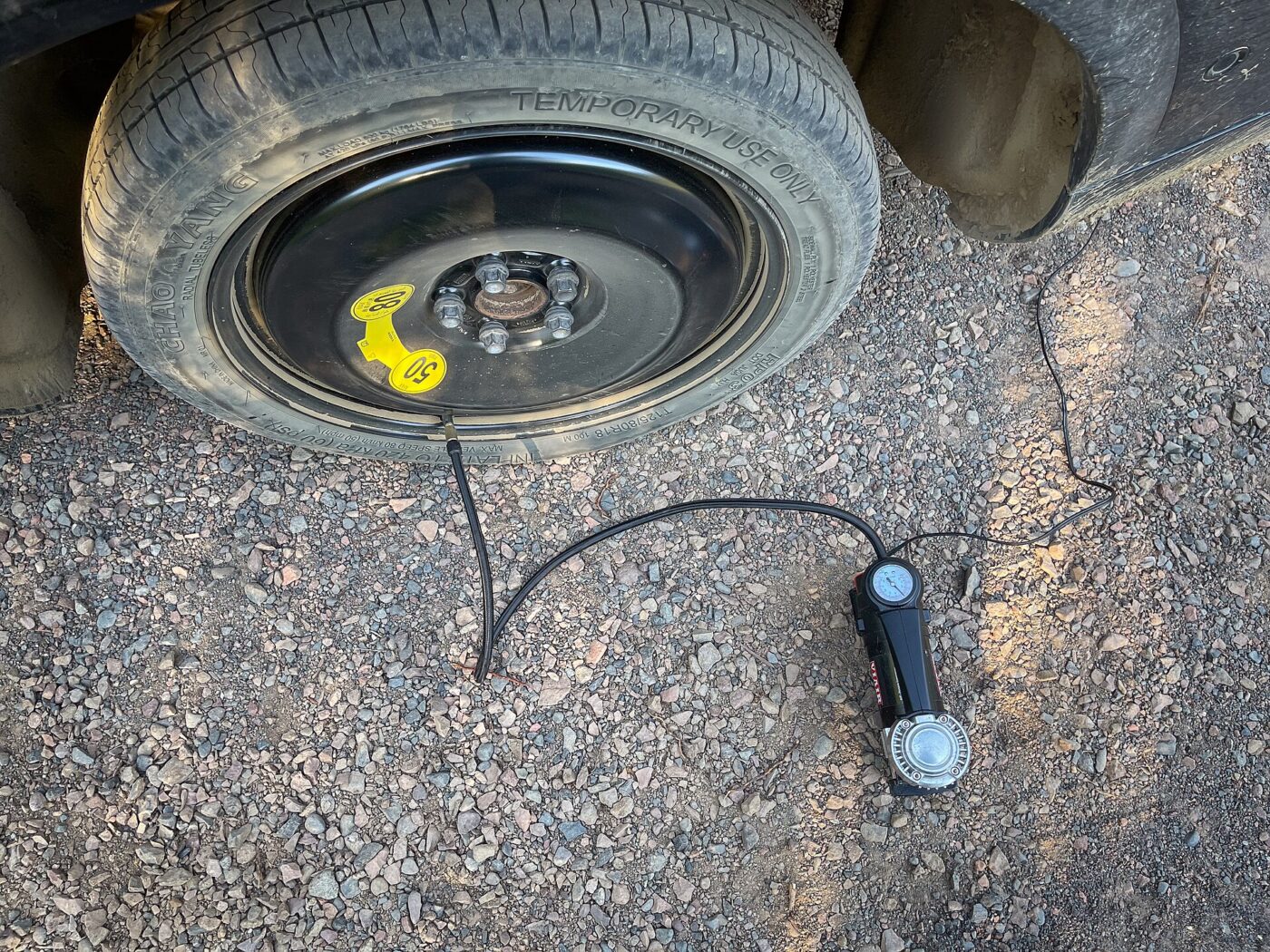
Three formats dominate. A 12-volt unit runs off the accessory socket, which means it works anywhere the car does but is limited by what that circuit can supply. A cordless inflator runs on a removable pack, often the same platform as a drill, which makes it convenient in a driveway and dependent on charge at the roadside. A corded 120-volt compressor is faster and lives in a garage.
The specifications worth reading are not the headline ones. Maximum pressure rating is rarely the constraint for car tires; duty cycle and hose reach usually are. Check the stated run time before the unit needs to cool, because topping up four tires in summer heat is where a cheap motor stops.
Also check the gauge. Built-in digital gauges on inexpensive inflators drift, and the auto-shutoff is only as accurate as the sensor behind it. A separate gauge to verify after inflating costs very little, which is why gauge and pump are complementary rather than alternatives.
- Duty cycle and cooldown time, not just the maximum psi number
- Hose plus cord reach from your accessory socket to the farthest tire
- Whether a cordless model includes the battery or expects your tool platform
- A separate gauge to check the built-in reading after the auto-shutoff trips
- Whether a sealant canister is included and what its expiry date says
Who needs one and who does not
Buy one if your vehicle came without a spare, if you park outside where cold snaps drop pressure several psi overnight, or if you drive enough miles that a 1% to 3% fuel economy difference is real money at $4.48 gasoline. Cars carrying a sealant kit instead of a spare gain the most, because a slow leak a pump can hold is otherwise a tow.
Skip it if you have a full-size spare, a short commute, and a habit of checking pressures at a gas station air pump. A gauge alone covers a lot of ground if the checking actually happens. The failure this product addresses is not the absence of a compressor; it is the absence of the routine.
We read the category as steady rather than climbing. It is driven by the design of the fleet and by fuel prices, not by new technology in the pumps.
What to watch next
- The weekly EIA gasoline price series, which sets how much a 1% to 3% fuel economy swing is worth to you.
- Whether AAA updates its research on the share of new vehicles shipping without a spare, since the usable figure still dates from 2017.
- Your placard pressure against what the tires read on a cold morning, the only number that decides whether this purchase pays.
Where to start
Paid links: we earn a commission if you buy through the buttons below, at no extra cost to you. As an Amazon Associate I earn from qualifying purchases.
Inflation tools compared on what changes between them
| Product type | Good fit for | Where to look |
|---|---|---|
| Cordless tire inflator | Fits driveway top-ups | See listings on AmazonOpens Amazon search results, not one listing: check the model on the product page. |
| 12-volt tire inflator | Fits roadside use with the engine running | See listings on AmazonOpens Amazon search results, not one listing: check the model on the product page. |
| Digital tire pressure gauge | Fits checking before you inflate | See listings on AmazonOpens Amazon search results, not one listing: check the model on the product page. |
Product types that fit the trend described above, not tested models. Check the exact listing before you buy. How we pick them.
Cordless tire inflator
Where to look: Amazon
Convenient if you already own a tool battery platform. The trade is that a flat pack at the roadside makes it an ornament.
- No cord to route
- Works away from the car
- Depends on pack charge
- Battery often sold separately
12-volt tire inflator
Where to look: Amazon
The format that never runs out as long as the engine does not. Measure from your accessory socket to the far rear wheel first, because that is the reach that fails.
- Draws from the car
- No charging to remember
- Limited by the accessory circuit
- Cord reach can be short
Digital tire pressure gauge
Where to look: Amazon
Auto-shutoff is only as good as the sensor behind it. A separate gauge is the cheapest way to know whether you hit the placard number.
- Verifies the inflator reading
- Cheap and pocketable
- Needs a battery
- Cold readings differ from warm ones
More: Auto and EVs trends and how the Trend Signal is scored.
Sources
- Standard No. 138, Tire pressure monitoring systems, 49 CFR 571.138 — U.S. Government Publishing Office
- Keeping Your Car in Shape — U.S. Department of Energy fueleconomy.gov
- Gasoline and Diesel Fuel Update — U.S. Energy Information Administration
- AAA Finds Nearly One-Third of New Vehicles Missing Spare Tire — AAA
- AAA: New Vehicle Ownership Costs Hit $12,863 Annually — AAA
- Consumer Price Index, Table 2, August 2026 — U.S. Bureau of Labor Statistics
Questions readers ask
At what pressure does the TPMS light come on?
Federal Motor Vehicle Safety Standard No. 138 requires the telltale to illuminate within 20 minutes once a tire is at or below 25% under the manufacturer recommended cold inflation pressure, or a floor value set in the standard, whichever is higher. On a car placarded at 35 psi that is roughly 26 psi.
How much fuel does an underinflated tire really cost?
The Department of Energy states that proper inflation improves gas mileage by 0.6% on average and up to 3% in some cases, and that under-inflation lowers gas mileage by about 0.2% for every 1 psi drop in the average pressure of all tires.
Can a tire inflator replace a spare tire?
No. AAA found in 2017 that inflator and sealant kits cannot provide even a temporary fix for many tire problems, including sidewall damage or blowouts, and that sealant has a shelf life of only four to eight years. A compressor handles slow leaks and low pressure, not structural damage.
Cordless or 12-volt: which is better for a car?
They fail differently. A 12-volt unit cannot run out of charge while the engine is running but is limited by the accessory circuit and by cord length. A cordless unit is faster to deploy in a driveway but is useless with a flat battery pack. If the tool lives in the trunk for emergencies, the 12-volt format removes one thing to remember.