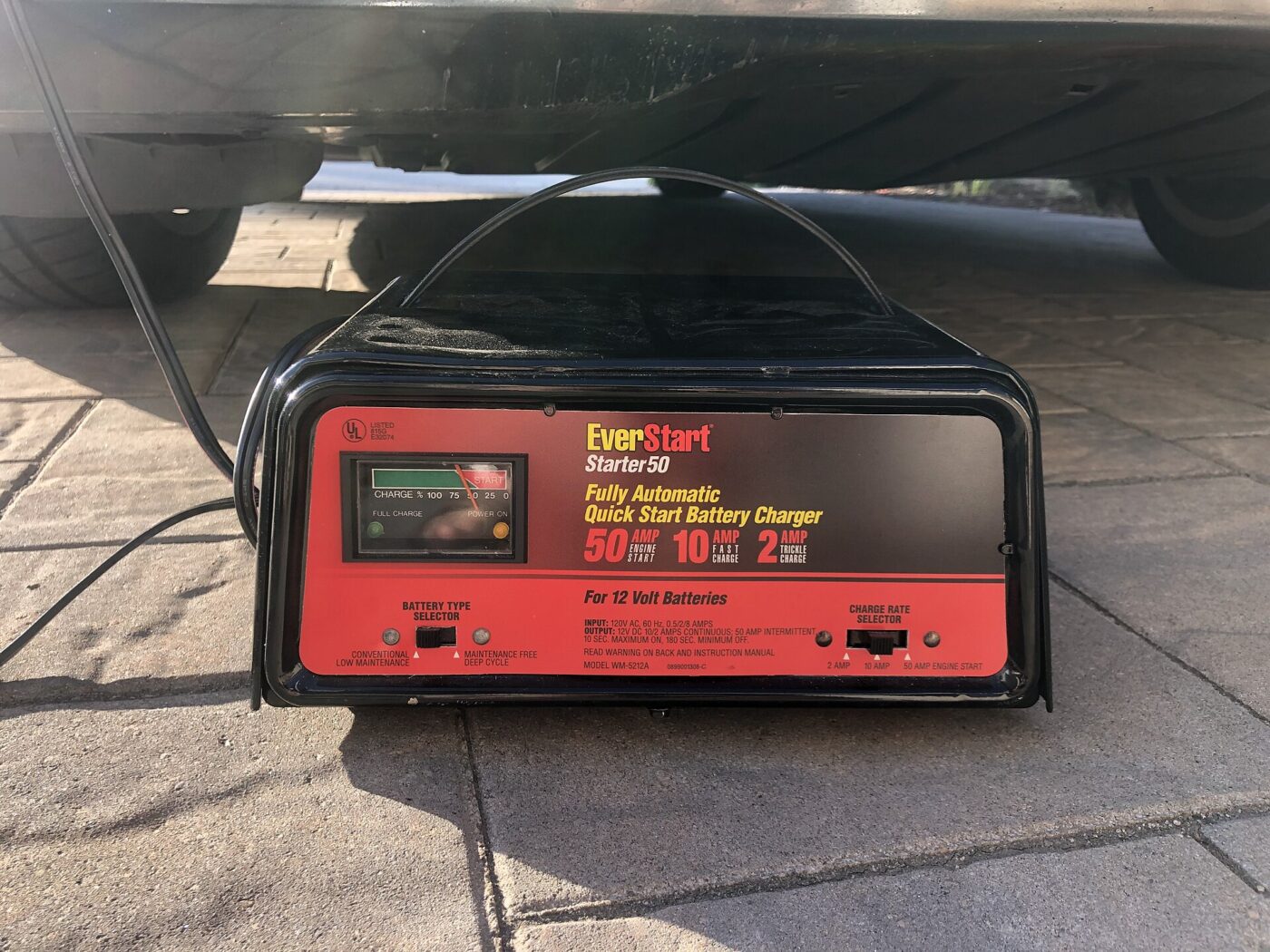
A trickle charger used to be one of the simplest objects in a garage: a transformer, two clips and a dribble of current into a parked battery. The product search demand points at in October 2026 is a different machine. Amazon’s autocomplete finishes the phrase as battery maintainer, and Google Trends lists smart battery charger and smart car battery charger among the fastest-rising queries related to car battery charger in the United States.
The word that changed is smart, and we read that as following the battery. Stop-start turns an engine off at idle and restarts it when the driver releases the brake pedal, and EPA says those vehicles use a larger alternator and an enhanced low-voltage battery. Add a cold season and the question becomes which settings a charger has to offer.
Trend Signal
64/100 Steady momentum
- Emerging
- Rising
- Mainstream
- Peaking
- Cooling
Stop-start put an enhanced 12-volt battery in most new gasoline non-hybrids
EPA’s 2025 Automotive Trends Report records non-hybrid stop/start at 58% of new gasoline vehicles in model year 2024, against under one percent when tracking began in 2012, and says such vehicles use a larger alternator and an enhanced low-voltage battery.
Our editorial reading of the cited data, not a forecast. How it is scored
By the numbers
- 58%New gasoline non-hybrid vehicles with stop/start in model year 2024U.S. Environmental Protection Agency
- 77%Share of the SLI starter battery market BCI attributes to the aftermarketBattery Council International
- 15%City fuel economy a gasoline car loses at 20F compared with 77F in DOE testsU.S. Department of Energy
- 3 to 5 yrsAverage car battery lifespan as stated by AAA South Jersey in winter guidanceAAA South Jersey
Why the battery under the hood got bigger
EPA began tracking engine stop/start at model year 2012, when it sat below one percent of new gasoline non-hybrids. The 2025 edition of its Automotive Trends Report, covering model year 2024, puts it at 58%, and records stop/start, mild hybrids, full hybrids and plug-in hybrids all at their largest market shares on record.
The hardware consequence is stated in the report: vehicles with stop/start generally use a larger alternator and an enhanced low-voltage battery. Battery Council International puts the payoff at a fuel consumption cut of up to 10%, and notes nearly every new car and truck carries a 12-volt auxiliary battery whatever its powertrain.
BCI attributes 77% of the SLI battery market — starting, lighting and ignition — to the aftermarket, so most of these batteries are eventually bought by an owner. We covered what that did to replacement prices in our look at AGM becoming the default car battery.
The 12-volt battery did not fade out with electrification. It got a harder job and a stricter charge profile.
What cold does to a battery already working harder
DOE’s cold weather page states that a conventional gasoline car’s city gas mileage is roughly 15% lower at 20F than at 77F, and can fall as much as 24% on trips of three to four miles. Among the causes it lists, one is the battery: performance decreases in cold weather, making it harder for the alternator to keep the battery charged.
AAA South Jersey, a regional AAA club, supplies the chemistry side. It puts average battery lifespan at 3 to 5 years, says cold slows the chemical reaction inside the battery, and says cold thickens engine oil and increases electrical resistance so the battery works harder. Terminal corrosion raises that resistance further.
The season is unusual. NOAA’s Climate Prediction Center carried an El Niño Advisory in its 8 October 2026 diagnostic discussion, judging a strong-to-very strong event more than 83% likely to continue, and put the chance of a historic event at 83% for October to December. CPC says an event that size makes El Niño-consistent impacts more likely rather than certain, so read it as a reason to test a battery early.
What the word smart covers on a charger box
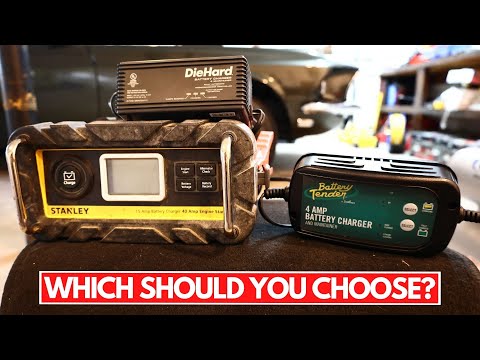
There is no single definition, and the published documents show it. A selectable 12-volt charger and maintainer from Battery Tender lists outputs of 2 amps and 8 amps, and its specification block names AGM, GEL, Lithium and standard sealed or flooded lead acid. The FAQ lower on the same page lists flooded, AGM, GEL and sealed maintenance-free, and tells lithium owners to look at other models. Those two lists disagree on one manufacturer page, which is the argument for reading the manual rather than the carton.
The same page is more useful where it is specific. It lists FCC, IC, CEC(BC) and DOE compliance marks, says the unit has spark-proof circuitry and reverse polarity protection, and answers the question owners ask of a maintainer: both of its modes are stated as safe for indefinite connection. That claim is the functional line between a maintainer and a plain charger. We are not quoting charge voltages here on purpose, because those belong to the battery maker’s documentation for your exact chemistry.
| What the label calls it | What it is doing | What to read on the spec sheet |
|---|---|---|
| Trickle or maintain | Holds a parked battery at a steady state | Whether the maker states it can stay connected indefinitely |
| Multi-stage or smart | Steps through stages, then holds | Which chemistries appear in the specifications, not the box |
| Repair or recondition | An optional mode some units publish | Whether your battery maker permits it for that chemistry |
Matching the charger to the battery you own
BCI issues group sizes to identify the correct battery for automotive applications, and the definition is tighter than owners assume. Batteries in one group share physical dimensions within 2 millimeters, their terminals must align with the vehicle’s cables, and performance is measured through cold cranking amps or amp hours depending on the age of the vehicle. BCI says its sizes also align with other international battery standards.
The fourth characteristic decides your charger setting. BCI states that by default a battery in a group is assumed to use lead chemistry with flooded technology, while EFB, AGM and lithium variants carry their own designations, such as LFP. So the group number and the chemistry marking on the old battery are what you match before any amp rating.
Batteries are safety-critical, so the only authorities here are the battery maker’s instructions and the charger’s manual. Nothing in this article replaces either, and nothing in it is a reason to work under a raised vehicle.
- The chemistry marking on the old battery: flooded, EFB, AGM or a lithium designation
- The BCI group size, which fixes case dimensions and terminal layout
- Whether the charger lists your chemistry in its specifications, not only on the carton
- Whether the maker states the unit is safe to leave connected indefinitely
- Whether an optional repair mode is permitted by your battery maker
Who needs one before the first hard freeze
The clearest case is a vehicle that sits. A motorcycle, a convertible, a camper or a second car parked from November to March gets no alternator time at all. Short-trip drivers are next: DOE singles out three-to-four-mile trips as the worst case for winter fuel economy, and those are the trips that never fully replace what starting consumed.
The weaker case is a daily highway commuter with a garage and a battery under three years old, where the alternator is already doing a maintainer’s work. The AAA club page’s advice is cheaper than any purchase: have the battery tested, because a charger holds a healthy battery rather than reviving a failed one.
We read the category as rising rather than new. The fleet beneath these products changed, the rising searches moved from charger to smart charger, and the chemistry label on the battery is now the specification that picks the box.
What to watch next
- EPA’s next Automotive Trends Report, where the model year 2025 stop/start production share will appear.
- NOAA’s ENSO Diagnostic Discussion, next scheduled for 12 November 2026, for whether the El Niño advisory holds.
- Whether a charger’s chemistry list matches between its specification block and its own FAQ.
Where to start
Paid links: we earn a commission if you buy through the buttons below, at no extra cost to you. As an Amazon Associate I earn from qualifying purchases.
Charger types compared on the things that actually differ
| Product type | Good fit for | Where to look |
|---|---|---|
| Smart 12-volt battery maintainer | Fits a vehicle parked for the season | See listings on AmazonOpens Amazon search results, not one listing: check the model on the product page. |
| Multi-stage smart battery charger | Fits a battery that needs a deeper recharge | See listings on AmazonOpens Amazon search results, not one listing: check the model on the product page. |
| Ring terminal quick-connect lead | Fits a battery that is awkward to reach | See listings on AmazonOpens Amazon search results, not one listing: check the model on the product page. |
Product types that fit the trend described above, not tested models. Check the exact listing before you buy. How we pick them.
Smart 12-volt battery maintainer
Where to look: Amazon
The format for a vehicle that will not be driven for months. The specification to find is the maker’s own statement about indefinite connection.
- Built to stay connected
- Small enough to wall-mount
- Slow on a flat battery
- Wrong chemistry mode is on you
Multi-stage smart battery charger
Where to look: Amazon
For a battery that has actually run down rather than just sat. Read which chemistries appear in the specification block, not the marketing copy.
- Higher amp setting
- Usually lists more chemistry modes
- Bulkier to store
- More settings to get wrong
Ring terminal quick-connect lead
Where to look: Amazon
A convenience part rather than a charger. Match the ring to your terminal hardware and the inline fuse to what the maker specifies.
- Leaves a plug you can reach
- No clipping on each time
- Needs the right ring size
- Adds a connection to inspect
More: Auto and EVs trends and how the Trend Signal is scored.
Sources
- The 2025 EPA Automotive Trends Report — U.S. Environmental Protection Agency
- Automotive, Essential Applications — Battery Council International
- BCI Group Sizes — Battery Council International
- Fuel Economy in Cold Weather — U.S. Department of Energy fueleconomy.gov
- Winter is Coming: Will Your Car Battery Survive — AAA South Jersey
- ENSO Diagnostic Discussion, 8 October 2026 — NOAA Climate Prediction Center
- 12V 8 Amp 2 Amp Selectable Battery Charger and Maintainer — Battery Tender
Questions readers ask
Is a battery maintainer the same as a trickle charger?
The useful distinction is published rather than linguistic: a maintainer is a unit whose maker states it is safe to leave connected indefinitely. Battery Tender’s page for its selectable 12-volt charger says both of its modes are safe for indefinite connection, which is the claim to look for.
Does an AGM battery need a special charger setting?
Battery Council International states that a battery in a given group size is assumed by default to use lead chemistry with flooded technology, and that EFB, AGM and lithium variants carry their own designations. Match the setting to the designation on your battery and to that maker’s instructions, not to a general rule.
Why do batteries fail in cold weather?
AAA South Jersey says cold slows the chemical reaction inside the battery, and that cold also thickens engine oil and increases electrical resistance so the battery works harder. DOE adds that cold battery performance makes it harder for the alternator to keep the battery charged, so the shortfall sits on both sides of the cycle.