A bed rail is the least interesting object in a bedroom: a metal frame, a strap that runs under the mattress, a foam grip. Federal regulators do not treat it that way. The U.S. Consumer Product Safety Commission identified 284 fatal entrapment incidents tied to adult portable bed rails between January 2003 and December 2021, and in July 2023 it turned an industry standard that had been voluntary into a binding rule.
Three years on, the shelf has not settled. Since February 2026 CPSC has announced four separate recalls of adult portable bed rails, two of them from the same brand, and all four notices describe the same hazard in almost identical language. For a buyer, that changes what the purchase decision is about: less which rail, more whether the one in the listing was built to the rule at all.
Trend Signal
32/100 Weak momentum
- Emerging
- Rising
- Mainstream
- Peaking
- Cooling
Four federal recalls since February 2026 under a standard in force since 2023
CPSC has announced four adult portable bed rail recalls since February 2026. The two Vive Health notices cover about 134,355 units between them, and the March notice reports two entrapment deaths in September 2024.
Our editorial reading of the cited data, not a forecast. How it is scored
By the numbers
- 284Fatal bed rail entrapment incidents CPSC identified, January 2003 to December 2021Federal Register
- 134,355Vive Health rails recalled in two 2026 CPSC notices after two entrapment deathsU.S. CPSC
- Aug 2023Manufacture date after which a rail must meet the federal safety standardU.S. CPSC
- Up to $298MYearly societal benefit CPSC estimated for the rule, against about $2M in yearly costFederal Register
What the federal rule actually changed
The rule is 16 CFR part 1270, published in the Federal Register on July 21, 2023 and applying to adult portable bed rails manufactured after August 21, 2023. It adopts ASTM F3186–17, the voluntary industry specification approved in 2017, and adds CPSC modifications at section 1270.2(b). CPSC’s business guidance says those modifications take precedence.
The requirements are mechanical, not advisory, and CPSC lists them in that guidance. The retention system has to be permanently attached and must not come off without a tool. The top of the rail has to sit at least 4 inches above the top surface of the thickest mattress the rail is recommended for. Four designated entrapment zones get tested. A rail has to be built so that mis-assembly renders it visually nonfunctional to the consumer. Sharp points and edges are judged against the tests in 16 CFR 1500.48 and 1500.49, and permanent labeling and warning statements are mandatory. Importers and manufacturers must issue a General Certificate of Conformity citing part 1270.
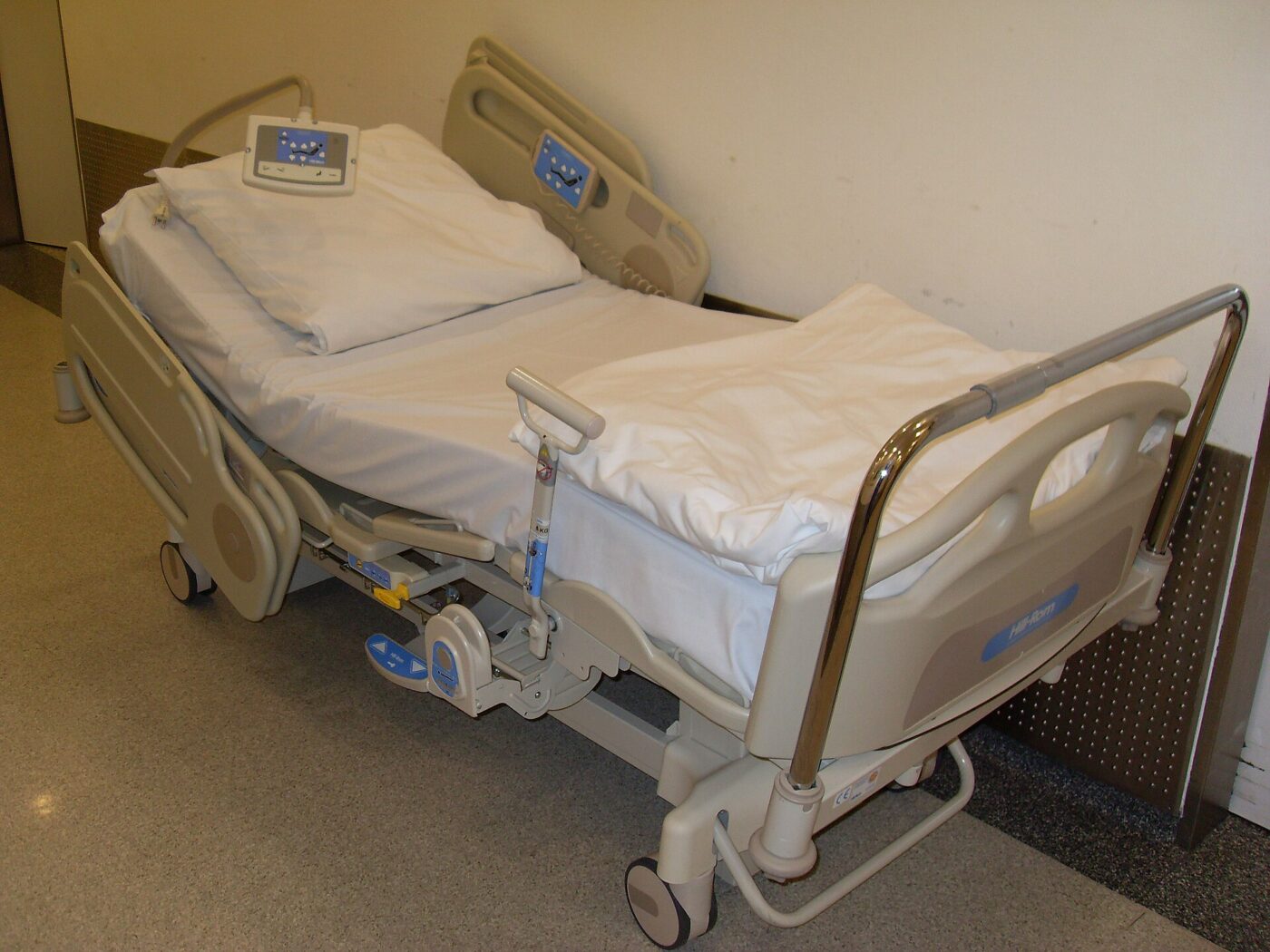
The scope is wider than the phrase “bed rail” suggests. CPSC defines the product as an adjacent-type bed rail, grab bar, assistive bar, transfer aid, cane or rail intended to be installed on, against or adjacent to an adult bed to help the occupant move on the bed, enter or exit it, or reduce the chance of falling out. Guardrails or side rails intended for FDA-regulated hospital beds are outside the scope, and children’s portable bed rails fall under a separate rule, 16 CFR part 1224.
The rule covers a whole family of bedside hardware, not just the classic strap-under-the-mattress rail.
The 2026 recall run, in order
Four notices have come out since February 2026. Two are from Vive Health, which sold through medical supply stores, its own site and Amazon; the other two cover rails sold only on Amazon.com. The pair of Vive notices splits one model by purchase date: February covers model LVA1024 bought after August 21, 2023, and March covers the same model bought on or before that date, plus two other models.
The March notice is the one with deaths attached. It says Vive Health received two reports of entrapment deaths, which occurred in September 2024 and involved a 97-year-old man at an assisted living facility in Texas and a 93-year-old man at his home in Florida.
| Announced | Brand and recall number | Units | Sold for | What CPSC cited |
|---|---|---|---|---|
| Feb 19, 2026 | Vive Health, 26-271 | about 12,355 | $45–$80 | Entrapment; missing required hazard warning labels |
| Mar 26, 2026 | Vive Health, 26-341 | 122,000 | $45–$90 | Entrapment; two deaths reported in September 2024 |
| Jul 16, 2026 | MNIENT, 26-630 | about 330 | about $66 | Entrapment; stability and retention straps; push pins |
| Sep 3, 2026 | Loyoda, 26-733 | about 2,200 | $40–$50 | Entrapment; retention straps; push pins; missing labels |
Why the recalls keep coming from marketplaces
Look at the sales windows rather than the unit counts. MNIENT moved about 330 rails on Amazon.com between January and March 2026. Loyoda moved about 2,200 between June 2025 and April 2026. These are short runs from brands whose only sales channel in the notices is Amazon.com, all of it after the mandatory standard was already in force.
The certification step is where that becomes possible. A General Certificate of Conformity is a document the importer issues; it does not pass through CPSC before a listing goes live. Enforcement therefore arrives after the fact, when the agency buys a sample or a report comes in, which is why three of the four 2026 notices describe the product as violating the mandatory standard rather than failing in the field.
The remedies show how awkward that is for the buyer. All four are refunds claimed by photograph rather than by return. The two Vive notices ask the owner to write RECALLED on the upper and lower portions of the rail in permanent marker, photograph it next to the buyer’s name on a piece of paper and email that to the company. The MNIENT notice asks for the foam padding on the handle grips to be cut and the destroyed rail photographed. The Loyoda notice asks for the black safety strap to be cut in half and RECALLED written on the rail.
Keep the model number and the packaging. The refund process in 2026 is built around a photograph of a rail you have already marked or cut.
What a compliant rail looks like on the listing
Nothing in the rule requires a seller to show its paperwork on a product page, so the practical checks are indirect. These are the ones that map onto the text of part 1270 rather than marketing copy.
- A manufacture date after August 21, 2023. Older stock can still be shipping from a listing that has been live for years.
- A stated General Certificate of Conformity citing 16 CFR part 1270. Ask the seller if the listing does not say.
- A retention strap or bracket that needs a tool to remove, not a hook or a buckle.
- A rail top that clears the mattress you actually own by at least 4 inches, measured with the bedding on.
- Permanent warning labels on the product itself, which two of the four 2026 recalls said were missing.
- A model number you can search against the recall notices at cpsc.gov before ordering.
The alternatives that do not create a mattress gap
The hazard described in every 2026 notice is a gap: inside the rail, or between the rail and the side of the mattress. We read that pattern as an argument for bedside gear that does not create a gap next to a mattress at all. Whether a rail is the right thing for a particular person is a question for the clinician who knows them.
A floor-to-ceiling transfer pole is tensioned between the floor and the ceiling joist rather than strapped under a mattress, so there is no rail-to-mattress interface to close. A low bedside floor mat changes the landing rather than the bed. Neither does the same job as a rail, and neither carries the part 1270 certificate, because neither attaches to the bed the way the rule describes.
Medicare’s own rulebook stays out of this decision. Chapter 15, section 110.1 of the Medicare Benefit Policy Manual, revision 13889 issued July 30, 2026, lists self-help devices such as safety grab bars among the equipment it treats as nonmedical, which places them outside its definition of durable medical equipment.
What to watch next
- Further adult portable bed rail recalls at cpsc.gov/Recalls, which list the affected model numbers
- Whether marketplace listings start publishing a General Certificate of Conformity citing 16 CFR part 1270
- CPSC’s business guidance page for adult portable bed rails, which carries the current requirement and certification wording
Where to start
Paid links: we earn a commission if you buy through the buttons below, at no extra cost to you. As an Amazon Associate I earn from qualifying purchases.
Bedside safety gear grouped by what it attaches to
| Product type | Good fit for | Where to look |
|---|---|---|
| Adult portable bed rail | Fits a standard home bed frame | See listings on AmazonOpens Amazon search results, not one listing: check the model on the product page. |
| Floor-to-ceiling transfer pole | Fits rooms where nothing can attach to the bed | See listings on AmazonOpens Amazon search results, not one listing: check the model on the product page. |
| Bedside floor mat | Fits the landing area beside the bed | See listings on AmazonOpens Amazon search results, not one listing: check the model on the product page. |
Product types that fit the trend described above, not tested models. Check the exact listing before you buy. How we pick them.
Adult portable bed rail
Where to look: Amazon
If a rail is the right tool, the work is verification: manufacture date, certificate, permanent labels and a model number that is not on a recall list.
- Cheapest option
- Fits most mattress depths
- The category with all four 2026 recalls
- Needs a compliance certificate you have to ask for
Floor-to-ceiling transfer pole
Where to look: Amazon
A tensioned pole gives something fixed to hold without creating the rail-to-mattress gap that every 2026 recall notice describes.
- Nothing straps under the mattress
- Works away from the bed too
- Needs a solid ceiling above
- Takes up floor space
More: Aging and Accessibility trends and how the Trend Signal is scored.
Sources
- Safety Standard for Adult Portable Bed Rails — Federal Register
- Adult Portable Bed Rails business guidance — U.S. Consumer Product Safety Commission
- Vive Health recalls adult portable bed rails, two deaths reported — U.S. CPSC
- Vive Health recalls adult portable bed rails, February 2026 notice — U.S. CPSC
- MNIENT adult portable bed rails recalled — U.S. CPSC
- Adult portable bed rails sold on Amazon by Loyoda recalled — U.S. CPSC
- Medicare Benefit Policy Manual, Chapter 15 — Centers for Medicare and Medicaid Services
Questions readers ask
Does the federal standard cover hospital bed side rails?
No. CPSC says 16 CFR part 1270 excludes guardrails or side rails intended for FDA-regulated hospital beds. Children’s portable bed rails are covered by a separate rule, 16 CFR part 1224.
How do I tell whether a rail was made after August 21, 2023?
The rule applies to units manufactured after that date, so a long-running listing can still be shipping older stock. Ask the seller for a manufacture date and for the General Certificate of Conformity, which has to cite 16 CFR part 1270.
What do the 2026 recall remedies actually require?
A refund claimed by photograph rather than by return. The two Vive notices ask owners to write RECALLED on the rail in permanent marker and photograph it beside the buyer’s name on paper. MNIENT asks for the grip foam to be cut, Loyoda for the safety strap to be cut in half.
Where do bed rails sit in the Medicare rulebook?
Chapter 15 of the Medicare Benefit Policy Manual lists self-help devices such as safety grab bars among the items it treats as nonmedical, outside its definition of durable medical equipment. It lists hospital beds among the items it treats as presumptively medical. For what any individual plan would do, ask the plan.