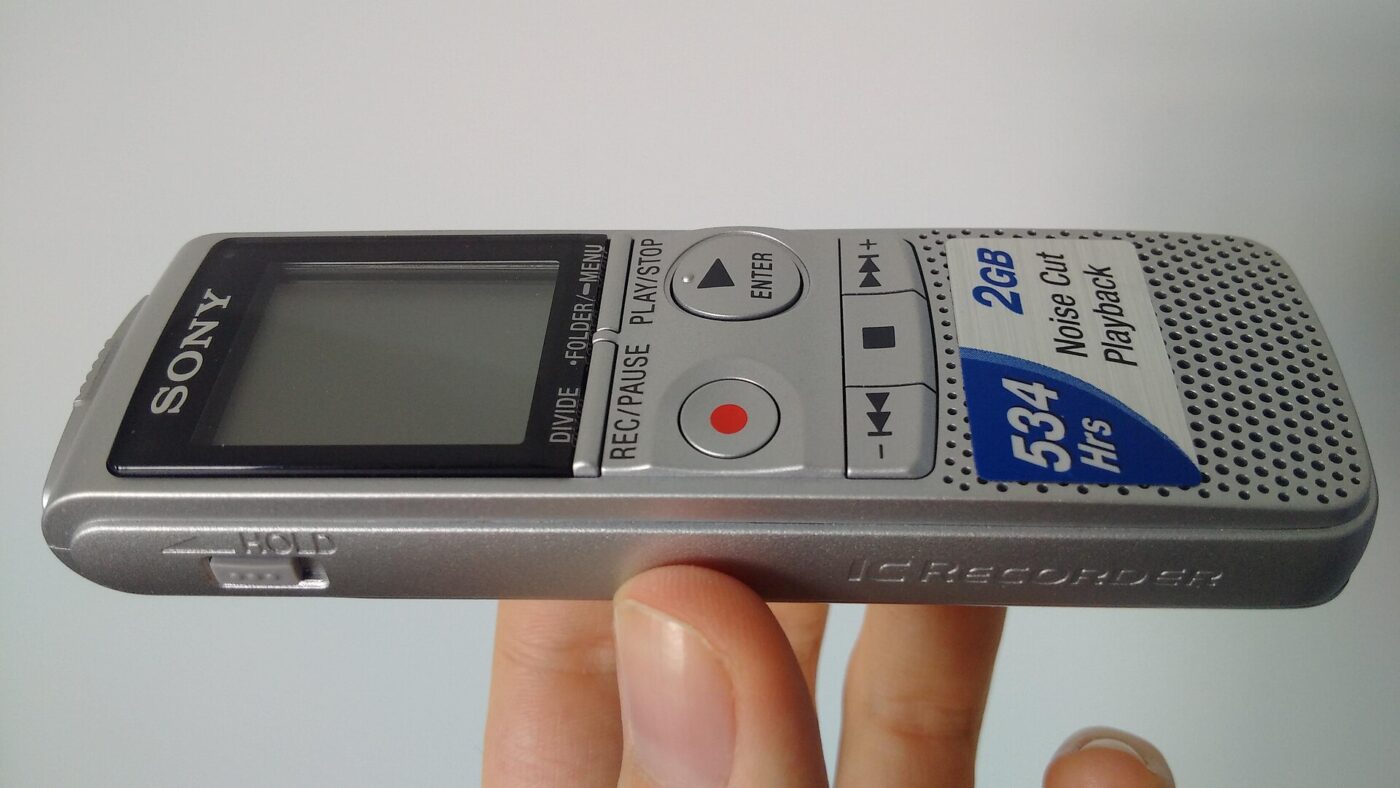
A voice recorder used to be a dictation gadget. In 2026 it is a crowded corner of work hardware: small pins, cards and earbuds that record a meeting, send the audio to a speech model and return a transcript, a summary and a list of action items.
Most of the hard numbers come from one company, Plaud, and are the company’s own figures, but the launches and acquisitions around it point the same way. Here is how big the category has become, how the pricing works and what to check before clipping one to a shirt at work.
Trend Signal
66/100 Steady momentum
- Emerging
- Rising
- Mainstream
- Peaking
- Cooling
Fast growth, a crowded field and subscription-led pricing
Plaud said in June 2026 that it had sold more than 2 million devices and passed $100 million in annualized software revenue, and a TechCrunch roundup first published in March 2026 covered devices from eight makers priced from $89 to $257. The growth figures are the company’s own, which keeps the score in the middle of the band.
Our editorial reading of the cited data, not a forecast. How it is scored
By the numbers
- 2M+AI notetaker devices Plaud said it had sold, as reported June 16, 2026Plaud, via TechCrunch
- $100MAnnualized software revenue run rate Plaud reported, per TechCrunch, June 16, 2026Plaud, via TechCrunch
- $89–$257Price range of AI notetaking devices from eight makers in a March 2026 roundupTechCrunch
- About 11US states that primarily require all-party consent to record a conversationReporters Committee for Freedom of the Press
From one gadget to a crowded shelf
Plaud’s growth is the clearest measure available, though every figure comes from the company. When it launched the $179 NotePin S in January 2026, TechCrunch reported the company had sold more than 1.5 million devices. On June 16, 2026 it said it had sold more than 2 million, and in late August TechCrunch put the number of people using its hardware or software at more than 2.5 million.
Rivals arrived in numbers. TechCrunch’s roundup of AI notetaking hardware, first published March 20, 2026, covered devices from eight makers: Plaud, Mobvoi, Comulytic (whose newer model carries the Comu name), Omi, Viaim, Anker, Pocket and Genspark. They come in card, pin, pendant, puck and earbud shapes, priced from $89 for Omi’s pendant to $257 for the Comu Action Pro.
The largest tech companies are involved too. Meta acquired Limitless, maker of a $99 AI pendant, on December 5, 2025; Limitless stopped selling hardware and said it would support existing customers for a year. Bee, which TechCrunch described in January 2026 as Amazon’s latest AI wearable, comes as a clip-on pin or a sports band.
Plaud’s reported two million devices and eight makers in one roundup put the category past novelty; it is rising, not peaking.
The subscription is the business
The hardware is the entry ticket. Plaud said in June 2026 that its software business had passed $100 million in annualized revenue and that nearly 50 percent of device users upgrade to paid plans. Its Plaud One earbuds come with paid plans from $8.33 a month billed annually, according to TechCrunch.
Free allowances cluster around 300 minutes of transcription a month, the figure TechCrunch lists for Plaud, Anker’s Soundcore Work and Genspark’s device. Others break the pattern: Mobvoi’s TicNote comes with 600 minutes, Comulytic offers unlimited basic transcription with advanced features at $15 a month or $119 a year, and Pocket includes core features with an optional $19.99-a-month plan.
That makes the allowance the number to compare. At 300 minutes, or five hours, a month, someone recording one hour-long meeting a week stays inside the free tier; two a week will not.
| Device | Form | Price | Included transcription |
|---|---|---|---|
| Plaud Note Pro | Card | $179 | 300 minutes a month |
| Plaud NotePin S | Pin | $179 | 300 minutes a month |
| Anker Soundcore Work | Coin-size pin with battery case | $159 | 300 minutes a month |
| Mobvoi TicNote | Rectangular recorder | $159 | 600 minutes |
| Comulytic Note Pro | Recorder | $159 | Unlimited basic; advanced $15 a month |
| Puck on the back of a phone | $199 | Core features; $19.99 a month optional | |
| Plaud One | Earbuds with eSIM case | $249 preorder | 300 minutes a month |
What changed in the hardware
The 2026 lineup differs mostly in where the device lives. Plaud’s NotePin S adds a physical button to start and stop recording and mark highlights, 64GB of storage, 20 hours of continuous recording and Apple Find My support. Pocket sticks to the back of a phone and claims a 15-meter pickup range; Comu’s Action Pro uses six microphones, a seven-meter range and 70 hours of continuous recording.
Earbuds are the newest form. Viaim’s earbuds, which TechCrunch listed at $200, add recording through the charging case. Plaud One, announced August 27, 2026 at $249 for preorder and shipping in the fourth quarter, records up to six hours of meetings or three hours of calls per charge and puts an eSIM in the case so it can reach AI agents without a phone; Plaud says its US pre-sale sold out in one day.
Software is closing in from the other side. Plaud’s own desktop app records online meetings on a Mac, and TechCrunch reported that Plaud aims it at meeting-software notetakers such as Granola, Fathom and Fireflies. If most of your meetings happen on a laptop, a device may add little that an app does not.
Consent is the buyer’s problem
A recorder on a lapel captures everyone in range. Federal law requires the consent of at least one party to a conversation, according to the Reporters Committee for Freedom of the Press, but about 11 states primarily require all parties to agree: California, Delaware, Florida, Illinois, Maryland, Massachusetts, Michigan (at least for recordings made by a third party), Montana, New Hampshire, Pennsylvania and Washington.
Some devices build consent into the design. TechCrunch reported that Amazon’s Bee is meant to be used by asking before recording someone, shows a green light while in use and discards the audio after transcription. Employers may also set their own rules for recording internal meetings.
This is not legal advice, and the details vary by state. The practical habit is simple: say that you are recording at the start, and stop if anyone objects.
Who should buy one now
Buy now if many of your meetings are in person, such as site visits, interviews, client meetings or field sales calls, and you already spend time typing up notes afterward. Pick the form by where you work: a card or desk recorder for meeting rooms, a pin for walking and standing conversations.
Wait if your meetings are mostly online, where a desktop app may do the job, or if you would need a large monthly allowance: price the subscription for a full year before comparing device prices. The Limitless shutdown is a reminder that a device depends on its company’s service, so a model with onboard storage and file export keeps your recordings usable if the service changes.
What to watch next
- Plaud One shipments in the fourth quarter of 2026, and whether earbuds take share from pins and cards
- Amazon’s and Meta’s next moves in AI wearables after Bee and the Limitless deal
- Changes to free transcription allowances, the clearest sign of where pricing is heading
Where to start
Paid links: we earn a commission if you buy through the buttons below, at no extra cost to you. As an Amazon Associate I earn from qualifying purchases.
AI and conventional voice recorders compared
| Product type | Good fit for | Where to look |
|---|---|---|
| Card-style AI voice recorder | Fits in-person meetings at a table | See listings on AmazonOpens Amazon search results, not one listing: check the model on the product page. |
| Wearable AI recorder pin | Fits field work and walking meetings | See listings on AmazonOpens Amazon search results, not one listing: check the model on the product page. |
| Digital voice recorder without a subscription | Fits buyers who want no subscription | See listings on AmazonOpens Amazon search results, not one listing: check the model on the product page. |
Product types that fit the trend described above, not tested models. Check the exact listing before you buy. How we pick them.
Card-style AI voice recorder
Where to look: Amazon
The most common form. Compare the monthly allowance and the annual plan price before the device price.
- Several microphones for a table
- Transcripts and summaries in an app
- Free allowances are often 300 minutes a month
- Features depend on the company’s service
Wearable AI recorder pin
Where to look: Amazon
For site visits and standing conversations. Choose a model with a clear recording indicator.
- Clips to a shirt, lanyard or wrist
- Physical record button on newer models
- Shorter pickup range than table recorders
- Visible to others, which raises consent questions
Digital voice recorder without a subscription
Where to look: Amazon
The fallback if you want recordings you control and can transcribe with software you already use.
- No monthly plan
- Files stay on the device until you move them
- No built-in summaries
- Transcription needs separate software
More: Work and Office trends and how the Trend Signal is scored.
Sources
- Plaud launches a new AI pin and a desktop meeting notetaker — TechCrunch
- These AI notetaking devices can help you record and transcribe your meetings — TechCrunch
- Plaud says its software business topped $100M in ARR after shipping over 2M AI notetakers — TechCrunch
- Plaud’s new earphones come with an eSIM-enabled case for talking to AI agents — TechCrunch
- Meta acquires AI device startup Limitless — TechCrunch
- Bee, Amazon’s latest AI wearable (January 12, 2026) — TechCrunch
- Introduction to the Reporter’s Recording Guide — Reporters Committee for Freedom of the Press
- Plaud One AI Earbuds Sell Out U.S. Pre-Sale in One Day — Plaud
Questions readers ask
Are AI voice recorders for meetings worth it?
They pay off mainly for people with frequent in-person meetings. Devices in TechCrunch’s March 2026 roundup cost $89 to $257, and many include a limited free transcription allowance, often 300 minutes a month, with paid plans beyond that.
Do AI recorders need a subscription?
Most work without one up to a free limit. Plaud, Anker and Genspark list 300 free minutes a month; Comulytic offers unlimited basic transcription with advanced features at $15 a month; Plaud says nearly half of its device users upgrade to paid plans.
Is it legal to record a meeting with an AI recorder?
Federal law requires the consent of at least one party, but the Reporters Committee for Freedom of the Press lists about 11 states that primarily require all parties to consent, including California, Florida, Illinois and Pennsylvania. Rules vary, so tell participants and follow your employer’s policy.
What happened to the Limitless pendant?
Meta acquired Limitless on December 5, 2025. The company stopped selling its $99 pendant and said it would support existing customers for a year, with free access to its Unlimited plan.