The first cold week sends people to the same search box with the same phrase, and the results are a wall of near-identical tubes, strips and sweeps. We have not tested any of these products and we do not pretend otherwise. This compares what manufacturers publish about size, fit and installation with what federal guidance says the fix is worth.
We named parts only where the maker lists a part number and dimensions on a page we opened on September 25, 2026. The choice turns on three measurements almost nobody takes first.
Trend Signal
55/100 Steady momentum
- Emerging
- Rising
- Mainstream
- Peaking
- Cooling
A flat seasonal category buoyed by a fifth straight year of rising power prices
EIA measured the U.S. average residential electricity price at 17.99 cents per kilowatthour for the 12 months ended July 2026, against 16.89 cents a year earlier, in the Electric Power Monthly released September 24, 2026.
Our editorial reading of the cited data, not a forecast. How it is scored
By the numbers
- 0.5 cfm/ft2Air leakage limit for an ENERGY STAR certified swinging door, Version 7.0ENERGY STAR
- 25%Median cut in air leakage after retrofit, 23,100 homes, Berkeley Lab 2012 studyLawrence Berkeley National Laboratory
- 36 in.Length Frost King publishes for its self-stick door sweeps, cut to fit on siteFrost King
- 17.99 centsU.S. average residential electricity price per kilowatthour, 12 months to July 2026U.S. Energy Information Administration
What a seal at the bottom of a door actually fixes
Federal guidance is blunt about this. EPA’s ENERGY STAR page on where to spend effort states that leaks through doors, windows and walls can cause uncomfortable drafts but usually have the least impact on energy use, while being the most accessible areas and ideal for a do-it-yourselfer. EPA’s 2016 do-it-yourself guide says the same: people notice drafts at windows and doors and assume they are the major source of wasted energy, but in most homes the significant leaks are hidden in the attic and basement.
For scale, Lawrence Berkeley National Laboratory analyzed blower-door results for roughly 134,000 single-family detached homes in its 2012 report LBNL-5966E. Among the 23,100 measured before and after a retrofit, the median cut in normalized leakage was 25%. That is a funded crew doing attic, duct and envelope work together, and the authors caution that contributors self-selected, so the database is not a representative sample.
Buy it for the draft on your feet. The bill is an attic and duct question.
Five ways to close the same gap
Two of the five never touch the door. A double draft guard slides underneath and seals both faces at once; Frost King lists its DDS1 at 1-1/4 inches by up to 36 inches wide and states in its own support answers that the product is not rigid enough to stop all insects, pointing buyers who want that to an aluminum and vinyl sweep. A fabric snake simply lies against the gap and gets shoved aside by the door.
The other three attach and stay. Frost King publishes self-stick sweeps at 1-1/2 and 2 inches by 36 inches, slide-on vinyl door bottoms at 1-3/4 inches by 36 inches for wood or steel doors, and an extra-wide screw-on aluminum sweep at 2-3/8 inches by 36 inches. M-D Building Products describes its self-adhesive CINCH sweep as a triple-fin vinyl seal needing no hardware and its U-shape under-door seal as a compression fit; both pages say to cut the part to length with a hacksaw first.
| Type | How it attaches | Published size to match |
|---|---|---|
| Double draft guard | Slides under the closed door | Frost King DDS1, 1-1/4 in. by up to 36 in. |
| Fabric draft snake | Rests against the gap, moved by the door | Sold by length; match the door width |
| Self-stick sweep | Adhesive strip on the inside door face | Frost King DS101, 1-1/2 in. by 36 in. |
| Slide-on door bottom | U-channel fit over the door edge | Frost King W79/36H, for 1-3/4 in. doors |
| Screw-on aluminum sweep | Screws into the door face, adjustable | Frost King A8236, 2-3/8 in. by 36 in. |
Three measurements to take before you order

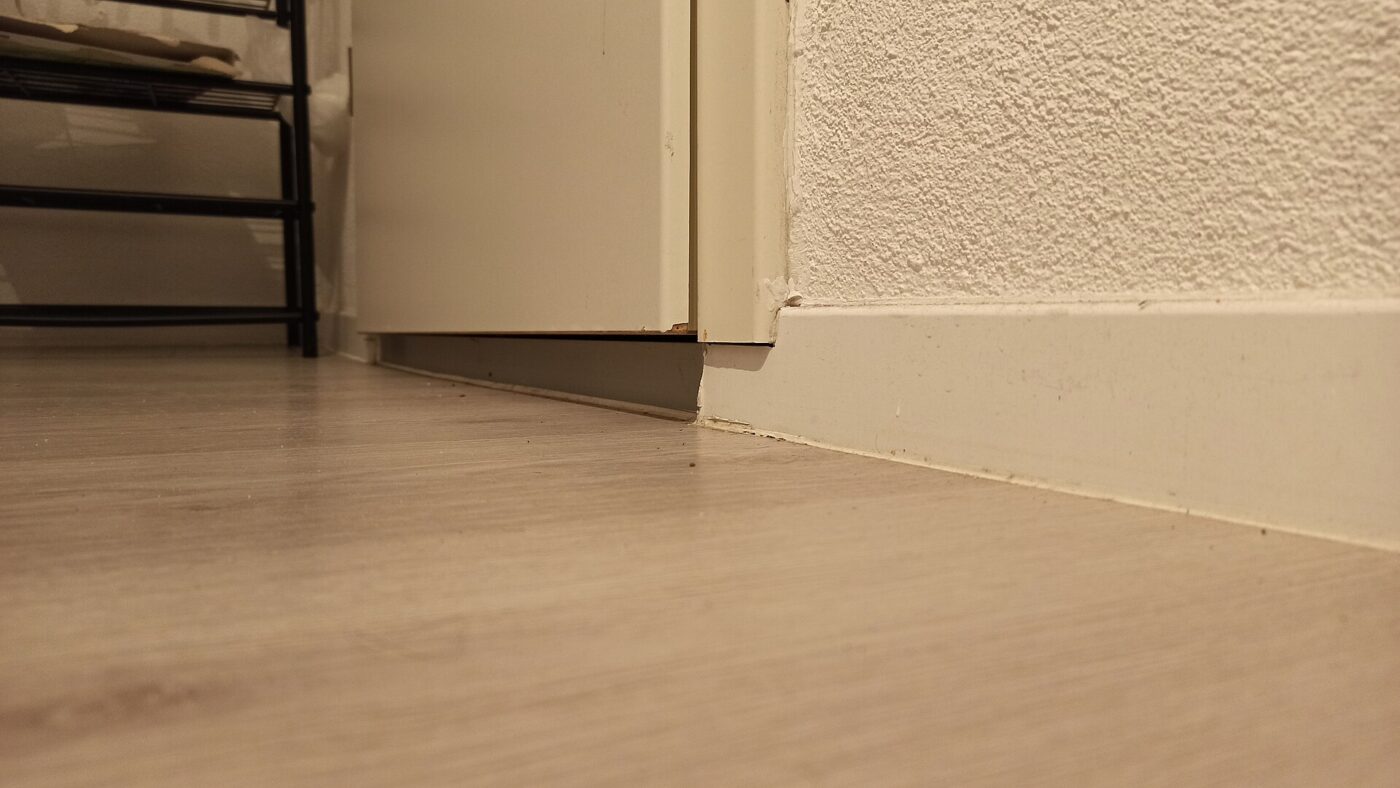
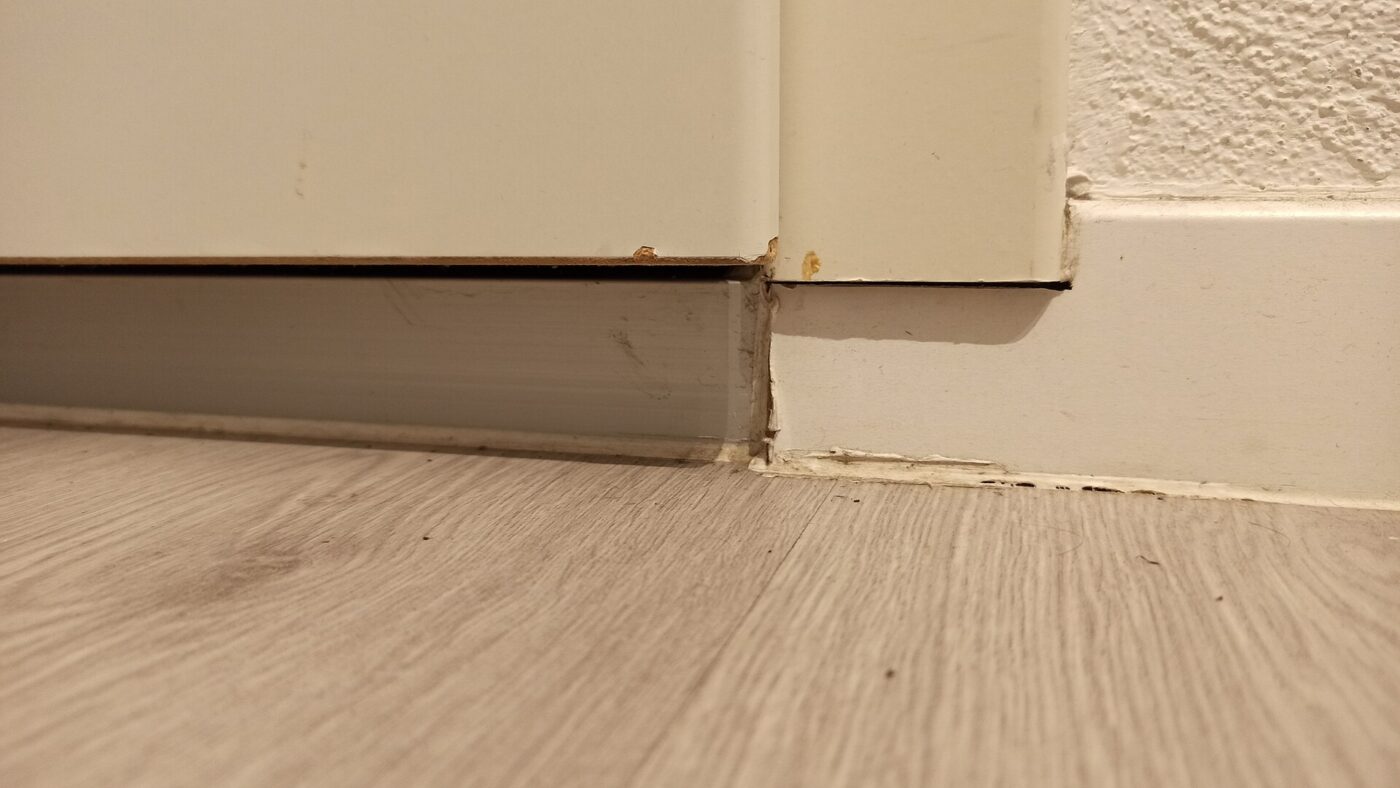
First, the gap. Close the door and measure the clear opening at its widest point, because old doors rarely sit square. Fin length is what covers it, and Frost King states that the fins on its PVC replacement door bottom cover up to a 1/2 inch gap.
Second, door width, which is where the 30-inch and 32-inch searches come from. Interior doors are commonly narrower than the 36 inches at which Frost King and M-D ship almost everything here. Neither sells a 30-inch part; both tell you to cut the 36-inch one down. Frost King says the foam tubes inside its Double Draft Stop cut to any size, with the loose ends folded over for a narrower door.
Third, door thickness, which matters for one type: a slide-on U-channel bottom grips the edge, and Frost King publishes its versions for wood or steel doors 1-3/4 inches thick.
- Gap height at the widest point with the door closed
- Door width, measured on the door rather than the frame
- Door thickness, for slide-on U-channel bottoms only
- Swing direction, since sweeps go inside an in-swinging door
- Floor clearance over carpet, rugs and transition strips
Almost every bad fit here is one of these five numbers going unchecked.
What the published savings numbers do and do not cover
No manufacturer can tell you what a door seal saves, and any listing quoting a percentage is quoting something else. The federal estimates that circulate cover whole-house air sealing plus added insulation. Our brief on whether weatherstripping is worth it works through those figures, so we will not restate them.
What can be stated precisely is what a factory-sealed door may leak. ENERGY STAR Version 7.0, effective October 23, 2023, caps a certified swinging door at 0.5 cubic feet per minute per square foot, tested to ASTM E283 in accordance with NFRC 400. On a 36 by 80 inch door that is 20 square feet and roughly 10 cubic feet per minute at the test condition, on our arithmetic. Certification bounds the leakage rather than removing it.
When the gap under the door is not the problem
If the draft persists with the gap closed, the leak is out of the sweep’s reach. The sides and head of the frame come next, which is the demand behind the separate phrase for a draft stopper for the side of a door frame, and they take compression weatherstrip on the jamb. Behind that sits the frame-to-wall joint, which ENERGY STAR treats as its own project and rates moderate to difficult because it means pulling the trim.
One situation deserves care. ENERGY STAR warns that sealing a home or its ducts can cause combustion appliances such as water heaters to backdraft, and that a tighter home may need added mechanical ventilation. A single door seal is unlikely to move a house there, but it is why the agency puts a professional inspection ahead of a sealing program in a house with vented combustion appliances.
What to watch next
- The monthly EIA residential electricity price series, since the value of any fixed percentage saving tracks it.
- Whether EPA opens a revision of the Version 7.0 specification that sets the 0.5 cfm per square foot swinging-door limit.
- Whether either weatherization brand starts publishing parts cut to 30 and 32 inches instead of leaving buyers to trim.
Where to start
Paid links: we earn a commission if you buy through the buttons below, at no extra cost to you. As an Amazon Associate I earn from qualifying purchases.
Under-door products compared on how they attach
| Product type | Good fit for | Where to look |
|---|---|---|
| Under-door draft guard | Fits renters who cannot drill | See listings on AmazonOpens Amazon search results, not one listing: check the model on the product page. |
| Self-adhesive door sweep | Fits a clean, smooth door face | See listings on AmazonOpens Amazon search results, not one listing: check the model on the product page. |
| Screw-on aluminum and vinyl door sweep | Fits an exterior door that stays put | See listings on AmazonOpens Amazon search results, not one listing: check the model on the product page. |
Product types that fit the trend described above, not tested models. Check the exact listing before you buy. How we pick them.
Under-door draft guard
Where to look: Amazon
The slide-under type removes without a trace, which suits a lease. Frost King publishes its version at 1-1/4 inches by up to 36 inches and says the internal foam tubes cut to any size.
- Nothing stuck to the door
- Trims with scissors
- Pushed out of place by the door
- Will not stop insects
Self-adhesive door sweep
Where to look: Amazon
Adhesive sweeps trade permanence for surface preparation. M-D publishes a triple-fin CINCH sweep that peels and sticks with no hardware, and both makers say to cut to length first.
- Stays put once fitted
- No tools beyond a hacksaw
- Adhesive fails on cold or dusty surfaces
- One shot at placement
Screw-on aluminum and vinyl door sweep
Where to look: Amazon
The type that survives a winter on an entry door. Frost King publishes an extra-wide version at 2-3/8 inches by 36 inches and notes that on an in-swinging door the sweep goes on the inside face.
- Adjustable after fitting
- Widest published fin coverage
- Puts screw holes in the door
- Must clear the threshold
More: Home Improvement trends and how the Trend Signal is scored.
Sources
- Assess the Level of Opportunity — ENERGY STAR
- A DIY Guide to Sealing and Insulating, 2016 — U.S. EPA
- Windows, Doors and Skylights, Version 7.0 — ENERGY STAR
- Air Leakage of US Homes, LBNL-5966E, August 2012 — Berkeley Lab
- Self-Stick Door Sweep — Frost King
- Double Draft Stop — Frost King
- Vinyl Slide-On Door Bottoms for Steel or Wood Doors — Frost King
- Premium Extra Wide Heavy Duty Aluminum and Vinyl Door Sweep — Frost King
- Vinyl CINCH Slide-On Under Door Seal — M-D Building Products
- Aluminum and Vinyl CINCH Self-adhesive Door Sweep — M-D Building Products
- Identify the Problems You Want to Fix — ENERGY STAR
- Electric Power Monthly, Table 5.3 — U.S. EIA
Questions readers ask
Does a draft stopper under the door lower my heating bill?
Not measurably on its own. ENERGY STAR states that leaks through doors, windows and walls usually have the least impact on energy use while being the most accessible areas, and EPA’s 2016 guide says the significant leaks in most homes are hidden in the attic and basement.
Why is everything 36 inches when my door is 30 inches?
Because the category is sold as stock to be cut. Frost King publishes its self-stick sweeps, slide-on door bottoms and aluminum sweeps at 36 inches, and M-D Building Products tells buyers to cut its sweeps and under-door seals to length with a hacksaw.
Which type works over carpet?
A slide-under guard or fabric snake rides on carpet, while anything fixed to the door has to clear the floor covering as the door swings. Measure that clearance with the door moving, not closed.
How airtight is a new exterior door anyway?
ENERGY STAR Version 7.0, effective October 23, 2023, allows a certified swinging door an air leakage rating of 0.5 cubic feet per minute per square foot, measured to ASTM E283 in accordance with NFRC 400. Certification bounds the leakage rather than eliminating it.