Amazon finishes ice fishing gear ten ways, and three of them are not tackle at all: gear bag, gear sled, gear tip up. We pulled those completions on October 12, 2026. They describe how the category is now sold — as a carrying system with a shelter, an auger and a sonar unit inside it. The part a first-time buyer misses is that a state rulebook decides how many lines the system may run.
We have tested nothing. This compares the 2026 Minnesota fishing regulations, a PDF we downloaded and extracted as text rather than reading in summary, against a public company’s annual report on SEC EDGAR, a BLS producer price series read off the BLS flat files, and our own CPSC recall search on October 12, 2026. Rules differ by state; read your own state’s book before buying to a line count. Method: how we track trends.
Trend Signal
60/100 Steady momentum
- Emerging
- Rising
- Mainstream
- Peaking
- Cooling
A new state rule for hook-setting devices, and the growth sitting in electronics
The 2026 Minnesota fishing regulations mark as NEW that non-motorized devices setting the hook with a spring or a bent fishing rod may be used through the ice, provided they cannot reel or retrieve automatically. Johnson Outdoors, whose Humminbird brand makes sonar and GPS for fish finding, reported fishing net sales up $6.8 million or 2% in the fiscal year ended October 3, 2025, mainly from new product introductions.
Our editorial reading of the cited data, not a forecast. How it is scored
By the numbers
- 2 linesLines allowed through the ice in Minnesota, 1 on designated trout lakes and streamsMinnesota DNR
- 200 ftHow close you must stay to a tip-up, and to an unattended portable shelter, in MinnesotaMinnesota DNR
- +2%Johnson Outdoors fishing segment net sales, fiscal year ended Oct. 3, 2025SEC EDGAR
- +1.7%PPI for sporting and athletic goods, Aug. 2025 to preliminary Aug. 2026, our calcBureau of Labor Statistics
What changed in the rulebook
The 2026 Minnesota fishing regulations carry one change flagged as NEW in the ice angling section, and it is a hardware permission. Non-motorized devices that set the hook using a spring or the force of a fishing rod released from a bent position can now be used through the ice, provided the device cannot automatically reel or spool the line, or automatically retrieve a hooked fish. That is a market signal as much as a rule, because it legalizes a shelf of spring-loaded rod holders in a state with a long ice season.
The rest of the ice angling page is the cap. Two lines may be used through the ice, except that only one line can be used on designated trout lakes and streams. You must remain within sight of your line, and if you are using a tip-up, defined in the book as a device with spooled line and a flag that pops up when a fish bites, you must be within 200 feet of the device. That sets the buying ceiling: a tip-up is cheap and the temptation is to buy a handful, but the legal maximum through the ice is two lines per angler and one on trout water. Four tip-ups is a plan for a group, not for one person.
Two lines, within sight, within 200 feet of a tip-up. Buy to that, not to the shelf.
The shelter is a licensed structure

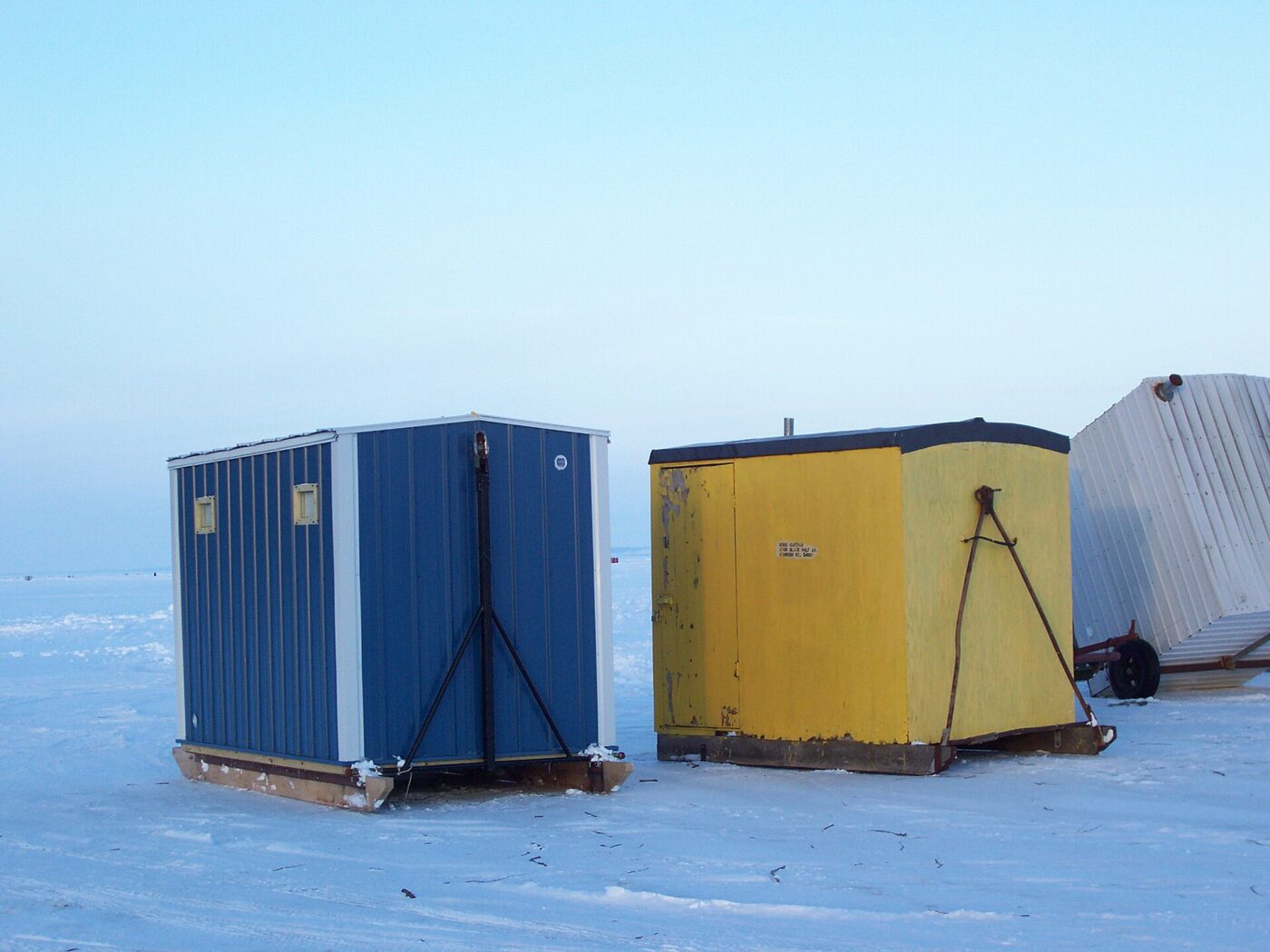
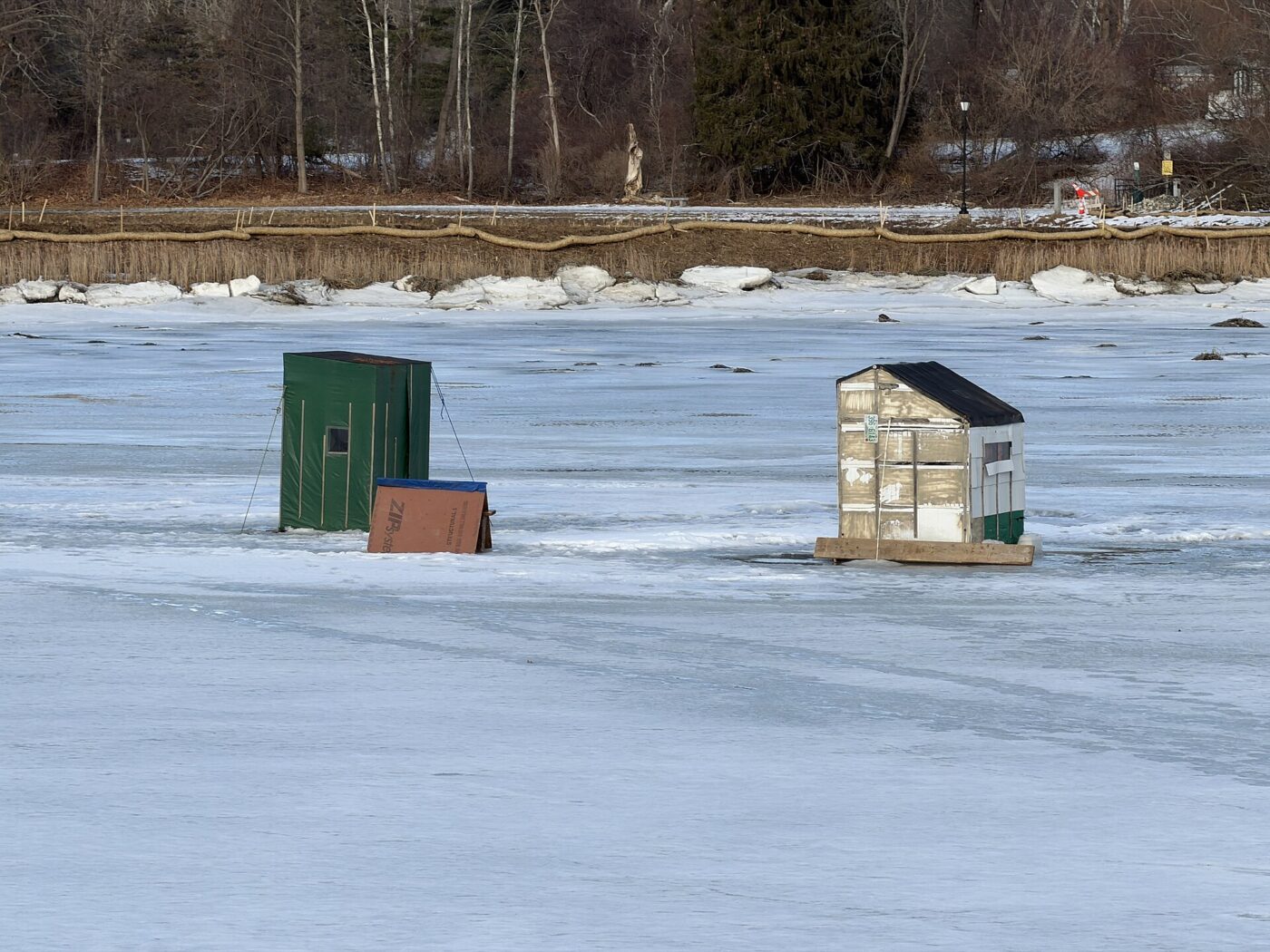
The biggest single purchase in this category is the one with paperwork. In Minnesota, all shelters except portable ones placed on inland and Canadian border waters need a shelter license, held by the owner. A portable shelter — one that collapses, folds or is disassembled for transportation, excluding trailers and campers — needs a license if left unattended any time between midnight and one hour before sunrise, or if the owner is not within 200 feet. The license runs from March 1 through April 30 of the following year.
Identification is a physical requirement on the shell you buy. All shelters need it except portable ones that are occupied, meaning somebody is within 200 feet, and it means the owner’s name and address, driver’s license number or Minnesota DNR identification number, visible from the exterior in characters at least 2 inches high. The regulations also require a trailer used to haul a fish house or a fish house on wheels to be registered through a local deputy registrar.
- Non-portable shelter: license required on inland and Canadian border waters
- Portable shelter: license needed if unattended between midnight and an hour before sunrise, or if you are over 200 feet away
- Identification: name and address, driver’s license number or DNR number, 2-inch characters, visible outside
- Overnight: at least 2 square inches of reflective material on each side, and no closer than 10 feet apart
The shell, the sticker and the trailer plate are one purchase decision.
Where the money went: electronics and batteries
The growth in this corner of fishing is in what shows you the fish. Johnson Outdoors, whose fishing brands are Minn Kota electric motors, Humminbird sonar and GPS equipment for fish finding, navigation and marine cartography, and Cannon downriggers, reported consolidated net sales of $592.4 million for the fiscal year ended October 3, 2025 against $592.8 million the year before. Inside that, fishing net sales rose $6.8 million, or 2%, which the company attributed mainly to the introduction of new products, particularly in the last half of the year.
Its regulatory risk factors state that uncertainty over global tariffs may negatively affect results, and that US domestic and global tariff frameworks have increased its costs of producing goods — the same pressure showing up in sporting goods prices.
The battery half of the system is older than it looks. On March 6, 2015 Rapala recalled about 3,000 StrikeMaster Lithium Lazer ice augers in the United States, described in the notice as a 24-pound unit running on a rechargeable 50-volt lithium-ion battery, because the trigger switch could fail and the unit not turn off; no injuries were reported, and the notice now lists no remedy available, under a note dated March 11, 2026. A battery-powered auger of that kind existed over a decade ago, which is why the cordless end of this category is mature rather than new.
The sled is the chassis, and the one piece with a recall pattern
Two of Amazon’s completions, gear sled and gear bag, describe the same decision: how the system gets onto the ice. The sled is the chassis everything else bolts to, and the Minnesota book assumes it, allowing items such as coolers and storage containers to be kept on the ice outside a shelter.
It is also the component with the clearest failure record. On May 25, 2010 Pelican International recalled about 250 utility snow sled tow hitches used with its Snow Trek sleds, after 10 reports that screws could work loose from vibration when towing, allowing the sled and hitch to detach. On June 8, 2016 Kwik Tek recalled about 4,200 sleds because the front handle bar assembly can break, with no injuries reported. Both notices are about the joint between a sled and whatever pulls it.
For the kids queries in the same completion list, Minnesota is simple: resident youth younger than 16 do not need a fishing license. A resident adult annual individual angling license is $25, with a 24-hour option at $12 and a 72-hour at $14, plus a $1 issuing fee for originals. The license year begins March 1 and ends the last day of February.
Prices across the group have been mild and the tackle-specific series is gone. The BLS producer price index for sporting and athletic goods read a preliminary 229.702 in August 2026 against 225.939 a year earlier, up 1.7% on our calculation, while its commodity index for fishing tackle and equipment stops in January 2017 at 214.6 in the flat files we read. SFIA’s release of August 20, 2026 reports 30.2% of participants seeing higher costs and 25% of those citing tariffs on sports equipment, which is what the ice fishing gear clearance completion sounds like from the other side of the counter.
Both sled recalls we found were about the hitch or the handle, not the hull.
What to watch next
- Whether other ice states follow Minnesota in permitting non-motorized spring or bent-rod hook-setting devices through the ice
- Johnson Outdoors fishing segment sales, up 2% in the fiscal year ended October 3, 2025 on new product introductions
- Whether BLS restores a fishing tackle and equipment index, which stops in January 2017 in its own flat files
Where to start
Paid links: we earn a commission if you buy through the buttons below, at no extra cost to you. As an Amazon Associate I earn from qualifying purchases.
Ice fishing gear compared on what the rules actually cap
| Product type | Good fit for | Where to look |
|---|---|---|
| Ice fishing tip-ups | Fits two legal lines | See listings on AmazonOpens Amazon search results, not one listing: check the model on the product page. |
| Ice fishing gear sled | Fits moving the kit onto the ice | See listings on AmazonOpens Amazon search results, not one listing: check the model on the product page. |
| Portable ice shelter | Fits a licensed overnight setup | See listings on AmazonOpens Amazon search results, not one listing: check the model on the product page. |
Product types that fit the trend described above, not tested models. Check the exact listing before you buy. How we pick them.
Ice fishing tip-ups
Where to look: Amazon
The book requires you to stay within sight of your line and within 200 feet of a tip-up, so the rules set the number you can usefully own.
- Cheapest way to cover a second hole
- Flag shows a bite at distance
- Minnesota caps you at two lines
- One line only on designated trout water
Ice fishing gear sled
Where to look: Amazon
Both sled notices we found were about the connection: a tow hitch whose screws could loosen in 2010, and a handle bar assembly that can break in 2016.
- Carries shelter, auger and electronics
- Doubles as the base of the setup
- Tow hitches have worked loose in a recall
- A hauling trailer must be registered
Portable ice shelter
Where to look: Amazon
Minnesota defines portable as collapsing, folding or disassembling for transport and excludes trailers, so the fold is the legal distinction rather than the weight.
- No license while occupied within 200 feet
- Collapses for transport
- Needs a license once left unattended overnight
- Reflective material required on each side
More: Sports and Recreation trends and how the Trend Signal is scored.
Sources
- 2026 Minnesota Fishing Regulations — Minnesota Department of Natural Resources
- Annual report, fiscal year ended Oct. 3, 2025 — Johnson Outdoors via SEC EDGAR
- Rapala recalls StrikeMaster ice augers — CPSC
- Kwik Tek recalls sleds due to crash hazard — CPSC
- Utility snow sled hitch recalled by Pelican International — CPSC
- Recall database REST web service — CPSC
- PPI series WPU1512, sporting and athletic goods — Bureau of Labor Statistics
- Producer price index commodity flat file, miscellaneous products — Bureau of Labor Statistics
- US sports and fitness participation reaches record high, mid-year data — SFIA
Questions readers ask
How many lines can you use ice fishing?
In Minnesota, 2 lines may be used through the ice, except on designated trout lakes and streams where only 1 line is allowed. You must remain within sight of your line, and within 200 feet of a tip-up. Other states set their own limits, so check the current regulations where you fish.
Can kids ice fish without a license?
In Minnesota, resident youth younger than 16 do not need a fishing license. A resident adult annual individual angling license is $25, with a 24-hour option at $12 and a 72-hour option at $14, and licenses carry a $1 issuing fee for originals.
Have ice fishing augers or sleds been recalled?
Our CPSC search on October 12, 2026 found a 2015 recall of about 3,000 StrikeMaster Lithium Lazer electric augers, where the trigger switch could fail and the unit not turn off, with no injuries reported, plus a 2010 recall of about 250 Pelican sled tow hitches and a 2016 recall of about 4,200 Kwik Tek sleds.