We have not tested any of the machines named here. What follows compares the figures each company publishes on its own United States product page, all read on October 1, 2026, against the Consumer Product Safety Commission recall database, which we queried the same day. Our selection rule: machines sold in the US today by the company that makes them, with a published specification block we could open and read in full.
The first number a beginner meets is the one on the front of the box, and it is the one makers define least consistently. We counted four different bar figures across five brands, attached to three different meanings. For the market backdrop rather than the buying decision, see home espresso machines and coffee prices in 2026.
Trend Signal
72/100 Strong momentum
- Emerging
- Rising
- Mainstream
- Peaking
- Cooling
A record share of US adults now drink espresso-based coffee
The National Coffee Association’s 2026 National Coffee Data Trends Fall Report, released September 15, 2026, found a record 47 percent of American adults had an espresso-based beverage in the past week, up 17.5 percent since 2022.
Our editorial reading of the cited data, not a forecast. How it is scored
By the numbers
- 47%US adults who had an espresso-based beverage in the past week, Fall 2026 surveyNational Coffee Association
- 16 recordsEspresso recalls in the CPSC database when we queried it on October 1, 2026CPSC
- 9 barExtraction pressure Breville publishes for the Bambino, behind a 15 bar pumpBreville
- 3 secondsHeat-up time Breville publishes for the Bambino ThermoJet systemBreville
What the bar number on the box refers to

A bar is a unit of pressure, and espresso machines use it for two different things: the maximum a vibration pump can generate against a closed valve, and the pressure the machine holds while water passes through the coffee. Most pages publish only the first.
We read five makers’ own US pages on October 1, 2026 and found four different figures. De’Longhi’s product data for the Rivelia carries a field labeled Pump Pressure in bar, set to 19; its Stilosa page says 15 bar pump pressure. Philips says the Baristina has a 16-bar pressure pump. Chefman says its CaféMaster Pro has a 15-BAR pump and its Coffee Station Pro a 20-Bar Pressure System, without saying what the system measures. SharkNinja publishes no bar figure for the Ninja Luxe Cafe Premier.
Two makers break it out. Breville writes the same sentence on the Bambino, Barista Express and Oracle pages: low pressure pre-infusion followed by a high pressure 9 bar extraction, delivered via a 15 bar Italian pump. Fellow states it as a 15-bar pump calibrated for up to 9 bars of extraction. Those two lines explain every other number here: the big figure is the pump, and the machine throttles down to roughly 9 bar at the basket.
| Machine | What the maker’s page says | What the number describes |
|---|---|---|
| Breville Bambino BES450 | Low pressure pre-infusion then 9 bar extraction via a 15 bar Italian pump | Both, stated separately |
| Fellow Espresso Series 1 | 15-bar pump calibrated for up to 9 bars of extraction | Both, stated separately |
| De’Longhi Rivelia EXAM44055 | Pump Pressure in bar, 19 | Pump only |
| De’Longhi Stilosa EC260 | 15 bar pump pressure | Pump only |
| Philips Baristina BAR303 | 16-bar pressure pump | Pump only |
| Chefman Coffee Station Pro | 20-Bar Pressure System | Not stated |
| Ninja Luxe Cafe Premier ES601 | No bar figure published | Not stated |
A higher bar number on the box tells you about a pump, not about your cup.
Single wall or dual wall: the basket sets the learning curve
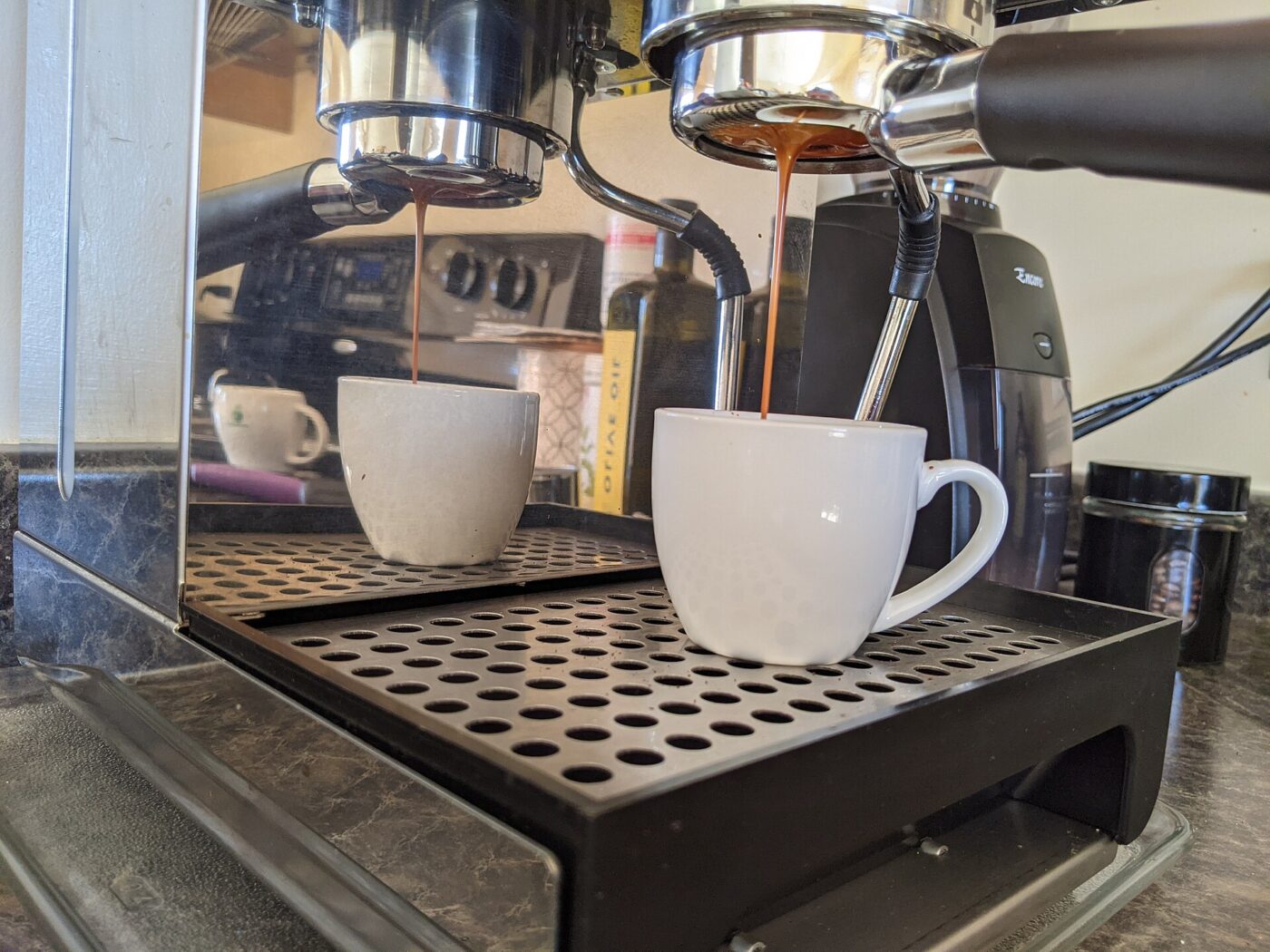
The part that decides how forgiving a machine is costs almost nothing and is rarely on the box. Breville publishes a plain description: a pressurized basket, also called a dual-wall basket, is a metal filter with an inner and an outer wall, where the inner wall has many holes at the bottom and the outer wall has a single small hole at the base. A non-pressurized, or single-walled, basket has holes covering the entire base and nothing behind them.
Breville ships both with its entry machines. The accessory lists for the Bambino and the Barista Express each include 1 cup and 2 cup single wall and dual wall filter baskets, and Breville’s instruction book says dual wall baskets are for pre-ground coffee and single wall baskets for grinding fresh whole beans. Fellow takes the other route and ships the Espresso Series 1 with a 58 mm bottomless portafilter and the grinder sold separately.
For a first machine this is the most useful line on a listing: it tells you whether the machine works on day one with pre-ground coffee or assumes you already own a grinder.
Heat-up, portafilter size and what is in the box
Three other published figures separate the used from the shelved. The first is heat-up. Breville says the Bambino’s ThermoJet system reaches extraction temperature in 3 seconds and claims up to 32 percent less energy annually than a thermoblock, citing internal benchmark testing as of November 2022. Fellow says the Espresso Series 1 is ready to brew in two minutes or less. De’Longhi publishes no warm-up figure for the Stilosa.
The second is portafilter diameter, which decides what tampers and baskets fit: Breville publishes 54 mm for the Bambino and Barista Express and 58 mm for the Oracle, Fellow 58 mm for the Series 1. Buy a tamper first and it may not fit.
The third is whether a grinder is included. Breville lists an integrated conical burr grinder with 16 grind settings on the Barista Express; Philips says the Baristina grinds, tamps and brews from whole beans; Fellow states the grinder is sold separately; the Bambino has none. That line moves a budget more than any other on the page.
Heat-up time, portafilter diameter and grinder-or-no-grinder are all on the page already.
What the espresso recall file actually holds
We queried the Consumer Product Safety Commission recall database by product name on October 1, 2026. A search on espresso returned 16 records, running from 1982 to March 20, 2025. A narrower search on espresso machine returned 3 and one on espresso maker returned 6, both subsets of the 16.
The pattern inside those 16 matters more than the count. Every record that names pressure as the hazard involves a steam or stovetop maker, not a pump machine. IMUSA in 2016 and Precision Trading in 2015 were both recalled because a filler cap could crack and let steam escape, or pop off from pressure buildup. IKEA’s METALLISK stovetop maker was recalled in 2022 because the safety valve could burst and expel hot contents. Hamilton Beach was recalled in 2004 because a steam tube could burst if the frothing nozzle clogged. The most recent entry, Sensio’s recall of about 12,300 Bella Pro Series and Cooks steam espresso machines on March 20, 2025, involves a brew cup handle that can forcefully eject.
That is information about a product type, not a verdict on a brand. CPSC records a recall only when a firm agrees to one or the agency compels it, so an empty result is not a safety rating. The file shows that the cheapest route into espresso, the steam-pressure maker with a glass carafe, is where the regulator has repeatedly acted. Our method for reading a recall file without testing is in how we choose kitchen appliances.
Where a beginner should start
To pull a shot with coffee you already own, look for dual wall baskets in the box and ignore the pump figure. To grind fresh, the specs that matter are portafilter diameter and whether single wall baskets are included.
If the budget covers one appliance rather than two, an integrated grinder removes the second purchase, at the cost of being stuck with that grinder’s settings count. If you are not sure you will stay with it, a stovetop moka pot is the cheapest way to find out, and we looked at the hardware around that in our note on the mini induction cooktop.
One thing no spec sheet answers: whether your kitchen has a free grounded outlet on a circuit that can carry a 1,500 watt appliance. Breville’s instruction book for the Dual Boiler recommends a properly grounded, dedicated circuit, separate from other appliances. That is the sentence to read before the one about bar.
What to watch next
- Whether other makers start publishing brew pressure alongside pump pressure, as Breville and Fellow do
- New entries under espresso in the CPSC recall database, free to search by product name before you order
- Whether entry machines keep shipping both basket types, which decides if pre-ground coffee works out of the box
Where to start
Paid links: we earn a commission if you buy through the buttons below, at no extra cost to you. As an Amazon Associate I earn from qualifying purchases.
Beginner espresso setups compared on what the makers publish
| Product type | Good fit for | Where to look |
|---|---|---|
| Entry semi-automatic espresso machine | Fits a first machine | See listings on AmazonOpens Amazon search results, not one listing: check the model on the product page. |
| Espresso machine with built-in grinder | Fits one appliance only | See listings on AmazonOpens Amazon search results, not one listing: check the model on the product page. |
| Espresso starter accessory kit | Fits a machine you already own | See listings on AmazonOpens Amazon search results, not one listing: check the model on the product page. |
Product types that fit the trend described above, not tested models. Check the exact listing before you buy. How we pick them.
Entry semi-automatic espresso machine
Where to look: Amazon
Check the accessory list for both basket types, and the portafilter diameter before you buy a tamper.
- Dual wall baskets work with pre-ground
- Small footprint is common
- No grinder in the box
- Steam wand needs practice
Espresso machine with built-in grinder
Where to look: Amazon
Breville publishes 16 grind settings for the Barista Express and 45 for the Oracle; De’Longhi publishes 13 for the Rivelia. Compare that number before the bar rating.
- One purchase instead of two
- Grind settings are published
- Larger footprint
- You are tied to that grinder
Espresso starter accessory kit
Where to look: Amazon
Worth buying only once you know your portafilter diameter: 54 mm on the Bambino and Barista Express, 58 mm on the Oracle and the Fellow Series 1.
- Cheap way to fix fit problems
- Sold in both common sizes
- Quality varies widely
- Sizes are often approximate
More: Food and Drink trends and how the Trend Signal is scored.
Sources
- Bambino BES450 — Breville
- Barista Express BES870 — Breville
- Pressurized vs. non-pressurized baskets — Breville
- Espresso Series 1 — Fellow
- Stilosa EC260BK — De’Longhi
- Baristina BAR303/60 — Philips
- Coffee Station PRO — Chefman
- CaféMaster Pro Espresso Machine — Chefman
- Dual Boiler BES920 instruction book — Breville
- Sensio Recalls Steam Espresso Machines — CPSC
- Recall database web service — CPSC
- Coffee tops beverage charts again — National Coffee Association
Questions readers ask
Is a 20 bar espresso machine better than a 15 bar one?
The figures describe pumps, not what reaches your coffee. Breville publishes the same line on the Bambino, Barista Express and Oracle pages: a 15 bar Italian pump delivering a 9 bar extraction. Fellow publishes a 15-bar pump calibrated for up to 9 bars. A maker quoting only 20 bar has told you about the pump and nothing about the brew.
What is a pressurized basket?
Breville describes it, also called dual-wall, as a filter with an inner wall full of holes inside an outer wall with a single small hole at the base. Breville’s instruction book says to use dual wall baskets with pre-ground coffee and single wall baskets when grinding fresh beans, and Breville ships both with its entry machines.
How many espresso machines have been recalled in the US?
Our CPSC query by product name on October 1, 2026 returned 16 espresso records dating back to 1982. The most recent is Sensio’s recall of about 12,300 Bella Pro Series and Cooks steam espresso machines on March 20, 2025, for a brew cup handle that can forcefully eject.
Do I need a grinder on day one?
Not if the machine ships with dual wall baskets, which Breville says are for pre-ground coffee. You do if it ships only with single wall baskets or a bottomless portafilter, as Fellow’s Espresso Series 1 does.