We have tested nothing and measured nothing ourselves. This article compares the published test criteria in the CertiPUR-US Technical Guidelines for Slabstock Foam, which we downloaded and extracted on October 1, 2026, against the specifications that mattress and foam sellers put on their own pages on the same day. Our selection rule for the pages we checked was simple: currently sold products from companies that make or cut the foam themselves, with a public product page we could open.
The question underneath is one almost every mattress shopper asks and almost no listing answers. Two beds are both labeled medium firm. Is that the same claim twice? The short version is that it is not a claim about anything measured, and the longer version explains which numbers are measured, where they come from, and why the ones with test methods attached are the ones you will usually struggle to find.
Trend Signal
50/100 Steady momentum
- Emerging
- Rising
- Mainstream
- Peaking
- Cooling
The only measured firmness number is taken on foam, not on a finished mattress
The CertiPUR-US Technical Guidelines for Slabstock Foam, 2025 version 1, require indentation force deflection to be measured by ASTM D3574 and held to a tolerance, while density only has to be reported, with no minimum set.
Our editorial reading of the cited data, not a forecast. How it is scored
By the numbers
- ReportCertiPUR-US requirement for average foam density: it must be reported, with no minimum setCertiPUR-US
- 10.0%Maximum 75 percent compression set CertiPUR-US allows for conventional and memory foamsCertiPUR-US
- 6.5 of 10Firmness number Nectar publishes for its Classic mattress on its own firmness scaleNectar Sleep
- 1.8 lb/ft³Density FoamOrder publishes for its economy foam, offered in three different ILD gradesFoamOrder
The two numbers that are actually measured
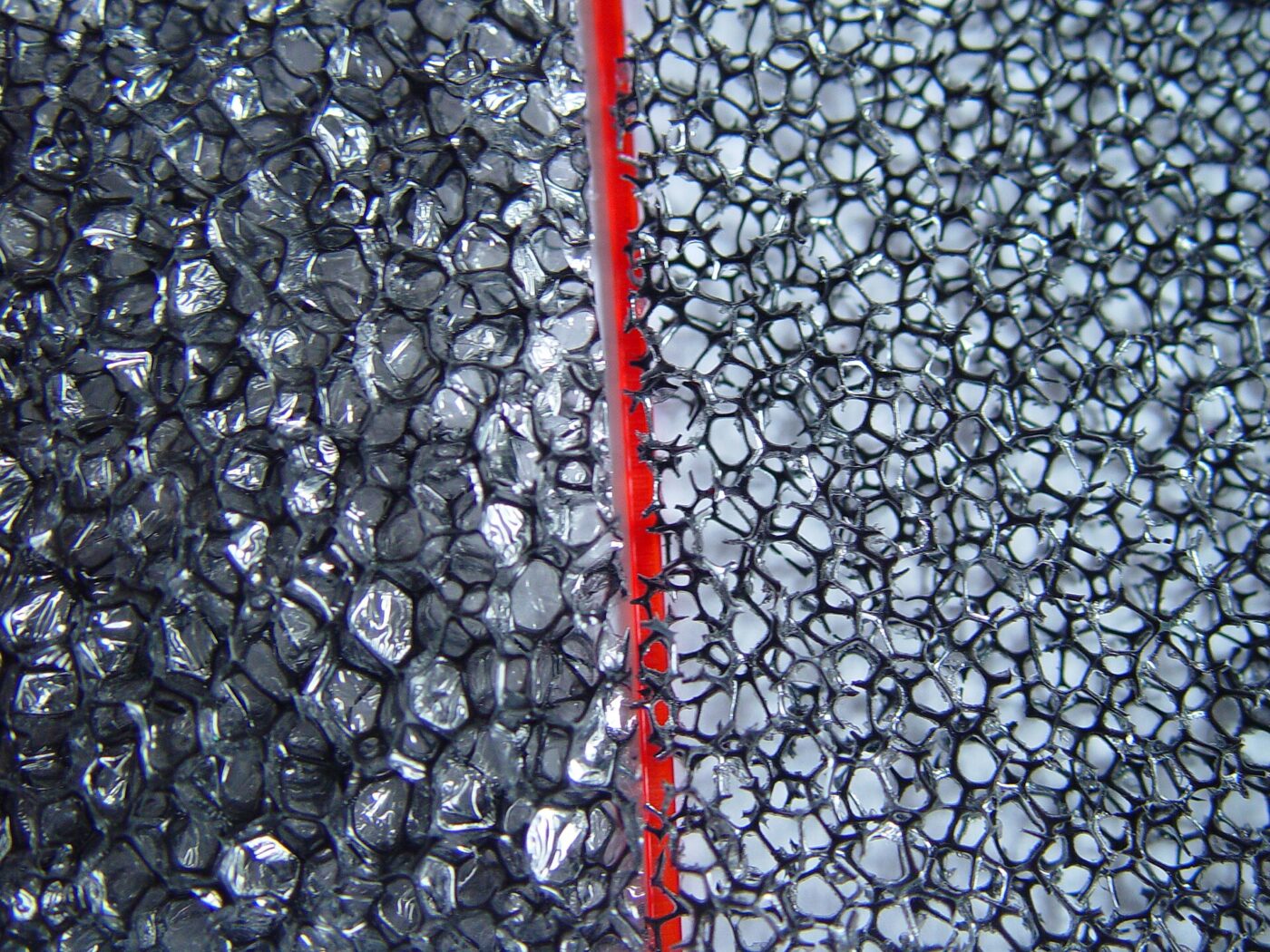
Density is mass per unit volume, written in pounds per cubic foot, and in the foam trade it is measured by ASTM D3574 Test A. It describes how much polymer is in a given block of foam. It is not a firmness rating, and the CertiPUR-US Technical Guidelines make that structurally clear: in the physical property table, the limit against average density is the single word Report. The program requires the number to be measured and submitted; it sets no floor.
Firmness is measured as indentation force deflection, abbreviated IFD and often written in the older trade form ILD, for indentation load deflection. The CertiPUR-US guidelines specify average 25 percent IFD under ASTM D3574, measured on samples 15 by 15 by 4 inches, with a tolerance of plus or minus 10 percent of the average or 3.0 pounds, whichever is greater. A higher IFD means more force was needed to push the sample down a quarter of its thickness.
The guidelines carry two durability criteria nobody advertises. Foams with a 25 percent IFD between 24 and 36 pounds must lose under 6 pounds of IFD after a constant force pounding fatigue test of 8,000 cycles. Seventy-five percent compression set is capped at 10.0 percent for conventional and viscoelastic foams and 20.0 percent for high resilience foams. Those numbers describe whether a foam holds its shape, and they are tested on samples, not on a built mattress.
Density says how much foam is there; IFD says how hard it pushes back. They are independent.
Density and firmness are different properties

The cleanest demonstration comes from a seller that publishes both. FoamOrder lists its foam grades with a density and an ILD against each. Its economy polyurethane foam is 1.8 pounds per cubic foot and is offered in ILD 25, 33 and 55. Its high density polyurethane is 2.6 pounds per cubic foot in ILD 24, 34, 44 and 54. Its memory foam is 5.0 pounds per cubic foot at ILD 13.
Read those three lines together and the point is unmissable. The densest foam on the list is also by far the softest. A 1.8 pound foam can be stiffer than a 5.0 pound foam, and the same density is sold across a wide spread of firmnesses. Anyone treating density as a firmness proxy, in either direction, is reading the wrong column.
CertiPUR-US recognizes the independence in its own category structure. One of its listed foam families is super-soft, defined as conventional foams at or below 15 pounds of 25 percent IFD and 1.5 pounds per cubic foot density, which pairs the two properties explicitly rather than deriving one from the other.
| Published grade | Density | ILD grades offered |
|---|---|---|
| Economy polyurethane | 1.8 lb/ft³ | 25, 33, 55 |
| High density polyurethane | 2.6 lb/ft³ | 24, 34, 44, 54 |
| Memory foam | 5.0 lb/ft³ | 13 |
What a firmness number on a mattress page means
It means whatever the maker says it means. Nectar states on its product page that it designed the Nectar mattress to a medium-firm 6.5 on a firmness scale of 1 to 10. That is a published number, which is more than most brands offer, and it is also a scale the company defined itself. Nothing obliges a second brand to put the same bed at 6.5, and nothing converts 6.5 into an IFD figure.
We looked for density and IFD on the product pages of several mattress brands on October 1, 2026 and did not find either on the ones we could open. Tempur-Pedic’s topper page states thickness and cover care and no foam specification. Nectar’s pages state a firmness number and the CertiPUR-US mark but no density. That is the normal condition of the retail category, and worth saying plainly rather than implying the numbers are hidden somewhere on the page.
The federal rules are no help here, and they do not pretend to be. 16 CFR parts 1632 and 1633 are flammability standards. Part 1632 tests cigarette ignition resistance, part 1633 tests open flame heat release, and neither mentions firmness, support or density. If you have been assuming that something official stands behind the word firm, nothing does.
What the certification mark covers
CertiPUR-US is administered by the Alliance for Flexible Polyurethane Foam, Inc., a nonprofit incorporated in 2008, and the mark is a registered certification mark of that organization. Its public materials say the process was developed by the foam industry with environmentalists, chemists and lab scientists, with content and emissions analysis done by independent accredited laboratories and physical property testing done either by an accredited lab or by a company’s internal lab.
Both halves matter when you read a mark on a mattress box. Content and emissions testing goes to an approved outside laboratory. Physical property testing, where density and IFD live, may be done in-house on the program’s own form. Certification attaches to a foam family rather than a finished mattress, so the mark describes a component.
We read certification marks the same way across the site: they are real programs with defined scopes, and the scope is the thing to check. That was the conclusion in our work on water filter certification, and the same reading applies to the rating numbers printed on packaging in categories like furnace filters, earplug noise reduction ratings and surge protector joule ratings.
How to compare two mattresses on published facts
Start by accepting that firmness words do not compare across brands. Inside a single brand they usually do, because one company applies one internal scale across its own line, so a medium firm and a firm from the same maker are a real ordering. Across two brands they are two different vocabularies.
Then look for the things that are published and do compare. Overall thickness in inches is always stated. The layer structure is usually stated. Whether the cover is removable, and whether the maker says it may be washed, is usually stated. Trial length and warranty length are always stated, and the warranty will define the indentation depth it treats as a defect, which is a harder number than any firmness label.
If a brand does publish a foam density, read it as a durability signal rather than a firmness one, alongside the compression set criteria above. If you are weighing a new mattress against adding a layer to an old one, our work on the mattress market covers the replacement side.
What to watch next
- Whether any mainstream mattress brand begins publishing foam density or 25 percent IFD, which would make two beds comparable on a measured quantity
- Revisions to the CertiPUR-US Technical Guidelines, which the program describes as living documents and republishes with a version and date
- Whether firmness numbers on brand pages start citing a method rather than an in-house scale
Where to start
Paid links: we earn a commission if you buy through the buttons below, at no extra cost to you. As an Amazon Associate I earn from qualifying purchases.
Mattress types compared on the specifications that are usually published
| Product type | Good fit for | Where to look |
|---|---|---|
| Medium firm hybrid mattress | Fits a coil and foam build | See listings on AmazonOpens Amazon search results, not one listing: check the model on the product page. |
| Medium firm memory foam mattress | Fits an all-foam build | See listings on AmazonOpens Amazon search results, not one listing: check the model on the product page. |
| Medium firm mattress topper | Fits changing an existing bed | See listings on AmazonOpens Amazon search results, not one listing: check the model on the product page. |
Product types that fit the trend described above, not tested models. Check the exact listing before you buy. How we pick them.
Medium firm hybrid mattress
Where to look: Amazon
A coil core under foam comfort layers. Compare the published layer list and thickness between models from the same maker, where one internal firmness scale is being applied consistently.
- Layer structure is usually described
- Coil unit has its own published gauge
- Firmness word is brand-specific
- Foam density rarely published
Medium firm memory foam mattress
Where to look: Amazon
All-foam beds are where density would tell you the most, which makes its absence from retail pages the most frustrating. Where a figure is given, read it next to the CertiPUR-US compression set criteria rather than alone.
- Any published density applies to the whole stack
- Easier to compare layer by layer
- Density is the exception, not the rule
- Compression set figures are never published
Medium firm mattress topper
Where to look: Amazon
Adding a layer is the low-commitment version of changing firmness. The specifications are thinner than a mattress listing, so thickness and the depth of mattress the skirt fits are the two numbers to compare.
- Thickness is always stated
- Cheapest way to change a surface
- Outside both federal mattress rules
- Published specifications are thin
More: Home and Kitchen trends and how the Trend Signal is scored.
Sources
- Technical Guidelines for Slabstock Foam, 2025 version 1 — CertiPUR-US
- Certified foam and who administers the program — CertiPUR-US
- Upholstery foam grades with published density and ILD — FoamOrder
- Nectar mattress product page — Nectar Sleep
- Standard for the Flammability of Mattresses and Mattress Pads, 16 CFR part 1632 — eCFR
- Mattresses, Mattress Pads and Mattress Sets business guidance — CPSC
Questions readers ask
Is there a standard that defines medium firm?
We found none. The two federal mattress rules, 16 CFR parts 1632 and 1633, are flammability standards and do not address firmness. Firmness scales such as the 1 to 10 number Nectar publishes are each company’s own.
What is foam density and does a higher number mean firmer?
Density is mass per unit volume in pounds per cubic foot, measured under ASTM D3574 Test A. It does not mean firmer. FoamOrder publishes memory foam at 5.0 pounds per cubic foot with an ILD of 13, and an economy foam at 1.8 pounds per cubic foot offered at ILD 25, 33 and 55.
What is ILD on a mattress or topper?
Indentation load deflection, called indentation force deflection in the current ASTM terminology, is the force required to compress a foam sample by a set fraction of its thickness. The CertiPUR-US guidelines use average 25 percent IFD under ASTM D3574 on samples 15 by 15 by 4 inches, with a tolerance of plus or minus 10 percent or 3.0 pounds.
Does CertiPUR-US certification tell me how dense the foam is?
No. The program requires average density to be measured and reported on its physical property form, but the guidelines set no minimum density, and the certificate published for a foam producer does not state a density to a consumer.